Bike Delivery Jobs in India
In Jammu, a man decides the bike he has ridden for years should earn its keep. This file reads bike delivery work from the rider's side: the companies, the requirements, the papers, the pay, the hours, the hiring, and the road.
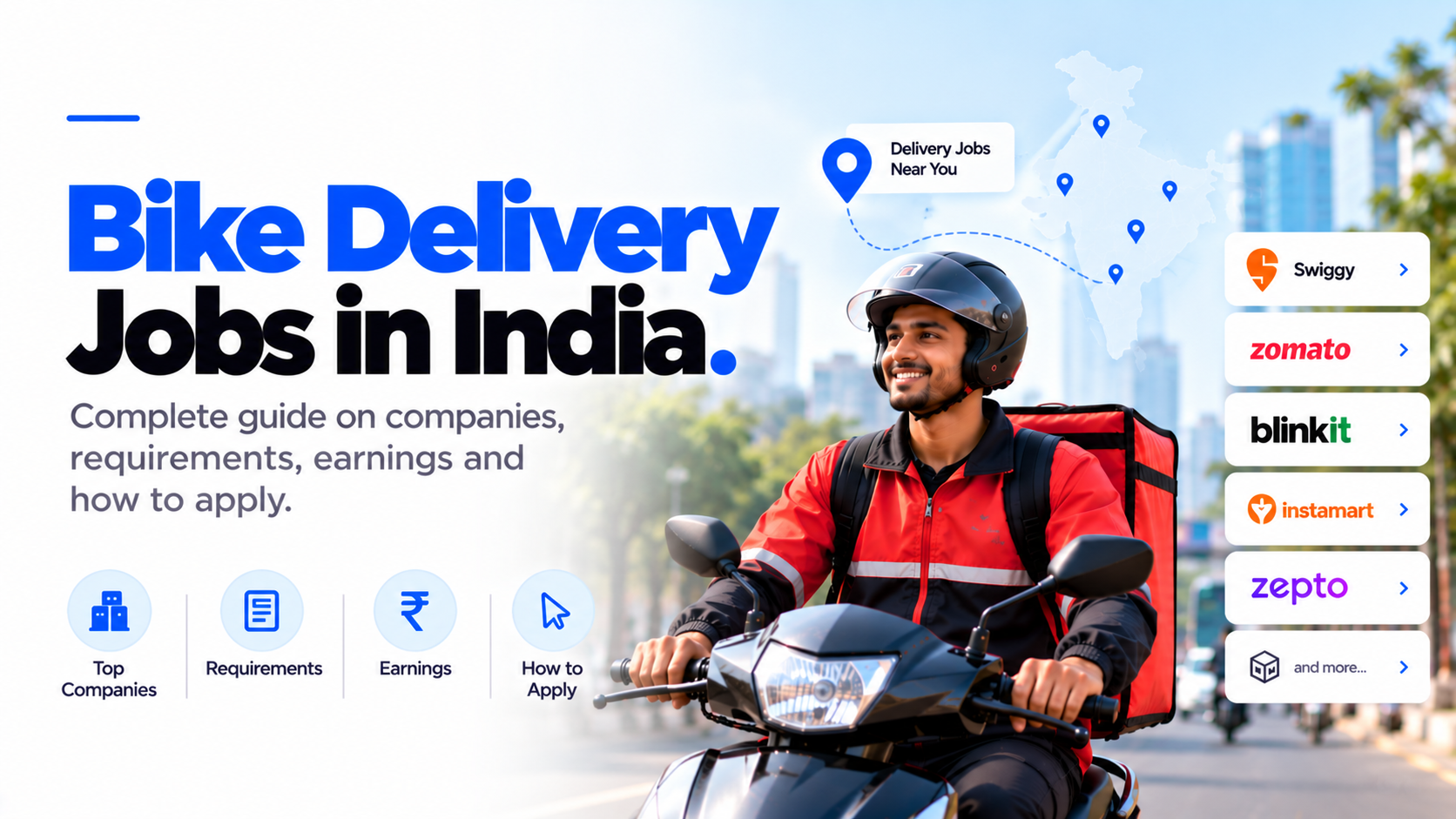
In Jammu, a man has ridden the same bike for years - up the slopes to the house, across the bridges to the shop, around the old city lanes when the main road chokes. The machine knows the routes the way his hands know the throttle. This month the house has begun asking it a second question: carry for the family, not just for him.
His nephew settled the argument. The boy rides evenings in Udaipur for a food app, and when the man asked what the trade takes, the answer came back short: the bike is the interview; the papers are the rest. A licence, a certified helmet, a phone that holds its charge, and the machine itself. Everything after that, the nephew says, the first week on the road teaches.
That answer is the whole file in one line, and this page is the file itself: bike delivery jobs in read from the rider's side - what the work carries, who hires, what the man and the machine both need, what the bike costs to run, which hours pay best, how the hiring moves, and what the road asks in return.
What the bike carries
From the outside the job looks like one thing - a man, a box, a road. The box changes with the hour. At lunch it holds meals packed by a restaurant kitchen; at dusk it holds grocery bags assembled in a quick-commerce store; through the day it holds parcels sorted for a neighbourhood; now and then it holds documents or a small load moving across town. One machine, four kinds of work, and the rider shifts between them without changing anything but the pickup point.
The method underneath stays identical on every run. The app shows an order, the rider reaches the pickup, checks the items against the screen, follows the route the map draws, hands the box over, and marks the drop done. The streets change, the box changes, the discipline does not: arrive inside the window, keep the food upright, keep the parcel sealed, keep the customer informed when a road turns slow.
The bike earns its place because the city itself runs on two wheels. Nearly 1.7 crore two-wheelers roll out of indian factories every year, and the last mile of a delivery is their natural habitat - lanes a car cannot enter, parking a car cannot find, costs a car cannot match. A parcel delivery job with bike and a dinner run ask for the same machine and the same habits, which is why the skill travels whole between companies.The category list on the hiring site splits this work into its families, and every family begins with a bike.
Who puts riders on bikes
Four families of companies do the hiring. The food apps - the zomato and swiggy class of platforms - move restaurant meals and run the largest visible fleets. Quick-commerce companies run small grocery stores built for ten-minute delivery and keep riders stationed close by. Parcel networks feed e-commerce and courier loads into neighbourhood routes. Intra-city movers shift documents, small freight and local orders across town. Behind them stands a second layer: fleet operators who own the bikes and hire riders to ride them.
The vacancy sheet reads alike across the families. An openings page that lists a zomato swiggy bike delivery job next to a parcel network's advertisement is really offering one seat: a bike delivery boy job vacancy typically asks for 18-plus age, a valid two-wheeler licence, the rider's own bike in running condition and a smartphone.The Bengaluru openings on the hiring network show the pattern live, in market after market.
Ownership is not a wall. Companies with rental tie-ups lease a machine by the week against documents and a deposit, and some fleets hand a bike to the rider as part of the job - a rent bike for delivery job listing usually means exactly that arrangement. The arithmetic of renting is plain: the weekly rent eats into the payout until the rider owns the machine, which is why most men treat the rented bike as a bridge and not an address.
What the rider needs
The man's side of the list is short. Eighteen years or older. A driving licence that covers geared two-wheelers - the class most delivery bikes need - carried in original or as a verified copy on the phone. Enough city sense to find a lane without three map recalculations, and enough phone discipline to keep the battery alive through a shift.
The machine's side is equally plain, and companies check it at joining. Registration certificate current and in the rider's name or his family's. Insurance valid on the day of the check. Emission certificate within its window. Headlamp, brake light and number plate working as the law expects, and a carrier or box space that can take the load of the day.
One requirement sits on the head, not the handlebar. The road transport ministry's helmet order of November 2020 brought protective helmets for two-wheeler riders under compulsory BIS certification, so that only certified helmets are manufactured and sold in the country; a committee that included AIIMS doctors had earlier recommended lighter helmets suited to indian climatic conditions,as the transport ministry's helmet order records. The bike delivery job requirements end in that strap: no certified helmet, no riding.
The papers both of them carry
Two folders travel with a rider. His own holds the Aadhaar card, the PAN card, the bank account where payouts land, a passport-size photograph and the driving licence. Companies photograph these once at onboarding and again whenever a document nears expiry. Scans stored on the phone save the second trip; blurred scans cause more joining delays than missing ones.
The machine's folder holds the registration certificate, the insurance paper and the emission certificate. Verification teams match the number plate against the certificate, the certificate against the insurance, and the insurance against the date. A lapsed paper stops a joining faster than a scratched mudguard, so the rider who renews on time rides on the day he chooses.
Across companies the documents for bike delivery job onboarding repeat so predictably that one folder serves every application: identity, address, bank details, licence, and the machine's three papers. The rider who assembles the folder once carries it from platform to platform for years, touching it up only when a date rolls over.
Pay and what the bike costs to run
Platform pay is built on the completed order: a base amount that scales with distance, add-ons for peak windows, bonuses for streaks of finished drops, sometimes a fixed sum for a scheduled shift. Payouts settle daily or weekly into the bank account on file, and the app's earnings screen keeps every order's amount in one running list.
The bike holds a claim on every payout before the family does. Petrol leaves first, then service, then tyres and brakes on a schedule the kilometres set. A rider who budgets the machine's share on payout day - a fixed slice set aside the moment the money lands - keeps the trade sustainable; a rider who treats the whole payout as income meets the service bill as a shock.
No single number answers the salary question, because the bike delivery job salary is a function the rider partly controls: the city, the hours chosen, the season, the weather, the honesty of the running-cost slice. The truthful test is one complete week on his own patch with the earnings screen open - earnings on one side, petrol and upkeep on the other - and a decision taken on the week's reading rather than a neighbour's story.
The hours that pay best
A riding day has two hills. The midday hill runs from late morning into mid-afternoon; the evening hill starts near dusk and runs into the night. Between them sits a flat stretch where orders thin and fuel burns the same. Weekends swell both hills, and the rider who positions himself near offices at lunch and near residential lanes after dark lets the map do half the earning.
The same shape makes evenings the natural part-time window. A part time bike delivery job - three hours after a shop closes, a college afternoon, weekends only - rides the evening hill when the payouts peak and stacks a second income over a first without touching the day's main work. Companies accept evening-only riders openly; the incentives follow the peak, not the clock.
The calendar moves the hills too. Festive weeks and sale days load the networks until every rider on the road earns; monsoon afternoons slow the streets and stretch the wait per drop; summer noons thin the orders. The riders who last plan rest against the calendar - quiet evenings saved, peak weeks ridden.
How the hiring actually works
How to get a bike delivery job, in one line: apply where the orders already are, carry the folder, show the machine. In practice the route runs through the company's rider app or a hiring site - fill the form, upload the scans, book the document check - or through a walk-in counter at a company hub, where the papers change hands in person.
The bike delivery joining process in compresses into two visits: one for the papers and the machine check, one for the kit and the app activation. The company photographs the documents, inspects the bike, hands over the delivery bag and logs the rider into the order flow. A training video or a short ride with a senior usually sits between the two visits, and the first paid drop lands inside the opening week.
The route shortens when the papers are ready.The how-to guide on the hiring network walks a first-timer through the search, the application and the follow-up, and men who arrive with scans on the phone clear the whole sequence in a day. The rider who waits for documents to be found takes a week; the trade rewards the folder.
The road and the body
Honesty first: the road is the expensive part of this trade. India recorded 4,80,000 road accidents and 1,80,000 deaths in the year the road transport minister reviewed in March 2025, with about 4,00,000 serious injuries, and 1,40,000 of those deaths fell in the 18-45 age group, affecting mostly two-wheeler riders and pedestrians,as the minister's road safety statement records. A rider hears those numbers differently from a car owner: he sits inside the statistic.
The helmet is the cheapest insurance this trade sells. The quality control order in force since June 2021 requires every helmet to meet the IS 4151 standard, helmets sold on roadsides routinely lack the mandatory BIS mark, and selling without certification breaks the BIS law,as the consumer affairs ministry's helmet drive notes; its teams ran more than 30 search-and-seizure operations in one financial year and pulled 2,500 non-compliant helmets off the market.
The rest of the discipline is unglamorous. Brakes and tyres checked on schedule, speed treated as the trade's real cost, rain gear for the monsoon, water through a summer shift, and rest days taken as seriously as the peaks. Rider cover exists on most platforms; the small print varies, and the rider who reads it once knows what a hospital day does to his month.
Choosing well and registering
A delivery job for bike owners and a fleet seat with a rented machine are two different bargains. Platform riding buys freedom - log in when he wants, ride the peaks, own the upside and the dry spell alike. Fleet work buys stability - a fixed shift, a fixed sum, a machine supplied. Parcel-network day loads sit between the two. The right pick depends on what the household needs this year, not on which advertisement shouts loudest.
One registration outlasts every platform. On e-Shram, the labour ministry's national database for unorganised workers seeded with Aadhaar, a rider receives one portable number on self-declaration; over 30.68 crore workers had registered by early March 2025, women making up more than half of them, and thirteen central welfare schemes now map to the account,as the labour ministry's e-Shram release records. The number travels with the rider across companies and years.
The last step is the street he already lives on. The trade he has been reading about is hiring in his own city this week:The open jobs page on the hiring site lists what is open now,The city index on the hiring site brings it down to his state, andthe Jammu delivery page on the hiring network shows the openings sitting inside his own riding distance.
The nephew had it right, it turns out: the bike is the interview; the papers are the rest. The machine qualifies first because it qualified years ago, on the slopes and the bridges, without anyone keeping score. The trade only asks the man to prove what the bike already knows - and to strap on a certified helmet while he does it.
For a rider mapping the trade before the first form,the platform walkthrough on the hiring blog explains how the hiring network matches delivery work to riders across indian cities. And the fastest way to test everything on this page remains the one this story began with: fill the folder, check the machine, ride one honest week.