Driver Jobs in India: Gig, Fleet and Delivery Opportunities
In Dehradun, a fleet driver weighs the payroll against the apps; his son in Gurugram already drives the other road. This file reads the trade from the driver's seat: the employers, the licence, the papers, the two pay structures, the hours, and the hiring.
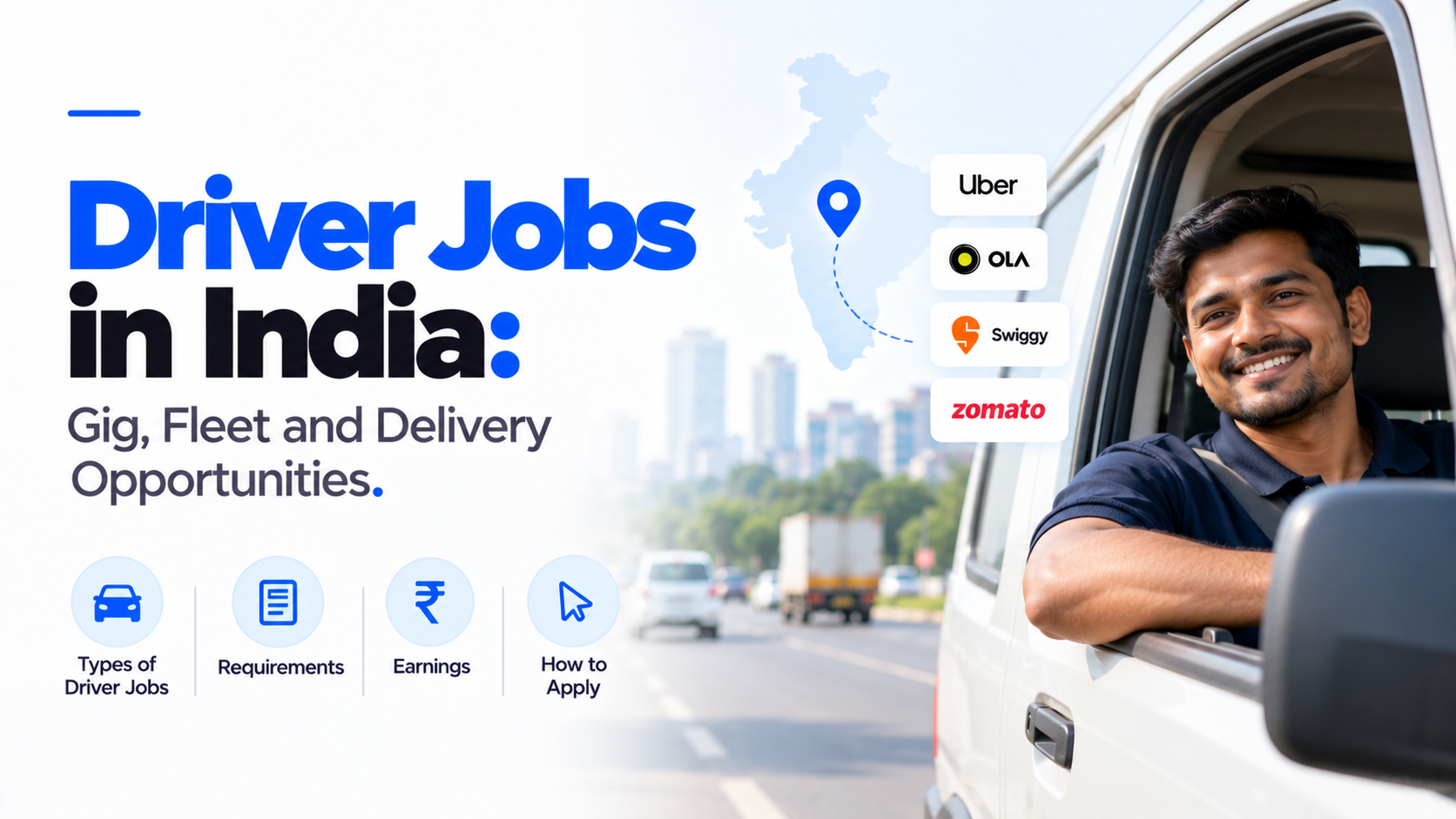
In Dehradun, a man has spent his working life driving other people's vehicles - a school van through the morning fog, then a company's visitor car down the airport road. He knows which valley curve stays wet till noon and which gate opens before the first shift. This month the fleet contractor offered him a fork: keep the monthly seat on the payroll, or take a car out on the apps as a gig partner and let the trips decide the pay.
His son took the other road two years ago: from Gurugram he drives a ride-hailing cab on the apps. The two compare accounts on festival nights at home - the salary slip is the same every month, the trip sheet is different every day - and neither will swap. The father wants a number to plan a household around; the son wants the days that pay double when the city moves.
Put the two accounts together and the whole trade appears; this page is that comparison set down in writing: driver jobs in gig fleet and delivery opportunities - the work, the employers, the licence, the papers, the two pay structures, the hours, the hiring route, and the seat that fits.
One licence, many roads
One licence opens more doors than any single job title suggests. A man searching a cab driver job in is looking at ride-hailing trips inside the city; delivery driver jobs in point the same licence at hatchbacks and vans carrying groceries and parcels; company cars run staff and visitors on fixed routes; tempos move shop loads between markets; schools, hospitals and hotels keep their own vehicles and drivers. The wheel is the same instrument in all of them.
The work divides by what the vehicle carries and how the day is shaped. Trip work waits for the app to ring - pick up, drop off, empty again. Route work repeats one circle every morning until the passengers know the driver's face. Load work counts consignments: boxes out of the warehouse, boxes at the shop. A driver who reads all three moves between them without starting over, because the skill underneath - road sense, patience, the walkaround before the first start - transfers whole.
That breadth is why the trade absorbs new men quickly: the entry papers are few, the work families many.The work families on the hiring site list driving roles beside warehouse and field jobs, and every driving family begins from the same wheel.
Who hires drivers
The hiring side splits five ways. Ride-hailing platforms sign on drivers who bring their own car and log in when they choose. Delivery companies - food apps, quick-commerce networks, parcel fleets - hire drivers for two-wheelers, hatchbacks and vans. Fleet operators own the vehicles themselves and attach drivers to them; a fleet driver jobs in listing points to exactly that arrangement. Companies and institutions run staff buses and visitor cars of their own; the movers-and-logistics layer hires tempo and lorry hands for city-to-city loads.
Two of these employers run on the gig model, two on the payroll; the line between them is the vehicle's registration, not the work. App based driver jobs in run on the driver's own car: he bears fuel, service and insurance, and keeps what the trips pay after costs. Fleet seats hand him a company vehicle; the company carries the running costs and takes the keys back at dusk. Choosing between them is choosing a cost structure as much as a job.
The pattern reads the same in every city.The Bengaluru delivery desk on the hiring network shows van and two-wheeler seats open in one city; cab and fleet listings repeat the shape across the metros.
What the licence asks
The driver job requirements in are short and legal. Eighteen years for a light-vehicle licence, twenty for transport work, and a licence of the correct class - car or goods vehicle - matching what the job drives. Employers add city-road experience, a working smartphone and a clean record; a commercial driving licence for driver jobs is the paper the paid work turns on, and taxi and fleet screens ask for it by name.
Training has a formal door now. Rules 31B to 31J of the Central Motor Vehicles Rules, in force since 1 July 2021, prescribe Accredited Driver Training Centres; a Form 5B certificate from such a centre exempts its holder from the driving test requirement under rule 15, while the power to issue the licence stays with the licensing authority,as the transport ministry's training clarification records. A driver who trains at an accredited centre walks into the test with the course already behind him.
The learner stage is the gate: learner's licence, supervised practice, the permanent licence after the test; transport work adds the commercial endorsement and, in several states, a badge issued after police verification. Drivers who arrive with the full stack - licence, endorsement, badge - skip the waiting window, which is why the stack is assembled before the first application, not after.
The papers folder
One folder covers nearly every employer in the trade. The documents required for driver job onboarding repeat wherever a man applies: driving licence, Aadhaar, PAN, bank details for the payout, passport photographs and - when the driver brings his own vehicle - the registration certificate and current insurance. Fleet applicants leave the vehicle papers out; the company's car carries its own file.
The licence itself sits on one national record. The road transport ministry's SARATHI database holds more than 15 crore driving licence records and over 25 crore vehicle records, connected across 36 states and union territories, with enforcement agencies given access for instant verification of licences and certificates,as the transport ministry's register release notes. A licence issued in one state reads clean in another - the record travels so the man does not have to.
Verification is where joinings are won or lost. Employers match the licence class against the vehicle, the birth date against the age rule, and in transport roles the badge against the police record. Blurred scans delay more joinings than missing experience does; the folder lives best as clear scans on the phone, carried once, reused at every employer.
The trip sheet and the salary slip
Driver salary in is really two different instruments. The salary slip pays a fixed sum on a fixed date - statutory deductions where the employer is registered, overtime on long routes, a festival bonus where the house allows. The trip sheet pays by the run: a base amount per trip, add-ons when demand climbs, bonuses for streaks of completed drops, settled into the bank account daily or weekly.
Each instrument carries its own ledger. On the gig side the car's costs come off the top - fuel, service, insurance, the finance instalment - and what remains is the income. On the fleet side the company carries the running costs and the driver nothing but his time, which is why fleet pay looks smaller and lands cleaner. The honest comparison is annual: a slow month that cannot pull the salary down, against a strong month the salary cannot match.
Men who have driven both put it in one line each: the salary slip never surprises, the trip sheet never repeats. The first suits a household with fixed claims on the month; the second suits a driver with time to put in. Neither wins in the abstract - the fit depends on what the month must absorb.
The hours that suit the wheel
The day divides into windows, and each window belongs to a different seat. Morning belongs to school vans and staff routes. The office peaks own the cabs - morning pickup, evening drop. Delivery runs stack at lunch and after dark. Airport and outstation trips ride the weekends. Fleet shifts ignore all of it: the duty list says when the day starts and ends, and life is planned around it instead of the demand.
The same windows are why a part time driver job in holds its value. Three hours of cabs after a shop closes, a school route that ends by noon, weekend outstation runs - the seats take part-time men openly because demand is shaped for it. A second income on the evening window stacks over a day job without touching it, and the payout follows the window's demand, not the day's length.
Rest is a scheduling decision in this trade, not an afterthought. Night shifts and long runs eat sleep, and a driver who plans rest days the way he plans fuel keeps his record and his reflexes. The men who last treat the calendar as equipment - festive weeks ridden hard, quiet weeks ridden less, no week ridden without sleep.
Where the applications go
How to apply for driver job openings, in one line: go where the seats already are. Ride-hailing platforms take applications inside their driver apps; delivery companies run hiring pages and hub counters; fleet operators interview at the depot; and hiring networks that carry many employers' vacancies list driver seats by city. How to get a driver job in therefore begins with the door, not the form.
The sequence after the application is standard: papers folder, licence check against the national record, a short driving assessment where the role demands one, vehicle inspection if the car is the driver's own, then app activation or the duty slip and the first assignment. Fleet joinings add a uniform and a shift briefing; gig activations add the wallet and the first trip.
First-timers lose time on the search, not the joining.The search walkthrough on the hiring blog follows a driver from the city list to the interview call, and men who arrive with scans ready clear it in days. The folder, again, is the difference.
The body at the wheel
Driving is a health trade whether employers admit it or not. Backs stiffen over long shifts, eyes tire on night roads, and the road keeps the trade's only unforgiving ledger. India's driver-training scheme exists partly for that reason: the road transport ministry builds institutes and regional centres to teach driving in a systematic, scientific manner, with licences issued on objective skill tests, and names employment generation in the transport sector among the scheme's aims,as the ministry's driving-training release records. The trade trains men because the road grades them.
The habits that keep a driver employable are unglamorous: sleep before night runs, breaks on long highways, mirrors set before the engine starts, and the speed the road allows rather than the one the clock asks. A hospital week takes more from a driver's month than any slow season does, and the men who last treat rest as part of the duty list, not a reward at the end of it.
Cover completes the picture. Platform drivers and fleet hands should read what their accident or health cover actually pays before they need it; the small print differs by company and model. The government's health net runs wider every year, but the driver's first insurance is the discipline he drives with.
Choosing the seat and registering
The choice between the apps and the payroll is a household decision as much as a work one. The gig seat fits a man with his own car, time to put in, and room for a variable month. The fleet seat fits a man who wants the vehicle off his hands and the month predictable. Delivery seats sit between: own-vehicle freedom with pay that tracks the orders completed. The father in Dehradun and the son in Gurugram were never really arguing - each had picked the instrument his month could carry.
Two papers travel with a driver across every seat. The first is e-Shram, the national register for unorganised workers, built on Aadhaar self-declaration - one number that stays his across companies and years. The second is the health net he should know the shape of: the AB-PMJAY backgrounder of September 2026 records annual cashless hospitalisation cover of up to 5 lakh rupees per family for economically vulnerable citizens, about a third of the population holding Ayushman cards, and 13.25 crore admissions funded worth 2.03 lakh crore rupees,as the health ministry's backgrounder records. The papers change; the registrations do not.
The last step is the road outside the window.The seats open now on the hiring site list what is hiring this week,the state index on the hiring site brings it to his state, andthe Dehradun delivery page on the hiring network shows the seats inside his driving distance - the same test every driver in this file passed: the seat he can reach tomorrow.
The two men were both right, which is the quiet finding of this file. The salary slip and the trip sheet are the same trade written in two hands; the licence, the folder and the road do not change between them. What changes is the risk each man can carry home - and only the man himself can measure that.
For a driver weighing the trade before the first application,the network explainer on the hiring blog shows how the network matches drivers to openings across indian cities. After that the trade stays as honest as it began: assemble the folder, pick the seat the month can carry, and let the wheel do the rest.