India Delivery Jobs Market: Workforce, Demand and Trends
The labour market behind India's doorstep economy — how many jobs it creates, where demand is moving, and the trends reshaping the work.
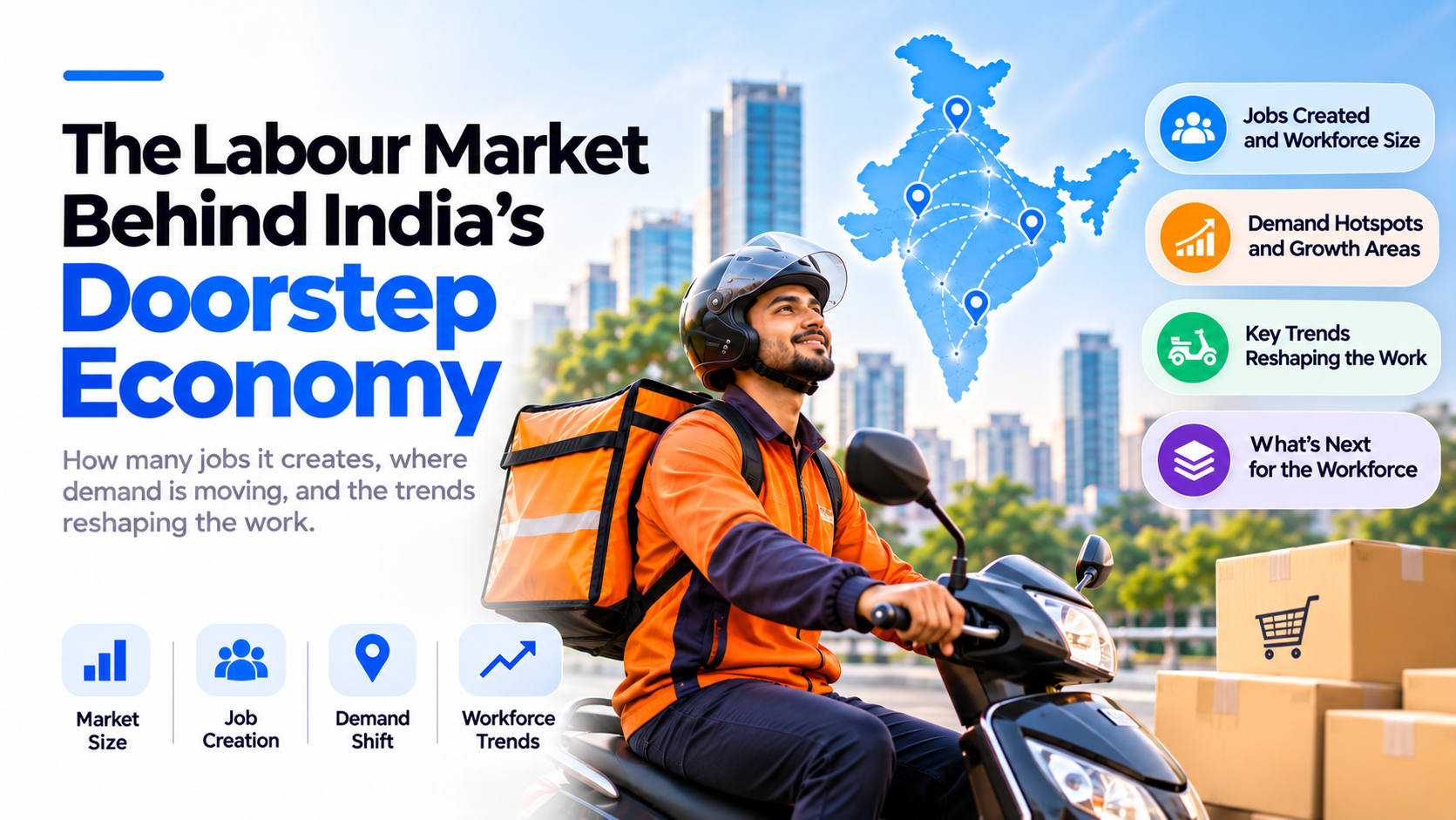
The labour market behind India's doorstep economy — how many jobs it creates, where demand is moving, and the trends reshaping the work.
Gig Economy Series for Indian Readers | November 2026
Delivery has stopped being a side door into the Indian job market. It is now one of the front doors — often the first salaried-or-predictable work a young Indian has ever held, and in a good month one of the fastest-growing sources of new work in the country. This instalment of the series reads delivery as what it has become: a jobs market, with its own workforce, its own demand curve and its own trends.
Three questions structure the piece. How many people actually hold these jobs? What does the demand for them look like in postings, hires and geographies? And which forces — wage floors, smaller cities, women workers, strikes, automation — will reshape the market over the next five years?
The tension at the heart of it is easy to state. In one festive window alone,platforms planned to add 80,000-100,000 workers at a 40-60 per cent stroke; a single state, Maharashtra, countsmore than 5 lakh delivery workers; and yet the government's own Economic Survey findsabout 40 per cent of gig workers earning under Rs 15,000 a month. A jobs market this large, growing this fast, and paying this unevenly is worth understanding properly.
1. The workforce: counting a market that refills itself
The official frame first. TheEconomic Survey 2025-26 counted India's gig workforce at about 120 lakh in FY25, up 55 per cent from 77 lakh in FY21, andNITI Aayog's projection of 2.35 crore gig workers by 2029-30 implies several more years of double-digit expansion. Delivery is the most visible slice of this workforce and, by most industry accounts, the largest.
The platform numbers show both the scale and the measurement problem.Swiggy describes a network of more than 6.5 lakh delivery partners.Eternal, parent of Zomato and Blinkit, reported 31 lakh unique delivery earners in FY26 — but its monthly active fleet runs to only a few lakh, because most people who sign up do not stay. The honest way to describe the market is therefore a range: a few lakh people doing delivery work in an average month, and a multiple of that earning from it at some point in the year.
State-level counts are now appearing too. Organisers of the December 2025 strikeput Maharashtra alone at more than 5 lakh delivery workers — a number that would have seemed implausible for a category of work that barely existed a decade ago.
2. What the jobs pay: the distribution, not the poster
Recruitment posters advertise ceilings; job-market data describes distributions, and the two tell very different stories. Citing Indian Staffing Federation data, theEconomic Survey 2025-26 noted that about 40 per cent of gig workers earn less than Rs 15,000 a month. AWorkIndia analysis of 24 lakh postings found 57.63 per cent of blue-collar jobs paying under Rs 20,000 — and delivery among the weakest categories, with only 16.23 per cent of delivery roles offering more than Rs 40,000 a month.
The averages sit in between. AnIndeed survey of employers and job seekers put the average monthly base salary for retail roles, including delivery drivers, at roughly Rs 22,600. And the pay-slip anatomy, when riders describe it, explains why the ceiling and the floor diverge so much: a 41-year-old Swiggy driver in Hyderabadtold CNN his base rate is Rs 5 per order, taking him to about Rs 20,000 a month before fuel and food — roughly Rs 700 a day after expenses.
Context makes the delivery numbers starker. AProNearMe study found skilled blue-collar trades — air-conditioning, plumbing, electrical work — growing their earnings about 15 per cent in FY26, roughly five points ahead of corporate salary increases. India's blue-collar market is not uniformly low-paid; delivery sits at its low-skill, high-churn end, while the trades directly above it are pulling away. That gap is itself a trend: the most ambitious riders are already exiting upward into them.
3. The demand side: India's fastest-growing job category
On the demand side, the postings data is unambiguous.WorkIndia's analysis of 4.81 lakh postings recorded a 92 per cent year-on-year rise in blue-collar gig and freelance opportunities in 2024, driven by e-commerce and delivery; delivery-related job postings more than doubled in Delhi, Ahmedabad and Kolkata, while applications grew a slower 63 per cent. When postings outgrow applications, recruiters are chasing workers — the defining condition of this market.
Hiring volumes confirm it. The quick-commerce industryhired about 40,000 workers in the October-December 2024 quarter alone, and thesame Indeed survey projected the sector would create over 5 lakh new blue-collar jobs beyond 2025, within a national need of 2.43 million blue-collar workers. Then the festive calendar stacks a surge on top:six quick-commerce platforms planned 40-60 per cent workforce increases — 80,000-100,000 people — for the 2025 season, whileFlipkart created over 2.2 lakh seasonal opportunities with 650 festive-only delivery hubs andAmazon India added more than 1.5 lakh seasonal roles across its fulfilment and last-mile network.
Few Indian job categories have ever posted demand growth like this — and none has done it while replacing a third of its workforce every month, as this series documented in the hiring report. Demand, in other words, is even stronger than the postings suggest.
4. The geography shift: demand moves to smaller cities
The most consequential trend in the delivery jobs market is where the demand now comes from.Quess says the share of tier-2 and tier-3 cities in festive flexi hiring has risen from 42 per cent in 2022 to an estimated 53 per cent in 2026, while the metros' share shrank from 58 to about 47 per cent. The growth rates are lopsided in the same direction:Quess projects 20-25 per cent year-on-year growth in temporary hiring in smaller cities this season against 8-10 per cent in metros, with TeamLease and GI Group reporting similar spreads.
The jobs themselves are precisely the ones this report covers.Randstad lists delivery, pickers and packers among the roles with the most traction in tier-2 and tier-3 India, with hiring mandates up 20-100 per cent in cities such as Jaipur, Lucknow, Indore, Coimbatore and Surat; Adecco says temporary staffing demand in these markets has nearly doubled in a year.
This changes the sociology of the job. Delivery work in a tier-2 city means earning where you live rather than migrating to Delhi or Bengaluru — lower living costs, family nearby, and pay that goes further. It also means the wage arbitrage that once made metros the only game in town is narrowing, and the next million delivery jobs will increasingly be created in the India that policy debates usually forget.
5. The gender gap: the market's largest untapped pool
No jobs-market review is honest without the gender ledger. In 2021,Zomato itself disclosed that only about 0.5 per cent of its delivery partners were women, and set a 10 per cent participation goal for three pilot cities. Five years on, the road remains overwhelmingly male; where women have entered delivery ecosystems at scale, it has largely been in picker, packer and store roles inside dark stores rather than on two-wheelers.
The direction of travel, however, has changed.Flipkart announced a 10 per cent rise in female hiring in its 2025 festive ramp-up, andAmazon highlighted thousands of women associates and more than 2,000 persons with disabilities in its seasonal intake. In a market that competes fiercely for the same young men, every point of female participation widens the hiring pool — which is why women's safety design, shift structures and late-evening policies are quietly becoming competitive variables, not corporate-social-responsibility footnotes.
6. Worker power: the winter of strikes
A jobs market is also shaped by how workers bargain, and the winter of 2025-26 was the sector's bargaining debut at national scale. On December 25,roughly 40,000 delivery workers walked out, cutting service in major cities by an estimated 50-60 per cent. On New Year's Eve,more than 200,000 workers joined a strike organised by the Indian Federation of App-Based Transport Workers, demanding minimum earnings guarantees and the removal of 10-minute delivery targets.
The organisers' own account shows both the muscle and the limits:IFAT claimed about 70 per cent participation across seven or eight states, and its president's sharpest line was arithmetic — companies offered Rs 90 per delivery on strike day against the usual Rs 20-25, proving the pay could move all along. Riders' apps, the same report noted, flashed slot bonuses of Rs 30, Rs 90 and Rs 75 through the day — the market's spot price of availability made visible. Within days, the Maharashtra labour minister's office had opened talks.
Policy has responded in kind. TheEconomic Survey called for state action to raise gig workers' pay, enable upskilling and regulate the concentration of platform power, and separatelyflagged algorithmic bias and burnout as structural risks of platform work. A jobs market born without HR departments is now acquiring the vocabulary — and slowly the machinery — of regulated employment.
7. Trends that will shape the next five years
1. A pay floor comes into view. Between theSurvey's policy language on stable earnings and strike-day incentives that revealed a 4x spread between ordinary and peak pay, the ingredients of a de facto wage floor are assembling. Watch whether state gig-worker laws convert festive bonuses into standing minimums.
2. The tier-2 market matures. Withsmaller cities already a majority of festive flexi hiring, the next phase — full-year dark-store networks, local career ladders, second-tier delivery hubs — will make delivery a genuinely small-town profession rather than a metro export.
3. Women move from poster to payroll. The distance from0.5 per cent in 2021 to Flipkart's10 per cent hiring increase is short in percentage terms and enormous in absolute jobs. The platform that fixes women's night-shift safety first unlocks the largest idle talent pool in the market.
4. Platform economics meet rider expectations. WithSwiggy's stock down and the sector facing a year of reckoning over profitability, the market's structural tension is now explicit: platforms need lower costs per order, while workers have just demonstrated they can shut the order flow down. Incentive design is where that tension will settle.
5. Automation stays a headline, not a replacement. Globally,one study warns robotaxis and drones could cut frontline delivery jobs by 57-76 per cent; in India, labour abundance, staircases, crowds and monsoons keep the human rider the cheapest reliable unit for now. The realistic automation story is assistive — fleet software, route optimization — not substitution.
The bottom line
India's delivery jobs market is the rare labour market that grew to millions of workers before anyone counted it. The counting has begun: a government survey that names gig work as a policy subject, postings data that doubles yearly, state-level rosters in the lakhs. By those measures, this is one of the great job-creation stories of the decade.
The unresolved part is the price of the job. Four in ten gig workers earn under Rs 15,000 a month, delivery sits at the bottom of the blue-collar pay ladder even as the trades above it pull away, and workers have learned that only collective disruption moves the rate card. The next chapter of this market will be decided not by how many jobs it creates — that question is settled — but by whether the jobs it creates can hold a worker for more than a few months.