India's Platform Economy: Workers, Companies, Technology and Regulation
India's platform economy is best read as four pillars holding one roof: the workers who log in, the companies that own the apps, the technology that assigns and judges the work, and the regulation now reaching into all three.
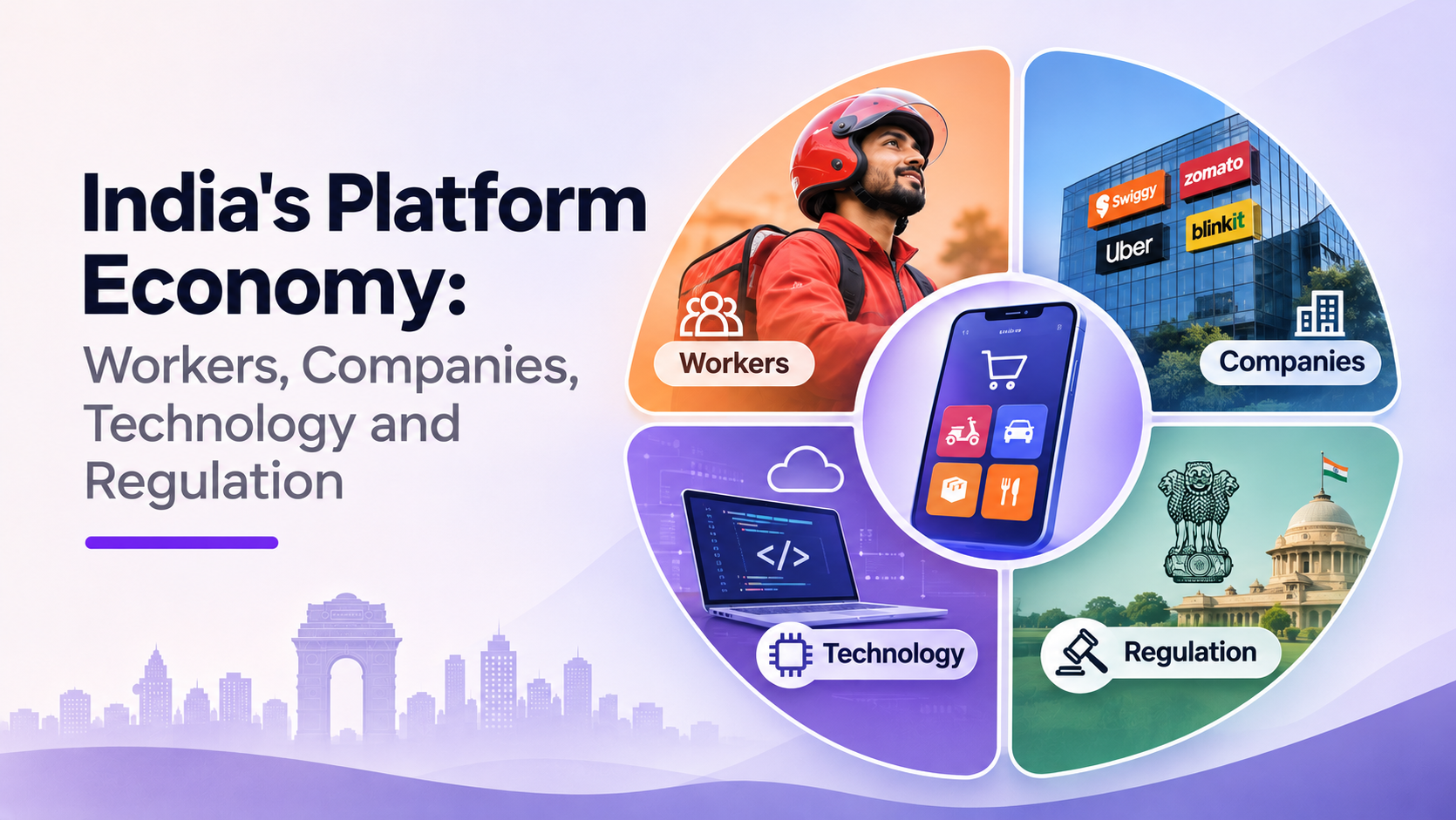
1. The frame: four pillars, one legal vocabulary
Indian law binds the four pillars together. The Code on Social Security, 2020 — in force since 21 November 2025 along with the other three labour codes (Fisher Phillips) — defines gig workers and platform workers separately from employees, and defines the aggregator, the company layer's legal shape, across nine categories in its Seventh Schedule (Fisher Phillips). The same Code directs the centre to build schemes covering life and disability cover, accident insurance, health and maternity benefits and old-age protection (Ministry of Labour and Employment). The worker pillar's official baseline is NITI Aayog's 2022 policy brief,India's Booming Gig and Platform Economy; the technology pillar has just received its first statutory definition, because India's new state laws regulate "automated monitoring and decision-making systems" by name (Centre for Communication Governance).
2. Workers: scale, skills and earnings
The worker pillar is large and young. NITI Aayog counted 77 lakh gig workers in 2020-21 (2.6% of non-farm workers) and projected 2.35 crore by 2029-30 (6.7%), with a skill mix of 47% medium-skilled, 22% highly skilled and 31% low-skilled (NITI Aayog). The Economic Survey 2025-26 updated the count to about 1.2 crore in FY25, a 55% rise over FY21 and above 2% of the total workforce, on its way to an expected ₹2.35 lakh crore GDP contribution from non-farm gig work by 2029-30 (PIB). PRS Legislative Research reads the same projections as 1.5% to 4.1% of the total workforce (PRS Legislative Research). Earnings are the pillar's fault line: the Survey says about 40% of gig workers earn under ₹15,000 a month (Moneycontrol), while IDinsight's survey of 2,547 delivery partners found full-time-style riders grossing ₹27,814 a month and netting ₹18,761 after fuel and maintenance — ₹75.3 an hour (IDinsight). On the upside, Urban Company's IPO filings claimed its professionals earn 30–40% more than peers off any app (Context, Thomson Reuters Foundation).
3. Companies: concentration and take rates
The company pillar is a few firms per sector. Food delivery: Zomato 57.3%, Swiggy 42.7% in the December 2025 quarter, with 24.9 million and 18.1 million monthly transacting users (The Economic Times). Quick commerce: 9.5 million daily orders by August 2026, Blinkit 3.4–3.6 million, Zepto 2.4–2.6 million, Instamart 1.3–1.45 million — three firms holding about four-fifths (Moneycontrol). Ride-hailing: Rapido at 94 million monthly active users against Uber's 40 million (Open Magazine). The money runs through take rates: the CCI's order in the NRAI case recorded alleged commissions of about 27.8% at Zomato (up to 37% for cloud kitchens) and up to 24% at Swiggy (CCI, Case No. 16 of 2021), and restaurateurs reported a further 2% increase in late 2025 within a 15–30% band (The New Indian Express). Mobility monetises differently: Rapido drew ₹275 crore of its ₹934 crore FY25 revenue from subscriptions, while Uber's ₹2,604 crore of gross Indian commissions shrank to ₹88 crore net after incentives and discounts (Open Magazine). Profit remains rare — Eternal's was ₹65 crore in the September 2025 quarter (Reuters) — while the labour intensity is constant: Swiggy's prospectus logged 457,249 delivery partners active monthly in the June 2024 quarter (Swiggy prospectus).
4. Technology: the app as manager
The technology pillar has a formal definition now: the ILO describes algorithmic management as systems that "use tracked data and other information to organize, assign, monitor, supervise and evaluate work", with or without AI (ILO). In India the operating evidence is concrete. Slot-booking systems introduced around 2022 determine when workers can log on (Fairwork India); field studies in Hyderabad found 40–45% of workers had faced sudden ID deactivation without notice (Frontline); and the ten-minute delivery race compressed both routes and pay — after the December 2025 strikes, Blinkit dropped "in 10 minutes" from its branding, the government pressed platforms to abandon time promises, and the reported payout on a 2.5 km trip fell from ₹36 to ₹31 (Frontline). The state runs technology of its own: the e-Shram aggregator module went live in December 2024, and by 1 December 2025 about 5.12 lakh platform workers were registered (PIB), near 12 lakh with 20 aggregators — Zomato, Swiggy and Uber included — by June 2026 (The Tribune).
5. Technology: what the studies find
The research layer is thin but pointed. A 2026 arXiv study drawing on interviews with 16 gig workers and 21 stakeholders concludes that India's blue-collar platform systems are "opaque by design" and produce "inequitable outcomes", and proposes an Algorithmic Human Manager framework pairing algorithmic efficiency with human accountability (arXiv). Fairwork's 2024 scoring of 11 platforms — none of which earned a single point on Fair Representation — reads as a direct audit of managerial technology: only bigbasket and Urban Company committed to a minimum wage, none to a living wage (Fairwork India). Workers translate the same findings into demands: the December 2025 strike platform called for an end to "algorithmic punishment" and ID blocking without notice (Frontline), under organising that began with IFAT's founding in December 2019 (IFAT).
6. Regulation: the central machine
The regulatory pillar switched on in stages. The Code obliges aggregators to contribute 1–2% of annual turnover, capped at 5% of worker payouts, to a Social Security Fund (Fisher Phillips). The Social Security (Central) Rules, 2026, notified on 8 May 2026, supply the machinery: aggregators register on Shram Suvidha and upload worker lists within 45 days; workers qualify with 90 days on one platform or 120 across platforms; returns are filed quarterly with 12% interest on late contributions (Medianama; the official text ishere). But the rate itself — section 114(5) of the Code — is not yet notified, so the fund has collected nothing (IMPRI). Budget 2025-26 layered on identity cards for 1 crore gig workers, e-Shram registration and Ayushman Bharat PM-JAY cover of ₹5 lakh per family (PIB). Against the Survey's 1.2 crore workers, roughly one in ten is registered — the machine exists; most of the workforce has not passed through it.
7. Regulation: the state layer and the algorithm clauses
States wrote the first working rules, and the first algorithm clauses. Rajasthan legislated first in July 2023 with a 1–2% welfare cess, then left the Act unimplemented after a change of government (Labour Review;Act text). Bihar's 2025 Act added seven-day payment ceilings and algorithm-transparency duties (ILO Digital Labour Platform Hub); Jharkhand followed as the fourth state in August 2025 (Labour Review); Telangana's assembly passed its bill on 30 March 2026 (PRS Legislative Research). Karnataka goes furthest: its Act requires aggregators to disclose the main parameters used to allocate and assess work, the grounds for denying work and the rating system, and to run procedures through which workers can query algorithmic decisions (Centre for Communication Governance;PRS Legislative Research); its welfare fee was fixed in February 2026 at 1% of payouts — capped at 50 paise two-wheelers, 75 paise three-wheelers, ₹1 four-wheelers (Legal 500) — and on 3 July 2026 the High Court refused a stay, ordered the disputed quarter's fees deposited with the registry and listed the next hearing for 14 August 2026 (Lawbeat;Medianama).
8. Regulation: global baselines and data protection
The outer layer is standard-setting from abroad. The ILO adopted its first platform-work convention, C193, in June 2026 (ILO), and the EU's Platform Work Directive 2024/2831 introduced a rebuttable presumption of employment with transposition due by 2 December 2026 (EUR-Lex) — its evidence base includes the EU-wide AIM-WORK survey on digital monitoring and algorithmic management, fielded in 2024–25 (Joint Research Centre). India's own data-protection law is the weak joint: a comparative legal analysis concludes the DPDP Act, 2023, as it stands, provides inadequate data protection for gig workers (IJLMH), which is why the transparency duties in Karnataka's Clause 14 carry the debate for now. Indian platforms with global investors are already being read against these baselines (ILO).
9. Where the pillars interlock
The pillars move together, and so do the gaps. Statistics: the Ministry of Statistics is redesigning employment surveys to capture gig, unpaid and multi-platform work better (Reuters). Evidence: Fairwork covers 11 platforms (Fairwork India) and IDinsight's earnings work covers delivery riders (IDinsight), so the technology pillar is audited mainly where work is most algorithmic. Financing: the central fund waits on a section 114(5) notification (IMPRI), while Karnataka's fee is in litigation (Lawbeat). Rights: algorithm-disclosure duties now exist on paper in at least two states, and their test will be enforcement, not drafting (Centre for Communication Governance). Read every pillar's numbers as floors, not ceilings — and watch the four joints where they move next.