Gig Workers and Platform Companies in India: An Ecosystem Study
An ecosystem study of India's gig economy has to follow two populations at once: the 1.2 crore workers who log into delivery, ride-hailing and home-service apps, and the platform companies that price, dispatch and pay them.
1. What an ecosystem study has to define first
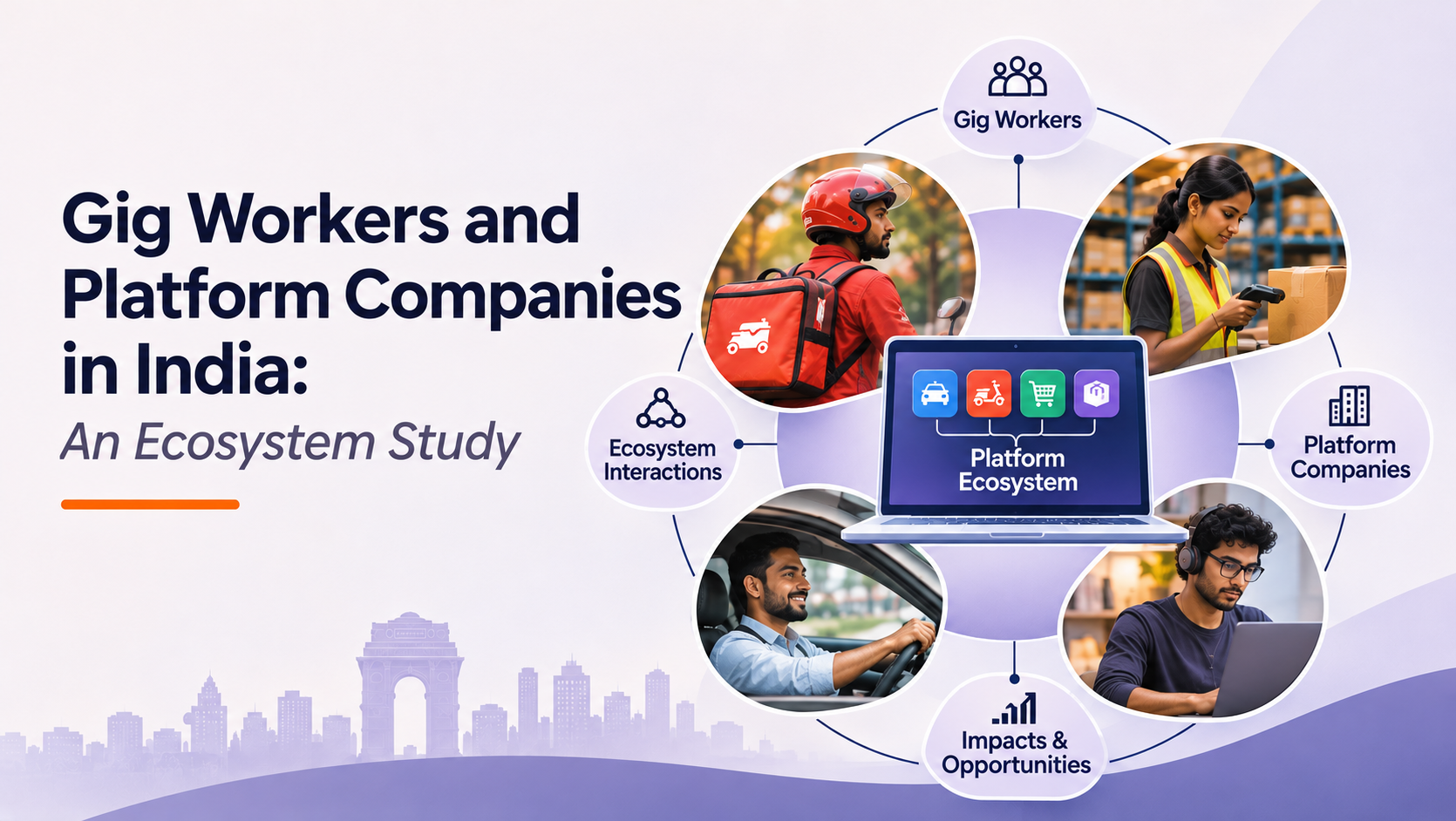
Indian law now supplies the vocabulary. The Code on Social Security, 2020 — one of four labour codes that came into force together on 21 November 2025 (Fisher Phillips) — distinguishes gig workers from platform workers and defines the aggregator, the digital intermediary at the ecosystem's centre; its Seventh Schedule lists nine aggregator categories from ride-hailing to food delivery (Fisher Phillips). The Code also directs the centre to frame schemes for gig and platform workers covering life and disability cover, accident insurance, health and maternity benefits and old-age protection (Ministry of Labour and Employment). Around those legal categories, the ecosystem has six layers: workers, platforms, consumers, the restaurants and fleets plugged into the apps, the state as both regulator and welfare provider, and an increasingly visible union layer. The government's baseline count of the worker layer remains NITI Aayog's 2022 policy brief,India's Booming Gig and Platform Economy.
2. The size of the system
NITI Aayog counted 77 lakh gig workers in 2020-21 — about 2.6% of the non-agricultural workforce — and projected 2.35 crore by 2029-30, or 6.7% of non-farm workers (NITI Aayog; the labour ministry's December 2025 summary repeats the same 7.7-to-23.5 million arc,PIB). The Economic Survey 2025-26 put the FY25 headcount at about 1.2 crore — a 55% increase over FY21 and above 2% of India's total workforce — and expects non-farm platform gig work to contribute ₹2.35 lakh crore to GDP by 2029-30 (PIB). The Survey also carried the distribution warning: about 40% of gig workers earn less than ₹15,000 a month (Moneycontrol). PRS Legislative Research's reading of the same projections, prepared for state lawmakers, converts them into a rise from 1.5% to 4.1% of the total workforce by the end of the decade (PRS Legislative Research). Scale, in other words, is settled; how the system divides its surplus is not.
3. The platform map: who runs the apps
Sector by sector, the company layer is remarkably concentrated. Food delivery is a duopoly: Eternal's Zomato held 57.3% of the market in the December 2025 quarter against Swiggy's 42.7%, against 57.1% and 42.9% in the January–March 2025 quarter, with monthly transacting users at 24.9 million and 18.1 million (The Economic Times). Quick commerce crossed 9.5 million daily orders by August 2026 — Blinkit 3.4–3.6 million, Zepto 2.4–2.6 million, Swiggy Instamart 1.3–1.45 million — roughly four-fifths of the market in three firms (Moneycontrol). In ride-hailing, Sensor Tower estimates show Rapido at 94 million monthly active users against Uber's 40 million, up from 74 million in January–February 2026 (Open Magazine). Every order is a work assignment for somebody: Swiggy's IPO prospectus recorded an average of 457,249 delivery partners active on the platform each month in the June 2024 quarter (Swiggy prospectus), and NITI Aayog's sector split — 26.6 lakh workers in retail trade and sales, 13 lakh in transport, 6.2 lakh in manufacturing — explains why delivery and mobility dominate ecosystem employment (NITI Aayog).
4. How platforms earn: commissions, subscriptions, incentives
The money flows through take rates. In the competition case brought by the National Restaurant Association of India, the CCI's 2022 order recorded allegations that Zomato charged about 27.8% of order value — up to 37% for cloud kitchens — and Swiggy up to 24% (CCI order, Case No. 16 of 2021). Restaurateurs reported a further 2% commission increase in late 2025, with effective rates running 15–30% (The New Indian Express). Mobility shows the alternative route: Rapido pitched zero commissions to drivers, then earned ₹275 crore of its ₹934 crore FY25 operating revenue from subscriptions (Open Magazine). Uber's India accounts expose the cost of incentive-led growth: ₹2,604 crore of gross ride commissions in FY25, almost entirely returned as driver incentives and customer discounts, leaving ₹88 crore of net ride-hailing revenue and a ₹1,407 crore segment loss (Open Magazine). Profit at scale remains the exception: Eternal reported a ₹65 crore consolidated profit in the September 2025 quarter (Reuters).
5. Who the workers are — and what they net
NITI Aayog's skill split — 47% medium-skilled, 22% highly skilled, 31% low-skilled — shows the workforce is more than delivery (NITI Aayog). The sharpest earnings evidence is IDinsight's March 2025 phone survey of 2,547 delivery partners: most ride part-time, only 23% work more than eight hours a day, and a full-time-style rider grossing ₹27,814 a month nets about ₹18,761 once roughly a third goes to fuel and maintenance — a net ₹75.3 per hour (IDinsight). The Survey's 40%-under-₹15,000 estimate brackets the bottom of that distribution (Moneycontrol). The upside case comes from the companies: Urban Company's IPO-era claim that its professionals earn 30–40% more than peers off any app was reported alongside workers bracing for tougher post-IPO conditions (Context, Thomson Reuters Foundation).
6. Conditions and algorithmic management
Fairwork India 2024 scored 11 platforms after 440 worker interviews: bigbasket, Swiggy, Urban Company and Zomato at 6/10; BluSmart 5; Zepto 4; Amazon Flex 2; Flipkart 1; Ola, Porter and Uber 0. No platform scored a point on Fair Representation, only bigbasket and Urban Company committed to a minimum wage, and none to a living wage (Fairwork India). Control is exercised through the app itself: since 2022, slot-booking systems have narrowed the working-time flexibility that defines gig work (Fairwork India), and field studies in Hyderabad found 40–45% of workers had faced sudden ID deactivation without notice (Frontline). The ten-minute delivery race is the system's sharpest edge: after the December 2025 strikes, Blinkit removed "in 10 minutes" from its branding, the government pressed platforms to drop delivery-time promises — and the same reporting recorded the platform cutting the payout on a 2.5 km trip from ₹36 to ₹31 (Frontline).
7. Contestation: strikes and the union layer
Collective voice organised before legal rights arrived. The Indian Federation of App-based Transport Workers (IFAT), founded at a Mumbai conference in December 2019, links ride-hailing and delivery unions across platforms (IFAT). The Telangana Gig and Platform Workers' Union and CITU affiliates such as the All India Gig Workers' Union and the Rajdhani App Workers' Union complete the layer (Frontline). July 2025 brought a drivers' strike in Mumbai across Ola, Uber and Rapido (Frontline); on 25 December and again on New Year's Eve 2025, unions called nationwide delivery strikes, claiming nearly two lakh participants and demanding higher per-trip payouts, an end to algorithmic punishment and ID blocking without notice, minimum wages, social security and collective bargaining rights (Frontline).
8. The state enters: codes, rules and five state laws
The central framework activated in 2025–26. The Code on Social Security requires aggregators to contribute 1–2% of annual turnover, capped at 5% of worker payouts, into a Social Security Fund (Fisher Phillips). The Social Security (Central) Rules, 2026, notified on 8 May 2026, built the machinery: aggregator registration on the Shram Suvidha portal, worker lists uploaded within 45 days, eligibility at 90 days on one platform or 120 days across platforms, quarterly returns and 12% interest on late contributions (IMPRI;Medianama). The financing switch is unflipped — section 114(5) leaves the contribution rate and start date not yet notified, so the fund has collected nothing (IMPRI). States legislated first: Rajasthan's 2023 law, a 1–2% cess on transaction values, was passed and then left unimplemented after a change of government (Labour Review;Act text); Bihar's 2025 Act added seven-day payment ceilings and algorithm-transparency duties (ILO Digital Labour Platform Hub); Jharkhand became the fourth state to legislate in August 2025 (Labour Review); Telangana's assembly passed its bill on 30 March 2026 (PRS Legislative Research). Karnataka is the live test: the welfare fee was fixed in February 2026 at 1% of each payout — capped at 50 paise on two-wheelers, 75 paise on three-wheelers and ₹1 on four-wheelers — and on 3 July 2026 the High Court refused a stay, directing Zomato, Swiggy, Blinkit, Zepto and Urban Company to deposit the disputed quarter's fees with the registry, with the next hearing listed for 14 August 2026 (Legal 500;Lawbeat;Medianama).
9. Registration plumbing: e-Shram and PM-JAY
Welfare reaches only workers the state can see. The e-Shram portal's aggregator module went live in December 2024, and after three nationwide campaigns about 5.12 lakh platform workers were registered as of 1 December 2025 (PIB). By June 2026 the count was near 12 lakh, with 20 aggregators — including Zomato, Swiggy and Uber — uploading worker data (The Tribune). Budget 2025-26 added identity cards for 1 crore gig workers, e-Shram registration and Ayushman Bharat PM-JAY health coverage of ₹5 lakh per family a year (PIB). Against the Survey's 1.2 crore estimated workers, one in ten registered: that ratio is the ecosystem's welfare plumbing problem in a single number.