India Last-Mile Workforce Ecosystem: Companies, Workers and Platforms
Who actually moves India's parcels: a map of the captive networks, third-party fleets, crowdsourced apps and the lakhs of riders who power them.
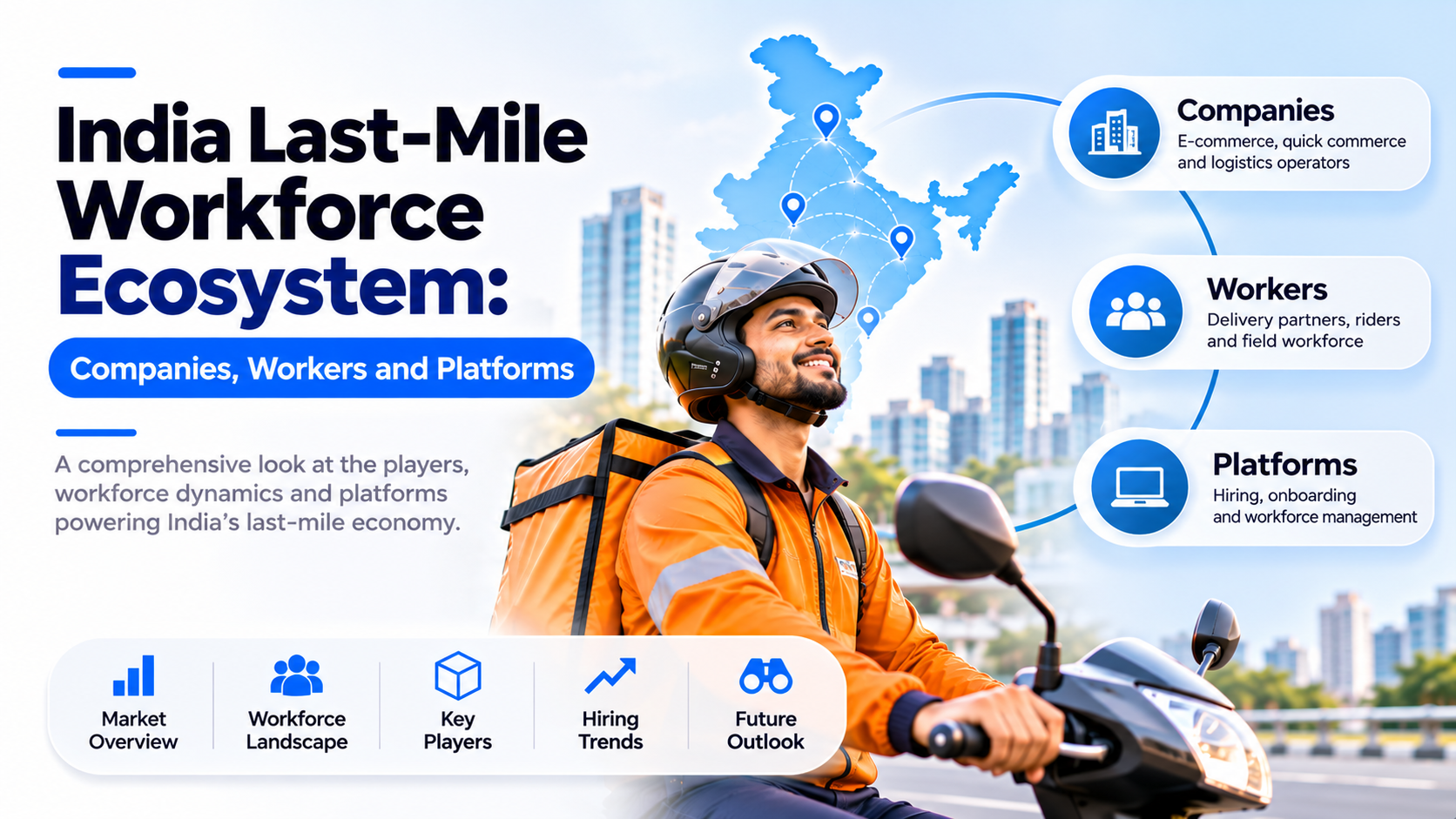
The last mile — the final leg that carries a parcel from a local hub or dark store to a doorstep — is the most labour-hungry stretch of Indian commerce. It is also the least visible as an industry. Consumers see an app; behind the app sits a layered ecosystem of captive delivery networks, third-party logistics firms, crowdsourced platforms and intra-city fleet aggregators, all competing for the same pool of riders, drivers and small-fleet owners.NITI Aayog estimated India's gig workforce at 7.7 million in 2020-21 and projects it to reach 23.5 million by 2029-30, and last-mile delivery is the single biggest concentration of that workforce.
This instalment of our gig-economy series maps that ecosystem. Earlier reports in this series followed the workers' earnings, the hiring funnel, the job market and the economics of recruitment; this one is the organisational chart — which companies employ or engage the workforce, how their business models shape what riders earn, and where demand, capital and regulation are pushing the whole structure next.
1. The demand engines: e-commerce, quick commerce and hyperlocal
Every last-mile job exists because an order exists, so the ecosystem starts with demand.Market research pegs India's e-commerce logistics market — of which last-mile delivery is the largest slice — at about INR 601 billion by 2029, growing at roughly 16 per cent a year. Conventional e-commerce remains the volume base: Delhivery alone handled 752 million parcels in FY25on revenue of Rs 8,932 crore, and each festive season converts that volume into a hiring shock, with Flipkart and Amazon together adding several lakh temporary and gig roles at peak (more on that below).
Quick commerce is the newer engine.Blinkit told investors it expected about 2,100 dark stores by December 2025 and wants 3,000 by March 2027;Swiggy's Instamart crossed 1,021 stores across 124 cities in March 2025 after adding 316 stores in a single quarter;and by mid-2026 Bernstein counted Zepto at roughly 1,255 dark stores across 61 cities, just ahead of Instamart's 1,181. Every dark store is a crew of pickers plus a standing pool of riders. Hyperlocal food delivery adds the sharpest peaks:on New Year's Eve 2026, Zomato and Blinkit delivered a record 75 lakh orders to 63 lakh customers through more than 4.5 lakh delivery partners working that single night — a snapshot of how large this workforce already is.
2. Captive networks: Ekart, Flipkart and Amazon
The first layer of supply is captive: platforms that deliver their own orders with their own (largely contracted) workforce. According to analysis cited by Economic Times,Amazon and Flipkart handle 85-90 per cent of their shipments through their own networks — a model that trades capital intensity for control. Flipkart's logistics arm Ekart runs the country's largest e-commerce delivery network, operatingmore than 7,000 facilities including fulfilment centres, sortation hubs and delivery stations, and recruits delivery partners continuously throughits own recruitment portal.
The festive season shows the captive model's true scale.For the 2026 festive season Flipkart announced more than 250,000 direct and indirect job opportunities — about 30,000 more than the previous year — with roughly 60 per cent, some 1.4 lakh roles, in last-mile delivery, supported by over 900 temporary delivery hubs. The company also disclosed that women make up about 20 per cent of its supply-chain workforce and that its support package includes medical and accident insurance plus e-Shram registration.Amazon India, for its part, hires up to 160,000 temporary workers for the same season. Captive networks are India's single largest — and most seasonal — last-mile employers.
3. Third-party logistics: Delhivery, Ecom Express, XpressBees and Valmo
The second layer is outsourced: 3PL carriers that deliver for many brands at once. Delhivery is the largest,having turned a Rs 162 crore net profit on Rs 8,932 crore revenue in FY25 — its first profitable year as a listed company. Consolidation is concentrating this layer:in June 2025 the Competition Commission cleared Delhivery's purchase of a 99.4 per cent stake in rival Ecom Express for up to Rs 1,407 crore, folding one large delivery workforce into another. XpressBees anchors the mid-market,covering more than 19,000 PIN codes through over 4,500 pickup and delivery centres.
The newest twist is insourcing by marketplaces. Meesho built Valmo, an asset-light network thataggregates spare capacity from small local delivery partners through a software layer rather than owning trucks or hubs.Valmo went from handling 2 per cent of Meesho's orders in FY23 to briefly crossing 60 per cent by mid-2025 — overtaking Delhivery as the marketplace's single largest carrier — before stalling near 50 per cent. The plateau is instructive: even Meesho found that aggregating micro-partners cannot fully replace fixed infrastructure, and analysts noted the insourcing threat had been the single biggest overhang on Delhivery's express-parcel business. Marketplace logistics choices, made in boardrooms, directly decide whose last-mile workforce grows.
4. Crowdsourced networks: Shadowfax and Loadshare
The third layer borrows the gig model wholesale. Shadowfax, India's largest crowdsourced last-mile platform, claimsa network of more than 1 million delivery partners serving e-commerce, D2C, hyperlocal and quick-commerce clients — capacity it rents per order rather than employs. The market has endorsed the model:the company processed 294.45 million orders in the six months to September 2025, growing at over 50 per cent, and its roughly Rs 2,000 crore IPO opened on January 20, 2026,making it the first big listed pure-play of India's crowdsourced delivery layer.
Loadshare runs a different variation: a network of networks. Rather than crowdsourcing individuals, itstandardises and digitises hundreds of thousands of delivery riders, fleet owners and small transporters who remain employed by local SME partners — offering forward and reverse last-mile across 19,000-plus PIN codes and even powering part of Amazon's network for segments the giants do not reach. Between them, Shadowfax and Loadshare show the two ways to sell flexibility: rent individuals by the order, or franchise the last mile to small entrepreneurs.
5. Intra-city fleets and trucking: Porter, Rapido and Vahak
Not every last mile is a parcel. Porter supplies on-demand mini-trucks and two-wheelers for intra-city freight, andin FY25 it swung to a net profit of Rs 55.2 crore on operating revenue of Rs 4,306 crore, up 58 per cent year-on-year — evidence that vehicle-based gig logistics can be a real business, not just a subsidised app. Rapido, better known for bike taxis, commandsa fleet of more than 1 million captains whose bikes double as parcel capacity in many cities;in May 2026 it raised $240 million led by Prosus at a $3 billion valuation to fight in that mobility-plus-logistics arena.
Below the parcel layer sits trucking.Vahak runs a digital marketplace connecting about 800,000 trucks and 20,000-plus daily loads with a community of some 20 lakh transporters, free of commission — the middle-mile supply that feeds every hub from which last-mile riders depart. Add these up and the fleet economy — LCV drivers, bike-taxi captains, truck owners — forms a workforce as large as the parcel-riding one, and far more capital-exposed, since each driver typically owns or finances his own vehicle.
6. The workers: what the ecosystem pays
Across all four layers, the workforce shares one trait: it is engaged, not employed. Pay is the clearest lens.Eternal disclosed that average earnings per hour for Zomato delivery partners rose 10.9 per cent to Rs 102 in 2025, from Rs 92 in 2024 — the first hard, platform-published hourly wage line for Indian gig delivery. Against that sits the lived range:a viral account from Dehradun showed a Blinkit rider earning Rs 763 for a shift of nearly 15 hours — about Rs 52 an hour — before fuel and maintenance. Published averages and street reality coexist because pay varies by city, hours, incentives and order density.
Working conditions are where the ecosystem scores worst.In the Fairwork India 2024 ratings, no platform scored above 6 out of 10, with Urban Company, Zomato, Swiggy and BigBasket leading and Amazon and Uber lagging;Ola, Uber and Porter sat at the bottom on zero. The pattern repeats across the sector: flexible income, thin protections, and conditions that depend on which layer — captive, 3PL or crowdsourced — a rider happens to sit in.
7. Formalisation: e-Shram, welfare levies and compliance
The state is now wiring itself into this ecosystem.A dedicated aggregator module launched on the e-Shram portal in December 2024 lets platform companies register their gig workers at scale; by mid-2026 the labour ministry said 15 aggregators, including Zomato and Swiggy, had joined, and told the rest to comply by June 21, 2026. Registration matters because it is the gateway to benefits:the government has publicly urged gig and platform workers to register on e-Shram for formal recognition and access to the PM-JAY health cover. For employers, registration quietly converts an anonymous fleet into a documented one.
Money is following the paperwork.Meesho disclosed it makes provisions under Karnataka's gig-workers' welfare law, which levies a welfare charge on platforms using gig labour, and analysts note the cost falls hardest on companies running their own delivery networks, since exposure scales with deliveries directly managed. If Karnataka-style levies spread to other states — as widely expected — the captive and crowdsourced layers will carry a rising, permanent charge that pure marketplaces escape. Formalisation is no longer a policy debate; it is a line item.
8. Capital, consolidation and what comes next
The past eighteen months have repriced the entire ecosystem. Delhivery consolidated a rival;Shadowfax crossed the line to public markets;Rapido tripled its valuation to $3 billion in a single round;Porter turned profitable; and Blinkit isspending on 900 more dark stores. Public-market ownership brings a new discipline to the workforce story: listed logistics companies must disclose more about the people who produce their volumes, from hourly earnings to delivery-partner counts, and answer to shareholders for churn and utilisation in ways private startups never did.
Three shifts now define the outlook. First, quick commerce has become the marginal employer — dark-store capex is now the most reliable leading indicator of last-mile hiring. Second, concentration is rising: fewer carriers control more of the volume, which strengthens the bargaining hand of platforms vis-a-vis both brands and workers. Third, formalisation costs are arriving just as profitability becomes the market's test — squeezing exactly the thin margins on which gig flexibility was built. The ecosystem's next phase will be decided less by apps than by where capital, store networks and labour law land.
The bottom line
India's last-mile workforce is not one labour market but a stack. Captive networks like Ekart and Amazon supply permanence and seasonal surges of lakhs of jobs. Third-party carriers such as Delhivery, Ecom Express and XpressBees supply scale and consolidation. Crowdsourced platforms — Shadowfax, Loadshare, Valmo — supply elasticity by the order. And the fleet layer of Porter, Rapido and Vahak supplies wheels of every size. The workers move between these layers fluidly; the companies compete for the same hands.
For job-seekers, the practical map is simple: captive networks offer steadier volume and benefits; 3PLs offer route work at scale; crowdsourced apps offer maximum flexibility and minimum cover. For the industry, the direction of travel is equally clear — public listings, dark-store expansion and welfare levies are pulling the last mile from an informal free-for-all toward a documented, regulated industry. The doorsteps will not notice. The pay slips will.