India Last-Mile Delivery Workforce: Complete Market Study
A complete market study of the people who carry India's parcels: what the last mile is worth, who employs its riders, what a delivery pays, and why the final leg is the costliest leg in commerce.
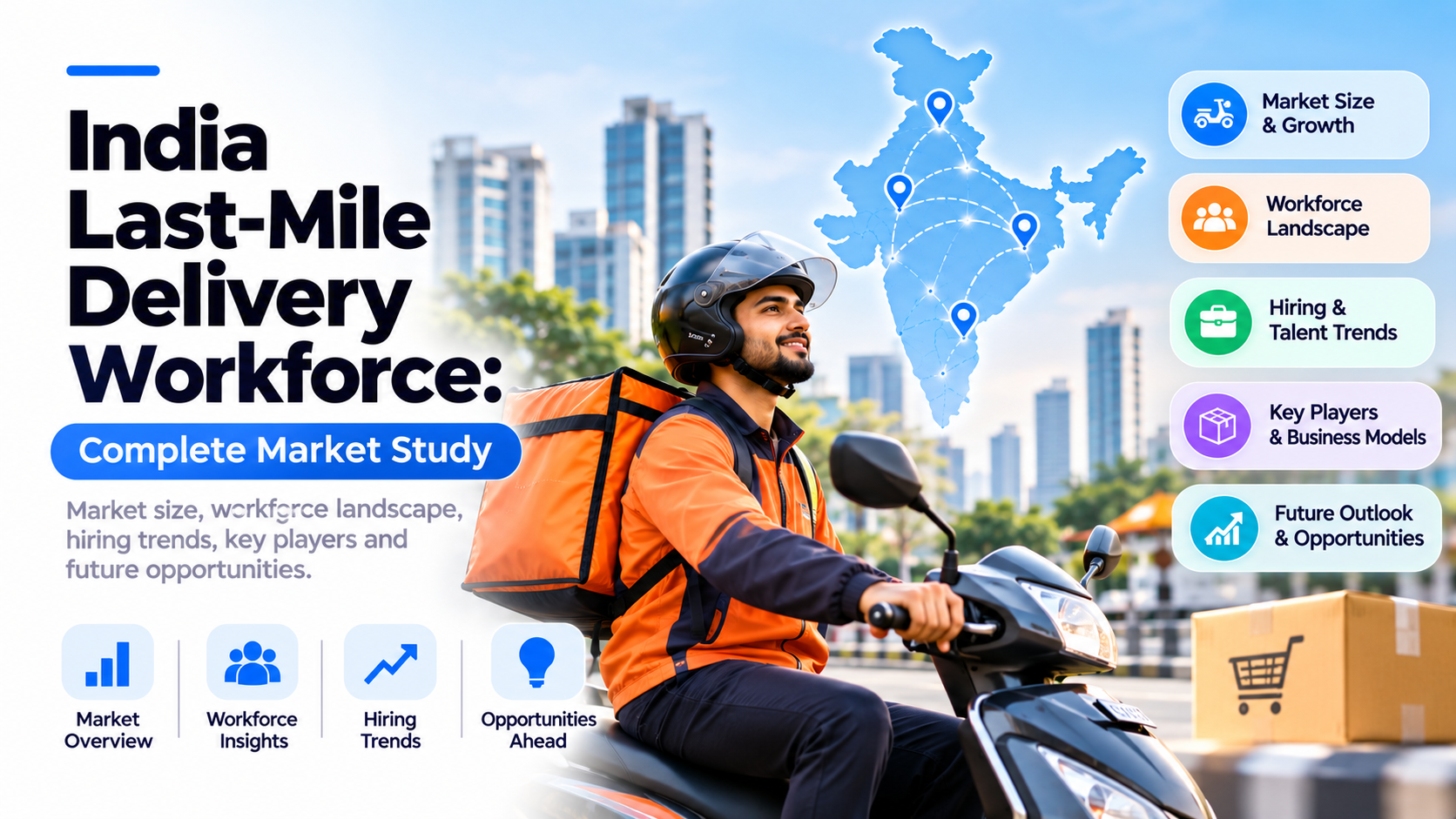
A complete market study of the people who carry India's parcels: what the last mile is worth, who employs its riders, what a delivery pays, and why the final leg is the costliest leg in commerce.
The most expensive few hundred metres in Indian commerce are the final ones — from the neighbourhood hub to the customer's doorstep. Everything before that leg moves in bulk: containers, trucks, sortation belts, thousands of parcels handled at once. Then the journey narrows to one rider, one two-wheeler and one address, and the cost curve bends upward for good.
This study treats that final leg as a market and its riders as a workforce. It sizes the last-mile business, maps the companies that employ its delivery executives, works through what a parcel actually pays, and follows the parcel that fails — the return journey that doubles the industry's workload. Wherever a number exists, it comes from a company filing, a government release or the employer's own site; where none exists, the study says so.
One scope note up front: this is the parcel economy — e-commerce, courier and reverse logistics. The food-and-grocery workforce that delivers dinner was counted in the previous report in this series; this study covers the people carrying everything else.
1. The market: what the final leg is worth
Size it in money first.Mordor Intelligence values India's e-commerce last-mile delivery market at 3.15 billion dollars in 2025, rising to an estimated 3.66 billion dollars in 2026 and 7.57 billion dollars by 2031 — a 15.6 per cent compound annual growth rate.Credence Research, on a broader definition, sees the country's last-mile market more than tripling from 3.5 billion dollars in 2023 to 10.6 billion dollars by 2032.
Size it in parcels next. India's express parcel industry handled 10-11 billion shipments in FY25 and is projected to reach 24-29 billion shipments a year by FY30,per Redseer estimates. E-commerce alone accounted for more than half of express parcel volume in FY24 — 4.8-5.5 billion shipments, byIBEF's account — while traditional courier franchises carried around 2 billion and grow at just 7 per cent a year. The growth is not evenly spread: it concentrates in e-commerce parcels and hyperlocal delivery, the two segments that hire riders.
Then size it in cost. The last mile went from 41 per cent of total shipping cost in 2018 to 53 per cent in 2023,as NetZero Insights' reading of the cost curve records;Locus, a logistics technology firm, puts the band at 40-55 per cent. Every rupee saved upstream is outcompeted by the rupee spent at the doorstep.
Put the three together and the economics explain the workforce. The fastest-growing leg of Indian commerce is also its most expensive, which makes the people who perform it simultaneously the industry's largest cost line and its most urgently recruited asset.
2. Who does the work
The last-mile workforce is not one labour market; it is four. Captive fleets — Amazon Transportation Services, Ekart for Flipkart, Valmo for Meesho — carry their parent's own orders. Integrated third-party logistics companies such as Delhivery, XpressBees and Blue Dart carry everyone's. Crowdsourced platforms such as Shadowfax absorb peaks by the hour. And the post office delivers parcels through the country's largest physical network.
What unites them is the unit of work: a rider paid per parcel or per order, on a two-wheeler, measured at the doorstep. Working for two or three networks at once is common, so headcounts overlap and no employer's number can simply be added to another's.
Add up only what employers publish and a floor emerges. Shadowfax's app listing counts2.6 lakh registered delivery partners across 2,500+ cities; Valmo's website claimsmore than 70,000 delivery executives shipping over 40 lakh parcels a day; Amazon's May 2026 announcement extends new benefits tonearly 90,000 delivery associates. That is over 4 lakh people before counting Delhivery, Ekart, XpressBees, Blue Dart and the post office's parcel force, none of whom publish courier headcounts. The honest conclusion is this study's first finding: India's last-mile workforce is measured in the tens of lakhs, and no institution publishes its total.
3. The employer map: who carries India's parcels
Delhivery is the market's benchmark. Its express parcel business carried 1,054 million parcels in FY26, up 40.2 per cent from 752 million a year earlier, across 18,830 PIN codes, per itsannual report. The year's defining move was consolidation: Delhivery announced the acquisition of rival Ecom Express in April 2025 and completed the integration within FY26, creating a denser network serving more than 52,000 customers. Momentum has carried into FY27 —the April-June quarter letter reports 322 million express shipments, up 55.2 per cent year on year.
The sharpest disruption came from inside a marketplace. Valmo, Meesho's in-house logistics arm built on an asset-light franchise model, signs up local partners to run pickup, sorting and doorstep delivery. Its own site now claimsover 40 lakh orders shipped per day — volume that until recently flowed to the big third-party networks. Mordor's analysts list platform-led control over captive delivery networks among the forces reshapingthe market.
The crowdsourced layer keeps professionalising. Shadowfax —trusted by 2.6 lakh partners across 2,500+ cities by its own app description — runs one of the country's largest automated sortation facilities, with a primary sorter rated at 48,000 shipments an hour, per Mordor.
Amazon's captive network is the largest to publish a workforce figure. Its May 2026 announcement expanded health coverage to nearly 90,000 delivery associates — mediclaim up to ₹1.5 lakh, personal accident cover up to ₹10 lakh, outpatient benefits and coverage for up to three family members — alongside a stated ₹2,800 crore investment in associate well-being and infrastructure,with rest centres under Project Ashray growing from 100 to 250 through 2026.
And the public system has re-entered the race. The Department of Posts earned ₹15,296 crore in FY26, 16 per cent more than the year before, with parcels its fastest-growing line — revenue up 69 per cent to ₹1,133 crore — perBusiness Standard's report of the ministry's numbers. Beneath all of these networks sits XpressBees-scale industry: IBEF profiles itmanaging over three million shipments a day.
4. The demand engine: festive India
Each October the market's hiring logic becomes visible. Flipkart announced more than 2.5 lakh direct and indirect festive jobs for the 2026 season — 30,000 more than the previous year — with 60 per cent of them, roughly 1.5 lakh roles, in last-mile delivery, and over 900 temporary delivery hubs opened to hold the volume, perEconomic Times Supply Chain's coverage. About 75,000 of the intake, nearly a third, were first-time jobseekers.
'The growth in delivery hubs shows how quickly the network is scaling, particularly as Flipkart Minutes expands and demand deepens across tier 2 and tier 3 markets,' said Hemant Badri, the group's supply chain chief, in the same report. Amazon India, for scale comparison, was hiring up to 1.6 lakh temporary workers for the same season.
The wider market grew more modestly. Festive hiring across India rose 7 per cent in 2026 to 1.27 lakh jobs on thefoundit tracker reported by Business Standard, led by quick commerce at 18 per cent growth, with e-commerce at 12 per cent and logistics at 10 per cent.
Quick commerce is also collapsing the boundary between parcel and grocery work. Flipkart Minutes reached 1,000 micro-fulfilment centres by June 2026 and processes about 820,000 orders a day, with 1,500 centres planned by year-end, per Mordor, while Amazon Now has expanded to more than 300 cities. Every speed promise converts directly into route workload — and into riders.
5. The money: what a parcel pays
Parcel pay is a rate card, and the rate card's ceiling is what gets advertised. Shadowfax's own listing promises earnings 'up to ₹45,000+ per month' with weekly payouts, incentives and insurance, per itsdelivery-partner page — a figure reachable only by riders working long peak hours. It is a ceiling, not a median, exactly as this series has flagged before in food delivery.
Parcel work differs from food delivery in ways that shape pay. Routes are denser — a courier may carry eighty stops — but each stop takes longer: gated societies, address hunts, and cash.Mordor's analysis notes that close to half of India's online orders are still paid in cash at the door, and cash collection is unpaid work time.
The benefits floor is forming fastest in captive fleets. Amazon's expansion — ₹1.5 lakh mediclaim, ₹10 lakh accident cover, outpatient care and family coverage forabout 90,000 associates — is the largest published benefits commitment in the segment. Flipkart's festive hiring materials list medical and accident insurance and e-Shram registration as standard, per the Economic Times report.
What does not exist is the number that matters most. No third-party logistics company publishes an audited median per-parcel payout, and no regulator collects one. Pay in the parcel economy remains, in the strict sense, unmeasured.
6. The failed delivery: the reverse workforce
Every address on a rider's list can fail twice. When a parcel is refused or unreachable, it travels back to the seller — the industry calls this return-to-origin, or RTO. GoKwik's data puts India's average RTO rate atabout 23 per cent, touching 40 per cent for some categories; Mordor's market study records COD return rates of 25-30 per cent against 2-3 per cent for prepaid orders.
The economics are harsh for everyone downstream. A ₹1,000 cash-on-delivery order that comes back costs the brand ₹200-250 with zero revenue earned, per GoKwik — and every RTO pays fortwo full logistics legs: forward shipping to the customer and reverse shipping to the warehouse. A failed parcel is, in cost terms, a delivered parcel that pays nobody.
The geography of failure is the geography of the workforce's hardest shifts. Tier-3 cities generate the most returns, and Bihar records the country's highest RTO rate at about 34 per cent, per GoKwik. The firm traces 60-70 per cent of RTOs to low buying intent — meaning the rider's second trip is manufactured by marketing funnels, not by logistics.
Reverse logistics is the quiet third of the last-mile labour bill. No one publishes the split, but every rider who has re-verified an address, called a customer a second time and re-booked a parcel knows which shift it belongs to.
7. The cost squeeze and the automation answer
India's largest listed logistics company has said openly that labour is now a strategic risk. Delhivery'sQ1FY27 letter to shareholders cites 'a challenging external environment owing to labour availability, seasonal factors, geopolitical factors leading to an increase in fuel, a key input cost, and statutory changes to labour codes' — and names forward investments in additional labour and supervisory capacity as the response.
The longer-term answer is automation — but look where it is being deployed. Delhivery is installing automated storage and retrieval systems, autonomous mobile robots and pallet shuttles to de-risk from labour costs, and operated 47 automated sortation centres with a rated sort capacity of 10.4 million shipments a day as of March 2026, per itsannual report. Shadowfax's OneNCR hub sorts 48,000 shipments an hour, per Mordor.
Note what the machines are not doing: they are not riding to the door. Sortation, the tractable middle of the journey, mechanises; the doorstep, with its stairs, gatekeepers and cash, stays human. That is why the industry automates and hires at the same time — and why Mordor still lists driver and rider attrition, compliance and peak-hour capacity gaps amongthe market's defining restraints.
8. Who is joining the last mile
Women are the workforce's fastest-moving edge, from a low base. They were 20 per cent of Flipkart's supply-chain workforce in the festive intake, per the Economic Times report; Delhivery's off-roll female headcount grew 45.1 per cent in FY26, and the company opened four more all-women-operated facilities — Aizawl, Lumla, Cochin and Ghaziabad — per itsannual report. Amazon's new benefits extend to three family members per associate, a design aimed at household-level retention.
The other large intake is first-time workers: nearly 75,000 of Flipkart's festive hires were entering the workforce for the first time, per the Economic Times coverage. For a large share of young India, the last mile is not just the market's cheapest logistics channel — it is the first rung of the formal labour market.
9. Five things to watch
1. The same-day premium. Same-day delivery is Mordor's fastest-growing segment at a 19 per cent compound rate through 2031,within the market it tracks. Speed premiums have historically flowed to riders before anyone audits them — watch whether parcel rate cards follow the clock.
2. Tier-3 economics. The market's fastest-growing geography is tier-3 India, at an 18.7 per cent compound rate — and its defining restraint, in Mordor's words, is the high cost per successful delivery in low-density PIN codes. The next pay dispute will come from where the cost curve is worst.
3. Consolidation. Ecom Express is absorbed, third-party networks are diversifying into quick-commerce servicing, and platform captive fleets keep growing. Fewer, larger employers change bargaining on both sides of the rate card.
4. Compliance enters the P&L. Delhivery's letter prices statutory changes to labour codes into its cost base alongside fuel. State welfare levies and codified labour law are becoming line items that per-parcel rates must eventually carry.
5. The benefits floor spreads. Amazon's ₹2,800 crore well-being investment and Flipkart's standard insurance package are, so far, captive-fleet behaviour. Whether crowdsourced per-parcel pay ever carries an equivalent cost is the question that decides the workforce's next decade.
The bottom line
The last mile is where Indian commerce actually touches people — 10 to 11 billion times a year, headed for double that within the decade. It is also where commerce spends most: over half the shipping bill, on legs its riders walk, ride and climb. Yet the workforce that performs it has no official headcount, no published median wage and no audited churn rate; it exists in employer fragments — 2.6 lakh here, 70,000 there, 90,000 somewhere else — that never add up to one number. If this study has one takeaway, it is the asymmetry: the final leg is the best-measured cost in Indian logistics and the least-measured workforce. Until someone counts the riders the way the parcels are counted, every hiring plan in the industry will be built on the same blind spot.