India Delivery Workforce: City-by-City Market Analysis
Where the riders actually are: dark-store densities, migrant flows, city pay gaps and the state rulebooks that make the same job different across India.
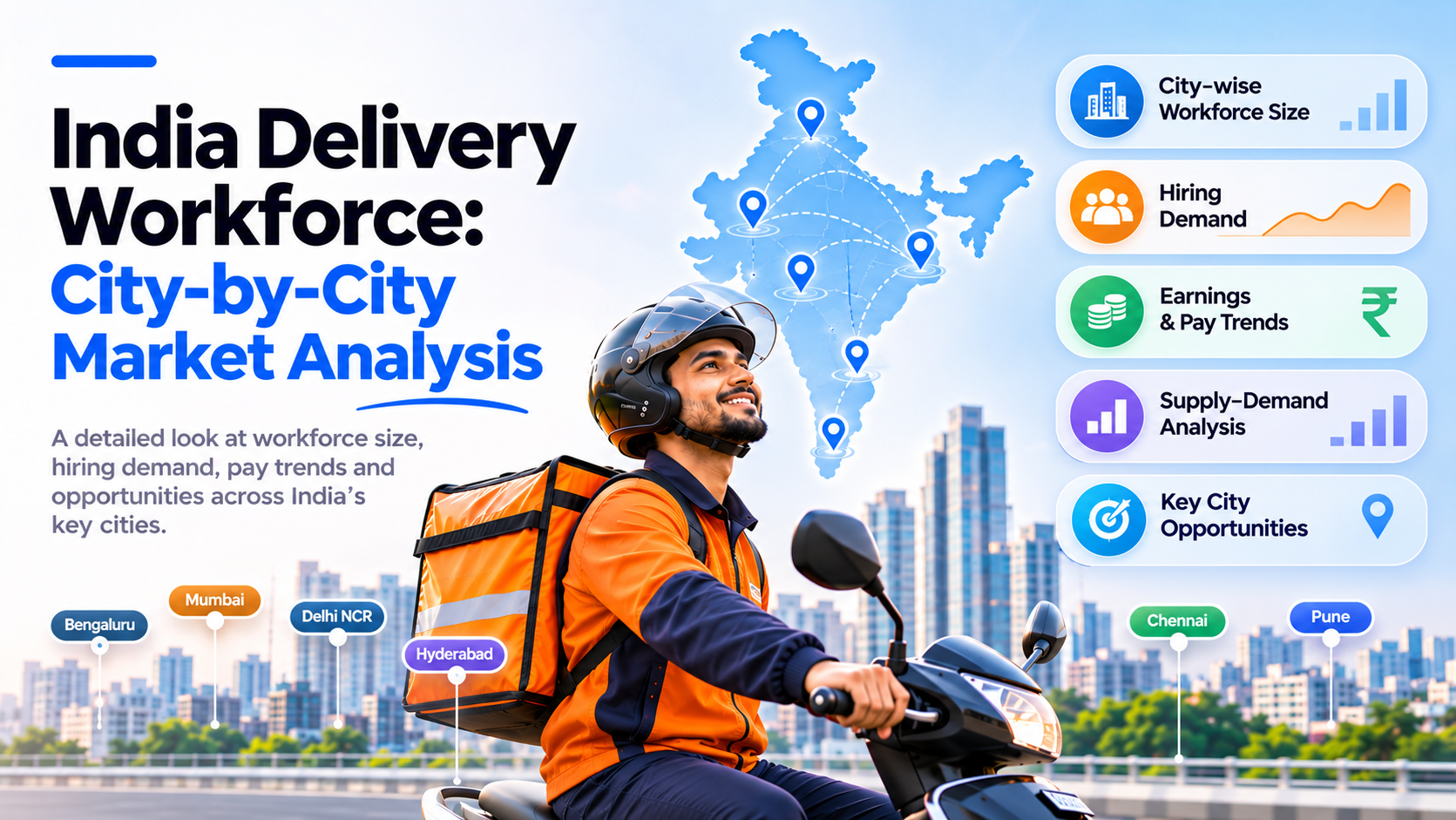
India's delivery workforce is one national labour market — about 12 million gig workers in FY25, projected byNITI Aayog to reach 23.5 million by 2029-30 — but it does not look the same in any two cities. Bengaluru packs three times the national average of dark-store space per person; Delhi writes the strictest vehicle rules; Rajasthan passed the country's first gig-worker law; and the riders staffing Mumbai's peaks increasingly fly home to smaller towns each season. Averages hide all of this, so this report goes city by city.
This is the seventh instalment of our gig-economy series. Earlier reports covered the workforce itself, the hiring funnel, recruitment economics, the job market, the ecosystem map and the future of the job; this one is the geography — where the work concentrates, what each market pays, who supplies its riders, and which local rules now shape the job street by street.
1. The national map: metros first, everywhere else catching up
Quick commerce is the best proxy for where delivery jobs sit, because every dark store is a standing crew of pickers and riders.Metros still account for about 62 per cent of India's quick-commerce market in 2026, andbrokerage analysis put Maharashtra at roughly 405 dark stores, Karnataka at 382 and Tamil Nadu at 262 — with Bengaluru's density at 153 square feet of dark-store space per 1,000 people against a national average of 50. Food delivery, the older market, is far wider:Swiggy alone serves more than 700 Indian cities, while its Instamart quick-commerce arm operates in only about 100, andboth major food platforms cover 600-plus cities including Indore and Jaipur.
The asymmetry defines the job market. A food-delivery rider can find order flow in hundreds of small cities, but the densest quick-commerce employment — the biggest, most stable rider pools — remains concentrated in a handful of metros,and the national dark-store network is projected to roughly triple to about 7,500 stores by 2030. Where those stores land decides where the next few lakh delivery jobs land.
2. Bengaluru: the densest delivery market in India
Bengaluru is the benchmark.ICICI Securities' analysis puts the city at 153 square feet of dark-store space per 1,000 residents — three times the national average — supported by high digital adoption, and Savills' research reaches the same conclusion with Bengaluru at about 150 square feet against 50 nationally.Karnataka's 382 dark stores make it the second-largest state network after Maharashtra. For workers this density has a concrete meaning: shorter delivery radii, more orders per hour on the road, and more stores competing for the same rider pool.
Bengaluru also shows where city rulebooks are heading.Karnataka's Platform Based Gig Workers law, promulgated by ordinance in May 2025, created registration duties, a welfare board and a welfare fee on aggregators,and by January 2026 the state was firming up a proposed fee of 1 to 1.5 per cent on each transaction to fund social security. Bengaluru's riders will be among the first whose work is registered, levied and covered under a dedicated state statute — making the city a live pilot for what formalisation looks like on the ground.
3. Delhi NCR: the biggest cluster with the strictest rulebook
Delhi NCR sits among the second-densest tier of markets —80 to 90 square feet of dark-store space per 1,000 people, the band shared with Pune, Hyderabad and Chennai — and it is the country's most regulated delivery environment.Delhi was the first city to mandate fleet electrification: a January 2022 aggregator policy required 10 per cent of all new two-wheelers added by delivery services to be electric, rising to 50 per cent by March 2023.
The screws keep turning.Delhi's 2026 EV policy now bars fleet aggregators and delivery companies from adding new petrol or diesel two-wheelers and light goods vehicles at all,and the ICCT notes the draft phases out new ICE three-wheelers by 2027 and two-wheelers by 2028 outright. For the delivery workforce this makes NCR a preview of the job's future: the city's riders are being pushed onto electric vehicles faster than anywhere else in India, with charging access and financing becoming as important as the app itself.
4. Mumbai, Pune, Hyderabad and Chennai: the second ring
The second ring of metros — Pune, Hyderabad and Chennai alongside Delhi NCR —all record 80-90 square feet of dark-store space per 1,000 people: mature, competitive markets that have tripled Bengaluru's pace of store-building but still trail its per-capita density.Maharashtra's 405 dark stores make it the largest state network in the country, spread across Mumbai's neighbourhoods and Pune's dense student-and-IT corridors, whileTamil Nadu's 262 stores anchor Chennai and Coimbatore.
What the second ring lacks in density it makes up in scale and reach. These are the markets where food delivery is deepest —both major platforms cover 600-plus cities, with Chennai, Hyderabad and Pune long-standing strongholds — and where intra-city fleets and trucking layers add jobs beyond parcels. For job-seekers, the second ring offers metro-level order flow with somewhat lower living costs than Bengaluru or Mumbai's priciest districts, which is why platforms keep steering expansion capital there.
5. Tier-2 and tier-3 India: where the next five years of jobs are
The growth frontier has moved.By July 2026, industry trackers mapped 5,625 dark stores across 408 cities — well beyond the original eight metros.Analysts list Jaipur, Lucknow, Indore, Surat, Coimbatore, Kochi, Nagpur and Chandigarh as the cities ready for the next wave of dark-store deployment,and CBRE expects franchise-led quick-commerce models to carry the expansion into tier-II and tier-III cities by 2030. Demand is already proving it out:Flipkart Minutes reported a 42-fold year-on-year jump in tier-2 orders, and tier-3-and-below volumes are forecast to grow at a 27.8 per cent CAGR through 2031.
For the workforce this is the single biggest fact of the decade.Redseer counts India's gig internet workforce at over 6 million monthly active workers, on track to nearly triple to 17-21 million, andNITI Aayog's projections always anticipated the growth spreading beyond the big metros. A delivery job that once required migrating to a metro is increasingly available in Jaipur or Coimbatore — at local pay levels, but near home.
6. The earnings map: same app, different pay
Pay varies more by city than by platform. At the top end,Eternal disclosed that average hourly earnings for Zomato delivery partners rose 10.9 per cent to Rs 102 in 2025 — a national average pulled up by dense metros where riders complete more orders per hour. At the other end,a widely shared account from Dehradun showed a Blinkit rider earning Rs 763 for a shift of nearly 15 hours — about Rs 52 an hour — in a smaller city with thinner order flow.
Field research explains the spread.IDinsight's study of India's platform delivery drivers finds per-hour earnings depend on the week, the time of day, the location and the driver's history on the platform — and that the work pays more than casual labour, on par with service and craft trades. The mechanics are simple: dense metros generate back-to-back orders; small cities generate gaps. City choice, more than app choice, sets a rider's income — which is exactly why the tier-2 expansion, and the migrant flows described next, matter so much to pay levels.
7. The migrant geography: cities borrow their riders
Metro delivery fleets are largely staffed by people from somewhere else.IDinsight finds over 50 per cent of platform delivery drivers are migrants — evidence that gig work is facilitating rural-urban migration — and 77 per cent are part-time, multi-app or dual-income. The metros' rider pools are therefore not fixed local labour; they are flows that swell when migrants arrive and thin when they go home.
Platforms now plan around this.In April 2026, industry executives reported daily active gig workers on quick-commerce apps running 10-12 per cent below early-2026 levels as the workforce returned home for the harvest and wedding season — a recurring seasonal dent that festive hiring must over-compensate for. The corollary: when a rider's home district gets its own dark stores, the migration that props up metro supply slows. City-by-city expansion is quietly rebalancing where the workforce lives.
8. The rulebook map: every state now writes its own terms
The same delivery run can cross three legal regimes.Rajasthan moved first: on July 24, 2023 it became the first Indian state to pass a platform-based gig workers law, creating a welfare board, unique worker IDs, a welfare cess on each transaction and penalties up to Rs 50 lakh for non-compliant aggregators,alongside a transaction-tracking system meant to make platform payments transparent.Karnataka followed with its 2025 law — in force since May 30, 2025 — and a proposed 1-1.5 per cent transaction fee.Delhi's contribution is the EV mandate. Registration also runs through the national layer:by mid-2026, 15 aggregators including Zomato and Swiggy had joined the e-Shram portal, with the rest ordered to comply by June 21, 2026.
For workers, the practical map is now three-dimensional: city determines demand and pay, state determines welfare and levies, and platform determines the app experience. For platforms, it means unit economics must be computed city by city — a welfare fee in Bengaluru, an EV fleet requirement in Delhi, seasonal migration math everywhere.
The bottom line
There is no single Indian delivery workforce; there is a national labour market wearing local costumes. Bengaluru shows the ceiling of density and the first full welfare state; Delhi NCR shows the strictest vehicle rules on the road; the second-ring metros trade density for scale; and tier-2 and tier-3 India — 408 cities and counting — is where the next few lakh jobs will actually appear, at wages that still lag the metro average.
For job-seekers the geography is the strategy: dense cities pay more per hour but cost more to live in; home towns pay less but end the migration; and the state you work in increasingly decides what protections attach to the job. For platforms, the era of one national playbook is over — hiring, electrification and compliance are now city problems. The app is national; the job is local.