Gig Jobs Without a Degree: Opportunities Across India
Gig jobs without a degree opportunities across india: what the gate asks, the work families, who hires, the papers, the money, the skills, and the ladder.
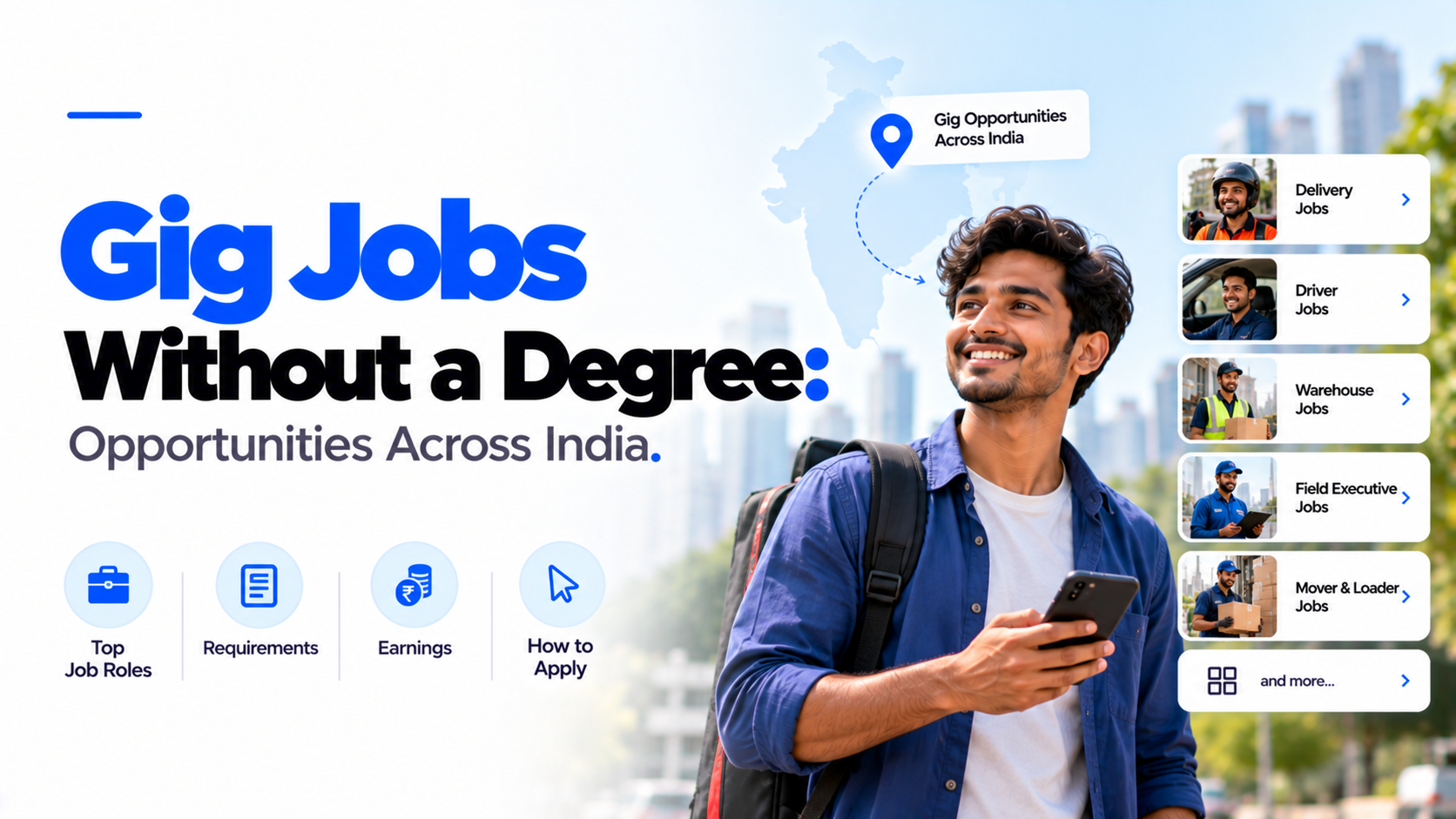
In Panaji, the season arrives before the tourists do. By early November the shacks on Miramar are being re-planked, the riverside hotels are hiring extra hands, and a nineteen-year-old in Mala has already turned on the three apps he will live by until March. He finished the twelfth standard last year, never filled a college form, and holds no certificate a desk would accept. What he owns instead is a phone, a bank account, and an Aadhaar card - and in his family that kit has already begun to look like a qualification.
Something has quietly reordered the Indian job market: whole industries of work now hire hands and habits, not marksheets. The platforms that move food, parcels, people and repair requests do not ask what a candidate scored; they ask how old he is, whether his documents are in order, and whether the phone in his pocket can run an app. That single change has opened a door wider than any recruitment notice - and most job-seekers still do not know how wide.
Read the market one family of work at a time and the territory opens: gig jobs without a degree opportunities across is one honest ledger - what the entry line actually asks, the families of work that open, who hires without a degree screen, the papers, the money, the skills that outrank certificates, and the ladder that starts where degrees end.
What the gate actually is
The question who can do gig work has one plain answer: almost anyone who is eighteen, owns a smartphone, and can hold a small bundle of papers together. The formal name for it is gig work eligibility in, and on most platforms the list runs to five lines - age, an ID, a bank account, a working phone number, and the fitness or licence the specific seat demands. Nowhere in the list does a degree appear.
The degree screen has not disappeared from the economy - it has moved. It still guards the desks, the forms and the government examinations. What it no longer guards is the fastest-growing layer of the job market: the seats that fill on an app in an afternoon. A candidate can be rejected by a college and hired by a platform in the same week, and neither side finds the contradiction strange.
The infrastructure behind that openness is measurable. The country's broadband subscriptions crossed one billion in November 2025,as the digital-divide backgrounder records, which means the entry device - the phone - already sits in the pocket of nearly every working-age Indian. What the platforms add on top is only a form.
The families of work that open
Types of gig jobs in divide into seven families, and every one hires without a degree. Delivery and logistics - food, groceries, parcels - is the biggest and the most visible. Driving and mobility runs from bike taxis to outstation trips. Warehouse and fulfilment hires pickers, packers and loaders by the shift.
Home services and repair - cleaning, electrical work, appliance care, carpentry - is the family where skill compounds fastest. Beauty and wellness professionals keep the highest repeat rates in the gig economy. Field sales and events hire promoters and surveyors by the day. Care and support - babysitting, elder care, patient attendants - is the quietest family and often the steadiest. For a candidate scanning jobs without a degree in, these seven families are the actual map.
The distinction repeats inside each family: the same platform can run a no-document seat and a screened one in the same listing.The category pages on the hiring site keep the families listed together, so a candidate can see in one page which seats ask for papers and which ask only for time.
Who hires without a degree screen
No degree jobs in are posted by four employer kinds. The platforms come first - the apps that onboard a worker directly after a document check. Staffing agencies come second: they contract with platforms and companies and place workers by the batch, often dozens at a time.
Contractor crews come third - the supervisors who assemble teams for events, warehouses and relocations, hiring whoever is ready on the morning line. Local businesses are the fourth and oldest: cafes, studios, clinics and shops that hire a gig hand the way their fathers did, on a nod and a phone number.The Bengaluru hub on the hiring network keeps one metro's live seats on a single page - a scan of it turns up seats from three of the four kinds.
The self-employment door stands beside them. The traditional trades that never asked for a degree now carry a government credit line: the artisan scheme covers 18 traditional trades and extends collateral-free enterprise loans of up to 3 lakh rupees in two tranches,as the MSME ministry's scheme note records. A skill inherited at home can now borrow like a business.
What each seat asks
Gig jobs for 12th pass candidates are the broadest entry, and the twelfth-standard file is where most gig resumes stop. Delivery seats ask for age and a smartphone. Warehouse seats ask for fitness and a shift preference. Beauty and care seats ask for the skill itself, verified by a trial or a short course.
The licence is the one document that changes a seat's pay grade: the driving families - bike taxi, outstation, EV fleets - ask for it, and every other family works without one. Language is the other honest filter: the platforms run in the local tongue, but the seats that face customers pay better to the worker who can move between the local language and some English.
What no family asks is the thing candidates fear most: a certificate chain. There is no marksheet to produce, no gap year to explain, no percentage cut-off. The gig market never sees the document a candidate is most ashamed of - for millions of workers, that silence is the entire appeal.
The papers in the kit
The documents required for gig work make a short list: an Aadhaar card, a PAN card, a personal bank account, and a few photographs. Add a driving licence only if the seat has wheels attached. The whole kit costs nothing to assemble and one afternoon to digitise - photographed, uploaded, and ready for any onboarding form.
Two details keep the kit working. PAN matters because payouts and taxes flow through the bank account, and mismatches between name spellings delay the first payment more than any background check does. A set of passport-size photographs, digital and physical, saves a return trip at every agency counter.
One paper is optional but wise: enrolment in e-Shram - free, one form, done once - puts the worker's name in the national register that welfare schemes read from. Beyond that, the kit is complete: no marksheets, no certificates, no recommendation letters. What a school-leaver carries into a platform hub weighs less than the phone.
What the seat pays
How much gig workers earn in depends first on the unit the seat pays in. Some seats pay by the task - a delivery, a service call, a completed shift. Some pay by the hour, common in events and warehousing. A smaller set pays by the calendar month, mostly in agency-run seats.
The pattern across families is consistent: seats that need a licence or a verified skill pay the most, seats that need only time pay the most predictably, and season moves the numbers more than seniority does. Tourist weeks lift the coastal cities, festive weeks lift everything else, and month-end lifts the platforms. The candidates who earn steadiest run two apps at once and keep one seat per weekday reserved.
Highest paying gig jobs in is a question the platforms answer indirectly: the skilled-service seats - electrical repair, appliance care, beauty at home - quote rates per visit that the time-only seats cannot match, while the driving seats scale with hours and distance. What holds everywhere is the rule underneath: the pay follows the skill attached to the seat, not the certificate attached to the worker.
Joining, week one
How to join a gig platform is a shorter process than most candidates believe, and it runs the same on every app. Pick the family first, then the platform. Keep the papers photographed. Fill the onboarding form - ten minutes on the phone - and reserve a verification time, online or at the nearest hub.
Verification is the only gate: an ID check, sometimes a short orientation video, and for some seats a trial task. The first payout cycle is the real interview - show up, finish the tasks, keep the customer ratings clean - and by the second week the worker exists in the system with a rating, a payout schedule and a history.
The offline door runs in parallel and often moves faster for the agencies: walk into a staffing agency's city office with the same set of papers and the same phone.The step-by-step search guide on the hiring blog walks the whole route - search, shortlist, join - and the first week it describes looks identical for a degree-holder and a non-degree-holder.
The skills that outrank the certificate
Skills that matter more than a degree resolve into five, and every one is self-taught or free. Phone fluency is the first - a worker who fights the app loses tasks to one who rides it. Language is the second: the local tongue plus simple English. Time discipline is the third, because gig ratings are attendance made visible.
Customer handling is the fourth: the gig economy is a ratings economy, and the workers who read customers well float to the top of every dispatch list. Safety is the fifth - on the road, in a stranger's kitchen, on a ladder - and it is the skill that protects the earnings instead of growing them.
The government has built the free classroom for exactly this candidate. More than 1.64 crore youth have been trained under the national skill mission and 13,888 industrial training institutes operate across the country,as the skill ministry's twelve-year note records; and around 70,000 rural youth across 24 states are lined up to begin training from October 2026,as the rural development ministry's rollout note records. The courses ask for age and schooling, rarely more - and the short-term ones ask for no paper at all.
The ladder without a certificate
The gig ladder has four rungs, and none of them reads a marksheet. The first is reliability: a worker with a clean rating history gets first pick of tasks on every platform. The second is the skill upgrade - the delivery rider who adds a licence, the cleaner who adds an appliance-repair certificate, the promoter who learns point-of-sale.
Third comes the team step, and it changes the work: senior gig workers become crew leads, then agency partners, hiring and managing their own batches. The fourth is ownership - the beauty professional with her own clientele, the driver with his own vehicle on a fleet contract, a tradesman running three apprentices under a government credit line. Each rung converts gig experience into something no employer can dispute: a book of work.
Fresh seats appear every day:the open seats on the hiring site show this week's openings across the families,the state pages on the hiring network keep the search within the candidate's home state, andthe Panaji page on the hiring network follows one coastal city through the season.
By March the nineteen-year-old in Mala will have worked through a season - the shacks, the cruise days, the wedding-week surges - without ever producing a certificate. The month his friends spend waiting for degree results, he will spend choosing between two platforms' bonus calendars. That is the quiet offer of the gig economy: it does not ask what a worker knows on paper; it asks what he can finish by evening.
For the candidate holding the kit,the network walkthrough on the hiring blog follows the road from papers to a first opening. The degree was never the door for this layer of work - the kit was. And the kit, unlike the degree, can be assembled this week.