e-Shram Card for Gig Workers: Registration, Benefits, Eligibility and Application Process
One free card, one 12-digit number, and the doorway to accident insurance, life cover, a matched pension and the promised hospital cover - that is the e-Shram card in one sentence.
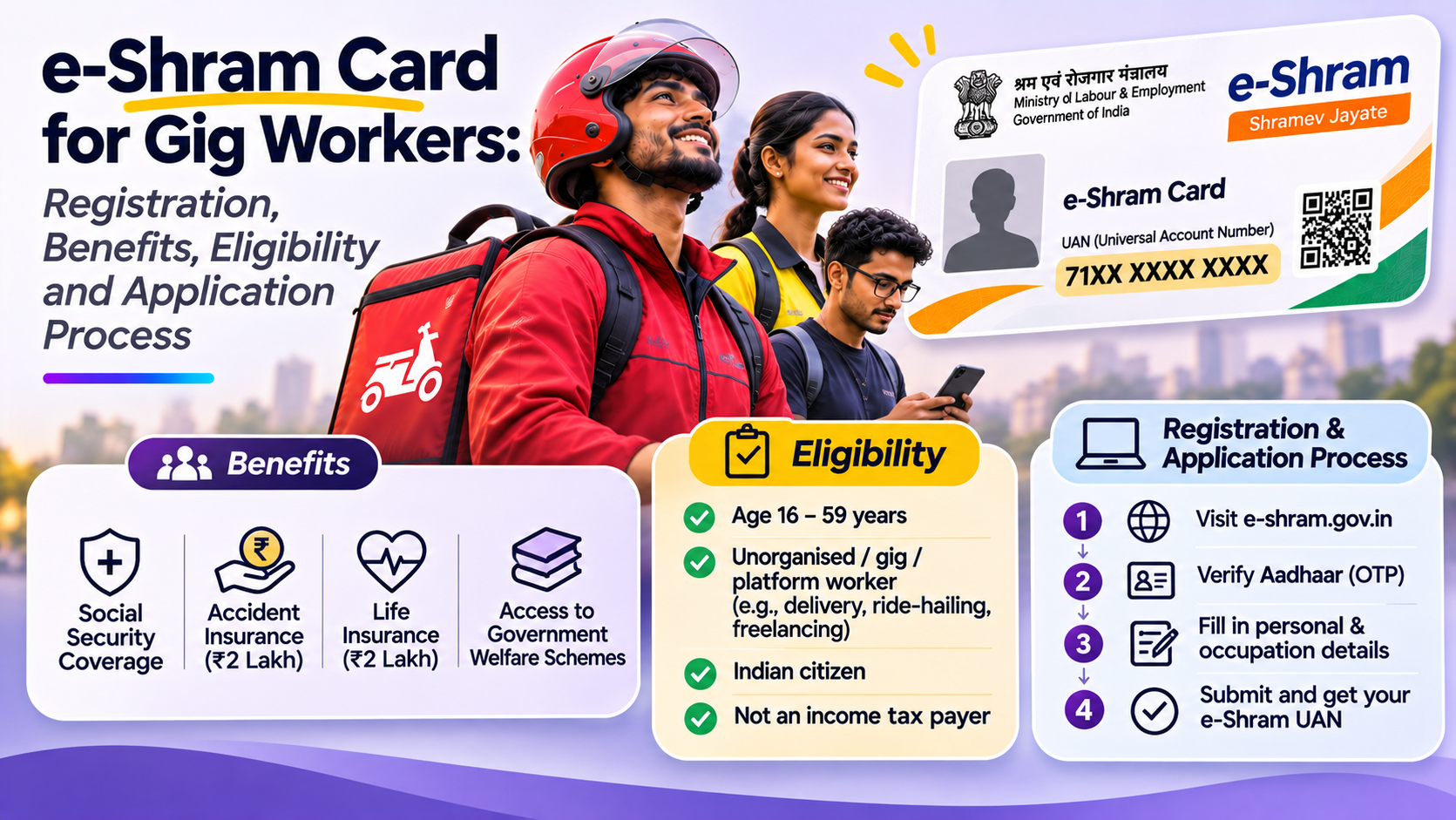
Every instalment of this series has eventually arrived at the same doorstep: the national worker registry. The accident cover enrols through it, the promised hospital cover will ride on it, and the government counts it as the place where a worker outside the formal system finally becomes visible. The registry's own five-year report recordsmore than 31.89 crore unorganised workers registered on the e-Shram portal, a national review countedmore than 10.65 lakh platform workers - the delivery and ride-hailing workforce - already on the same portal, and the parliament's question-and-answer record lists the social security code's promise for exactly this group:life and disability cover, accident insurance, health and maternity. This instalment is the doorway itself - what the card is, who qualifies, what the application takes, what it unlocks, and how to keep it alive.
Every figure below carries its source inside the sentence it supports, and no separate source list is appended. The record behind it is deliberately official: the labour ministry's own five-year release on the portal, the ministry's frequently-asked-questions page, a parliament answer on the registry's coverage, a national business review of the platform-worker rollout, and a legislative research service reading the central rules. The insurance products themselves and the after-crash claim journey had their own instalments; this one stays on the card - what it is, who holds it, and what it opens.
1. What the card actually is: a 12-digit number on a national database
The e-Shram portal, run by the labour ministry and built by the National Informatics Centre, created the country's firstAadhaar-seeded national database of unorganised workers. A worker who registers receives a12-digit Universal Account Number, assigned once and never changed, and the card itselfnever expires and needs no renewal - the government's own advice is simply to keep the details on it current. The design purpose is convergence: one identity through which welfare schemes across ministries can find the same worker, benefits can follow the worker across states, andthe database can serve planning in emergencies. The portal speaks22 Indian languages, and a dedicated helpdesk - the number 14434, answered every day including Sundays - takesregistration and update queries.
For a gig worker the practical reading is this: the card is not a benefit by itself, it is the address at which benefits are delivered. The social security code's scheme menu for gig and platform workers -life and disability cover, accident insurance, health and maternity - reaches the worker only if the registry can find the worker, which is why every other instalment of this series keeps returning to this card.
2. Who qualifies: the eligibility line most gig workers clear
The age line is wide:any individual engaged in unorganised work and aged 16 years or above is eligible to register, subject to the other criteria. The definition the portal uses is equally plain - ahome-based worker, self-employed worker or wage worker in the unorganised sector who is not a member of ESIC or EPFO - and the unorganised sector itself is defined asestablishments employing fewer than ten workers, outside the ESIC and EPFO nets. The exclusion list is short and the government's five-year release states it outright:a worker must not be an income tax-payer or a member of EPFO or ESIC.
Gig and platform workers are named, not implied. The release's coverage list runs through construction workers, migrant workers,street vendors, domestic workers, agricultural workers - and gig and platform workers. A delivery partner on a bike, a ride-hailing driver on an aggregator's app, a dark-store picker on shift work: none of them has an employer deducting provident fund, so nearly all of them clear the line. The worker who does draw salary with EPFO deductions, or files income-tax returns, is the exception the card is not for.
3. What you need: two things, no fee
The document list is the shortest of any government card in this series. Registration requiresthe worker's Aadhaar number, for the Aadhaar e-KYC, and a mobile number - preferably the one linked with Aadhaar; the portal's question page repeatsthe same two items and nothing else. The fee is equally short:registration on the e-Shram portal is completely free of cost, and workers are not required to pay any fee to any registering agency or service provider - a sentence worth memorising, because assisted-registration rackets at CSC counters run on the assumption that workers assume otherwise.
The one genuine checkpoint is the mobile number. Where the phone number isnot linked with Aadhaar, the worker registers through biometric authentication at the nearest Common Service Centre or State Seva Kendra instead of the self route - which makes the CSC trip the default plan for any worker whose SIM was bought years before the Aadhaar linkage drives.
4. The application process: self-registration and the assisted desk
The self route starts atthe registration page on register.eshram.gov.in. The worker enters the Aadhaar number, consents to the e-KYC, verifies with the OTP sent to the Aadhaar-linked mobile, and then fills the profile - name and address as Aadhaar carries them, occupation, skill, education and bank details. The occupation field matters more than it looks: the portal's guidance is thatthe worker must select the occupation that best represents the activity he or she is currently engaged in,classified under the national occupation code so that schemes can be matched to the work. Once the form is submitted, the UAN is issued and the e-card becomes downloadable from the account - the logged-in homepage carriesthe profile, the update option and the download UAN card option in one place.
The assisted route covers everyone the self route excludes. A worker canregister through the nearest Common Service Centre or State Seva Kendra, withbiometric authentication standing in where the Aadhaar-linked mobile is missing, andstate government field officers carry registration to the district and sub-district levels. The assisted desk is, in fact, how most of the country joined: the five-year figures showregistrations completed through Common Service Centers first, followed by self-registration. For a gig worker already comfortable with app forms, the self route is the evening's work; for a worker sharing a family phone, the CSC desk does the same job in one visit.
5. What the card unlocks: the schemes that answer through the UAN
The portal's transformation into a one-stop solution changed what the card does after registration. Logging in with the UAN opens a single dashboard wherethe worker can see eligible schemes, enrol for government schemes, and track already-enrolled ones - an Apply button marks what is not yet enrolled,and a View button marks what is - and the ministry's release countsfifteen social security and welfare schemes brought together on the single platform, acrosshealth insurance, pension, credit, housing, food security, employment and skilling categories, with examples from theNational Career Service and MGNREGA to the widow pension and PM-SYM schemes.