Zomato Delivery Partner Registration: Step-by-Step Process and What Happens After You Apply
A practical, source-linked guide to registering as a Zomato delivery partner in India: what the job involves, the documents you need, the official sign-up flow, and the fees and checks built into it.
1. What the job actually is
A Zomato delivery partner is an independent contractor who picks up food or grocery items ordered by customers from restaurants and outlets and delivers them to the customer's door. The work is done on your own vehicle - the company's FAQ defines the role around bikes and cycles rather than a company fleet. That contractor status matters: you choose when to work, you supply your own documents and vehicle, and you are paid per delivery rather than on a fixed salary.
The scale behind this job title is worth understanding before you apply.Eternal's Q4FY26 shareholder letter states that its platforms - Zomato and Blinkit - support livelihoods for over 1 million delivery partners, alongside more than 400,000 restaurants and 100,000 supply-chain workers. Sign-ups run continuously across Indian cities, and nobody is hired against a fixed vacancy: the platform speaks of livelihoods supported rather than jobs filled, because the same person may work intensively for a month and barely at all the next.
Day to day, the job is simple to describe: you log in when you want to work, wait in or near your allocated locality, accept orders, pick them up and deliver them. How much you log in, and when, is up to you - the official FAQ describes login hours as flexible. Everything that follows in this post - documents, fees, checks, earnings - is about turning that simple loop into an activated, paying account.
2. Who can apply: eligibility and the documents you need
Zomato's official requirements list is short and mechanical: you must be at least 18 years old; you need an Android phone running version 6.0 or higher with at least 2 GB of RAM; and you need a two-wheeler that meets applicable law and safety requirements. On the papers side, the official FAQ asks for a driving licence, the vehicle's registration certificate (RC) and an insurance certificate, plus address proof, a valid PAN card and proof of a bank account. Everything is uploaded digitally during sign-up, so scan or photograph clean copies before you start.
For address proof, the document most applicants already hold is their Aadhaar letter or e-Aadhaar, which you can download fromUIDAI's official Aadhaar portal; the same portal is used to order a PVC Aadhaar card or update your details. For the vehicle papers,Parivahan, the Ministry of Road Transport's portal, handles driving-licence services such as learner's licences, appointment booking and application status, along with registration certificates and pollution-under-control certificates. If any of these documents are missing or expiring, fix them before applying rather than after.
One check applicants regularly skip is the PAN-Aadhaar link. Payouts flow into a bank account tied to your PAN, and a mismatch between your PAN and Aadhaar details is exactly the kind of thing that surfaces later as an onboarding delay rather than as a clear error message. You cancheck or update PAN-Aadhaar linking on the Income Tax e-filing portal, which carries a 'Link Aadhaar/View Status' quick link on its home page. Doing this ten-minute check before you apply costs nothing and removes a common failure point.
3. How to register, step by step
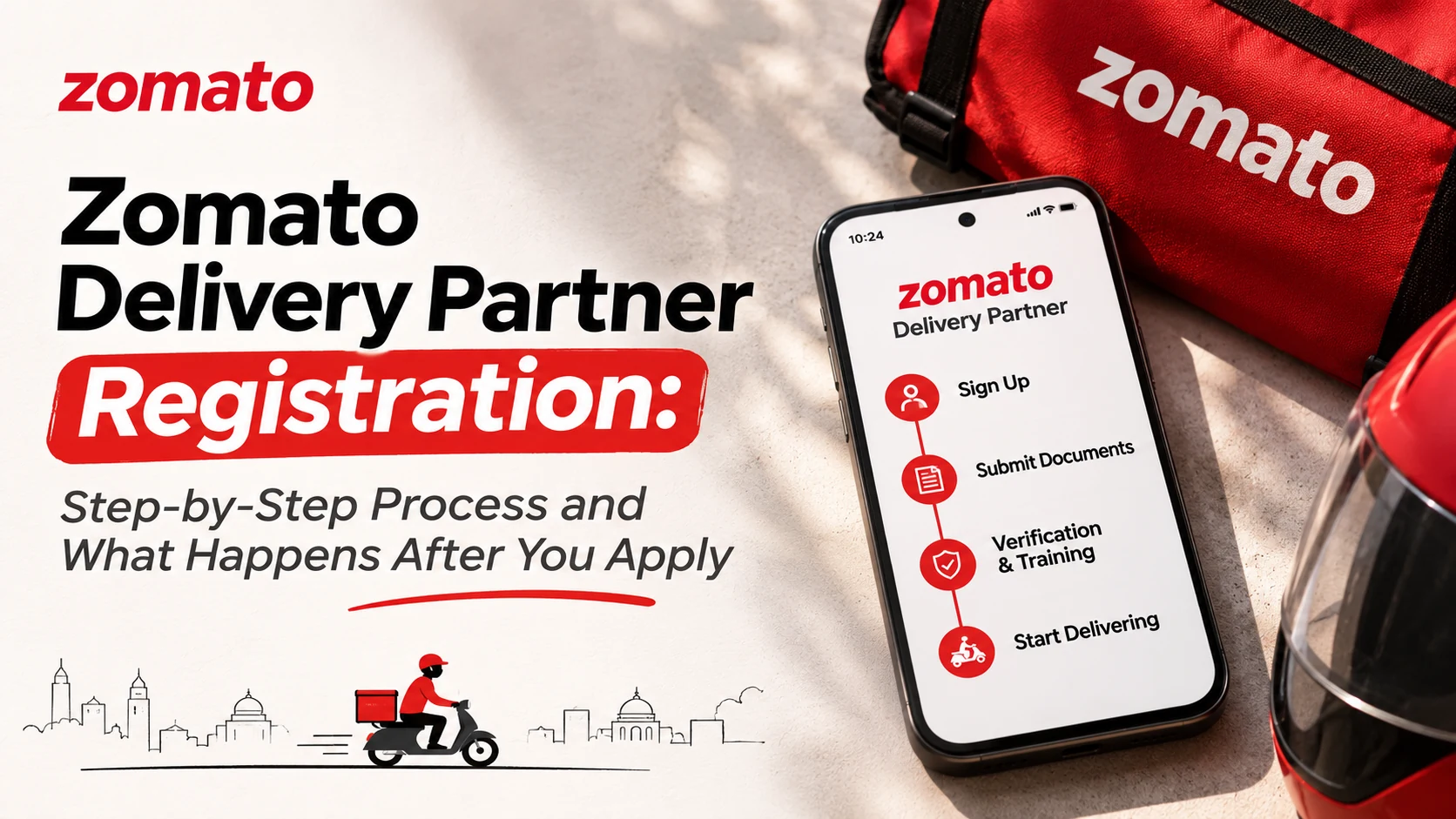
Registration runs through Zomato's own app, not through agents or third-party 'consultants'.Zomato's official delivery partner page compresses the journey into three steps: download the food delivery app, complete online training, and start delivering and earning. Those three steps expand into the fuller sequence the official FAQ spells out, and the rest of this section follows that expanded flow.
First, install the app. The FAQ points toZomato's official self sign-up app page as the place to get it, so start there rather than searching app stores or clicking files sent over WhatsApp. The page pairs a 'Get app link' button with a city selector, and it is the same official channel that will show your city's current onboarding fee later in the process.
Second, create your account and submit your details. Inside the app you enter your mobile number, fill in the required personal details, and upload the documents from the checklist in the previous section - the FAQ's phrasing is to submit the required details, updated documents, and pay the onboarding training fee. Take the document upload seriously, and make sure your name is spelled identically across PAN, Aadhaar, licence and bank records; mismatches are slow to fix once an application is in review.
Third, the offline touchpoint: once your details are in, you visit the nearest asset collection centre to collect your delivery kit, then log in to the app with your mobile number and visit your allocated locality to start accepting orders. That is the entire official flow. If anyone offers to 'do the registration for you' outside the app - especially for a premium - they are inserting themselves into a process Zomato has designed to run without them.
4. Fees, verification and background checks
Registration is not free, and it is better to walk in knowing that. Theofficial FAQ states that a one-time, or fixed, amount is collected from delivery partners - in various installments - for training and support purposes, and that the current onboarding fee for your city is displayed in the self sign-up app. So the fee amount shown in the app before you pay is the authoritative figure, not a number quoted by an agent or a video. What the fee is not is a 'job purchase': it covers training and support, and it is collected through the app's own flow rather than handed over in cash.
The second gate is the background check. The FAQ is explicit about timing: once your registration is complete, Zomato's team runs a background check, after which you can start delivering orders. The company does not publish how long this takes, and your in-app application status is the only official progress signal. The documents you uploaded are verified inside this window, which is why clean, matching documents from section 2 pay off here.
A note on fraud, because delivery-job scams are their own industry: the legitimate process never asks for cash handed to a person, never needs your bank OTP, and never runs through a link outside Zomato's own app and pages. If an 'agent' wants money to 'confirm your ID' or 'guarantee activation', you are being sold nothing. The fee, when it applies, appears in the app; the check happens after registration; the kit comes from a physical collection centre.
5. What happens after you apply: training, kit and activation
Here is what the official pages add up to once the application is in. The background check runs after your registration is complete, and the online training - the second of the three official steps - sits alongside the document-and-fee stage. The FAQ's own sequence then reads: visit the nearest asset collection centre to collect your delivery kit and assets, log in to the app using your mobile number, and visit your allocated locality to start accepting orders. None of this needs you to be online at a particular hour; the sequencing that matters is documents before verification, and fee before kit.
The kit is not decoration. The official well-being framework lists assets - t-shirts, delivery bags and the like - as one of its nine support elements, and the official page adds that women riders receive a safety kit including pepper spray and a torch. The delivery bag matters practically, since hot food travels in it, so collect it before your first shift rather than improvising.
Once you are activated, the shape of the work is yours to set. Login hours are flexible by design - you choose when to be online, and earnings accumulate per delivery. The app's Payments section shows what you have earned, and payouts land weekly in your bank account. Two bonus types can stack on top: a starting bonus for completing a minimum number of orders within a specified window, and a referral bonus for bringing in other partners - both vary by city.
6. What you can realistically earn
The base model is earn-per-delivery: the official FAQ says you earn for each delivery you make, and it declines to quote a number, pointing instead to the onboarding centre or helpline for city-level detail. That restraint has a reason - rates vary by city, distance, time and demand - and it is why any single rupee figure advertised online should be read as marketing until you see it in your own app. What the company does publish is aggregate data, and that data is specific enough to plan around.
Incompany-published earnings data for 2025, Zomato's CEO stated that average earnings per hour on the platform, excluding tips, were ₹102 in 2025, up from ₹92 in 2024 - a rise of about 10.9 percent. Tips flow to partners in full, transferred instantly with zero deductions; the average tip added ₹2.6 per hour in 2025, on roughly 5 percent of orders. The same post estimated gross earnings of about ₹26,500 per month for someone working ten hours a day for 26 days, or about ₹21,000 after fuel and maintenance.
The more instructive numbers are about how people actually work. The average delivery partner on the platform worked 38 days during the year, at around seven hours per working day, and only 2.3 percent worked more than 250 days. In other words, for most people this is flexible and supplementary income layered around other commitments, not a fixed office-style job. Plan your finances accordingly: the ₹102-per-hour average is real, but it is an average across highly uneven hours.
Where does that leave the bonuses? A starting bonus, when your city offers one, lifts the first weeks precisely when you have just paid the onboarding fee; the referral bonus rewards bringing other partners in. Both are city-specific and time-bound, so treat them as a top-up rather than the plan. The durable core is the per-delivery rate plus tips, paid out weekly.
7. Insurance and support after onboarding
The clearest benefit beyond earnings is insurance. The official FAQ states that Zomato provides delivery partners with personal accidental, life and health insurance - cover against injuries and the financial cost of an accident. Women riders additionally receive the safety kit - pepper spray and a torch - noted on the official page. None of this replaces your own vehicle insurance, which remains your responsibility as part of the road-legality requirements.
In October 2024 the companyannounced a Delivery Partner Well-being Framework structured around five areas - financial, social, physical, mental and professional - and nine elements with more than eighty sub-elements. The elements cover earnings and payouts, the order delivery experience, grievance redressal, health and safety, financial inclusion and security, assets, diversity and respect, knowledge acquisition, and growth and retention. The framework commits to annual disclosure of scores, so it works as an accountability mechanism rather than a brochure.
Some of those sub-elements are practical enough to matter in month one: timeliness of payouts, seamless access to tips, and support for delivery expenses such as charging and fuel costs through third-party collaborations. Named initiatives include a 'Shelter Project', real-time weather notifications, a facility to file income taxes, EV renting services and maternity benefits.
Electric two-wheelers are becoming part of this economics.Eternal's shareholder letter reports that active EV-based delivery partners doubled from 52,000 in March 2025 to over 100,000 in March 2026, and that in Delhi NCR close to a quarter of monthly active partners now deliver on electric vehicles. Since the well-being framework also includes EV renting services, owning a petrol bike is not the only entry path - renting an electric two-wheeler through the platform's collaborations is an option worth pricing against fuel savings.
8. Frequently asked questions
Is there a fee to register as a Zomato delivery partner? Yes - an onboarding training fee, collected once or in installments for training and support. The current amount for your city is shown inside the self sign-up app, and it is collected through the app's own flow rather than in cash to any person.
How long does it take to get activated? Zomato does not publish a fixed timeline. The official sequence is: registration completed, then a background check, then delivering. Your in-app status and the onboarding centre are the only official checkpoints worth trusting.
Can I join without a bike? The FAQ's definition of the role covers partners using their own vehicles, described as bike or cycle. The requirements list, however, assumes a two-wheeler with licence, RC and insurance. What your city actually accepts is shown during sign-up, so check the app before buying or renting anything.
Do I keep my tips? Yes. Company-published data states that partners receive 100 percent of tips, transferred instantly with zero deductions; about 5 percent of Zomato orders were tipped in 2025.
When and how do I get paid? Earnings are transferred weekly, directly into your bank account, and are visible in the app's Payments section. There is no separate payout request to make.
How do I close my account later? Send an email to dpsupport@zomato.com and include your phone number for verification. That is the official account-deletion route stated in the FAQ.
9. The bottom line: your registration checklist
Stripped of narration, the path from reader to rider runs like this. Get your papers in order first: a PAN card that is linked to Aadhaar, a driving licence, the vehicle's RC and insurance, address proof and bank-account proof. Then install the app through Zomato's official self sign-up page, submit your details and documents, and pay the onboarding training fee only where the app shows it. Complete the online training, let the background check run, and collect your kit from the asset collection centre.
From activation, the levers are practical. Log in during mealtimes in your allocated locality, keep your order acceptance and delivery clean so your account history stays healthy, and treat the starting bonus - if your city has one - as a head start rather than an income plan. Check the Payments section after your first week so bank details and payout timing are confirmed early, not during an emergency. And keep the earnings expectations from the 2025 data in mind: about ₹102 an hour excluding tips, with tips yours in full and payouts weekly.
The honest summary is that registration is a self-service flow with a known fee, a verification gate and an offline kit pickup, and everything around it - training, bonuses, insurance, support frameworks - is documented on Zomato's own pages. Keep those pages as your reference points, keep every payment inside the app, and the process holds together from first login to first payout.