Zomato Delivery Partner Registration: Step-by-Step Process and What Happens After You Apply
Downloading the app takes minutes and the sign-up form is genuinely quick - what nobody hands you in advance is the sequence that follows: a training fee paid in instalments, a background check, a trip to an asset collection centre, activation, and your first weekly payout.
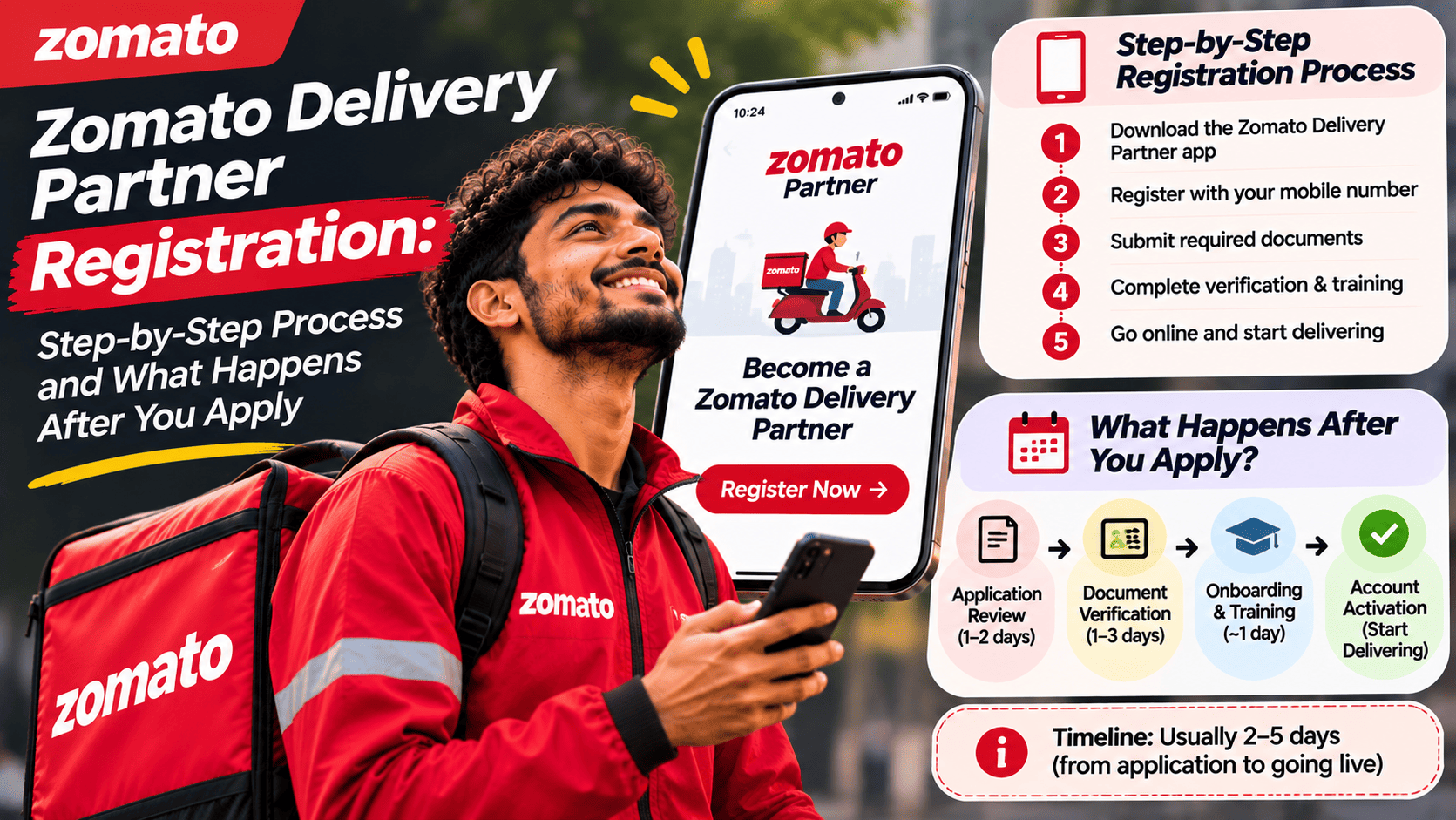
Zomato says a new delivery partner can be onboardedin as little as ten minutes, and the claim is technically true - the sign-up form itself is quick. What the ten-minute framing hides is everything that happens after you tap submit: a training fee that gets deducted in instalments, a background check that has to clear before you can accept orders, a visit to an asset collection centre for your delivery bag, and a payout cycle that pays weekly. None of it is difficult, but each step has its own timing, and knowing the sequence in advance is the difference between waiting anxiously and knowing exactly where your application stands.
Before getting into the steps, it helps to be clear about what the role actually is. Zomato's own FAQ describes delivery partners asindependent contractors who pick up food or grocery orders from restaurants and outlets and deliver them to customers, using their own vehicles - a bike or even a cycle. You log in whenever you want, earn per delivery, and get paid into your bank account on a weekly cycle. The operation runs across500+ Indian cities, from Bengaluru and Delhi NCR to Jaipur and Kochi, so the process below is the same in structure everywhere; only the fee amount and the local per-order rates change from city to city.
1. What you need before you apply
Zomato keeps its official requirements list on thedelivery partner FAQ page, and it is shorter than most people expect. You must be at least 18 years old. You need an Android phone running version 6.0 or higher with at least 2 GB of RAM, because the delivery partner app is Android-based. You need a two-wheeler that meets all applicable law and safety requirements, along with a driving licence, the vehicle's registration certificate (RC) and its insurance certificate - the three documents Indian law expects from anyone riding for pay. Finally, you need address proof, a valid PAN card and proof of a bank account in your name.
Two practical notes sit around that list. First, the FAQ's definition of a vehicle is generous: delivery partners deliver on bikes or cycles, and if you do not own a two-wheeler at all, the Play Store listing for Zomato's delivery app says you canrent a bike or an electric vehicle inside the app itself. Second, while the FAQ's formal list centres on PAN, licence, RC and insurance, the 1 registration flow described on Google Play specifically asks you toupload your Aadhaar and PAN during sign-up, so keep both documents photographed and ready before you start.
These are photo uploads inside an app form, so clear, well-lit images of each document will save you a rejection round. The bank account proof matters more than people assume: since Zomato transfers earnings directly into your bank account every week, an account in your own name is what actually receives your payouts. Check that your mobile number is active and linked to the bank account you plan to use - the app verifies you by phone, and the bank credits flow through the same identity.
2. The sign-up process, step by step
Zomato's FAQ lays out the joining process infive official steps, and it is worth following them exactly as written. Step one: download the Zomato Delivery app - the FAQ links toZomato's own download page, and the app is listed on Google Play as Zomato Delivery Partner. Step two: submit your details, upload your updated documents and pay the onboarding training fee. Step three: visit your nearest asset collection centre to collect your delivery kit. Step four: log in to the app using your mobile number. Step five: go to your allocated locality and start accepting orders. Zomato'slanding page for prospective riders compresses the same journey into three lines - download the app, complete the online training, start delivering and earning.
Inside the app, the form itself is straightforward: your mobile number for verification, your city, your vehicle type, and then the document uploads covered above. The registration also includes a short online training module, which the Play Store listing describes as quick and the official three- step summary treats as a mandatory middle step between signing up and delivering. Do not treat it as optional filler - completing it is part of how your account moves towards activation.
The onboarding fee is the part most applicants have questions about, and Zomato's official answer is deliberately unspecific:a one-time or fixed amount is collected from delivery partners in various instalments for training and support purposes, and the current figure for your city is shown inside the self sign-up app itself. Zomato does not publish a city-wise fee table on its website, and independent observers who track delivery work costs make the same point -treat any figure you hear as unverified until the app shows it to you. The instalment structure matters: the fee is not demanded upfront in cash, it is deducted from your earnings in parts after you start delivering.
That leads to the one safety rule worth stating in an otherwise app-native process: the training fee is paid through the app's own payment flow, never to a recruiter's personal UPI ID, and Zomato operates a dedicatedreport-fraud channel for anything that looks like a solicitation outside official channels. Everything else in this guide is mechanics; this sentence is the one to remember if someone contacts you claiming to speed up your registration for money.
3. What happens after you apply
This is the stage the marketing pages do not explain. Once your registration is complete, Zomato's FAQ says the teamruns a background check, and only after it clears can you start delivering orders. This is a database and document verification run by the platform - not a visit to a police station - and while Zomato does not publish a fixed timeline for it, the status is visible inside the app, so check the app rather than waiting for a phone call. The widely quotedonboarding takes as little as 10 minutes line refers to completing the sign-up steps themselves, not to the background check, so treat the two as different clocks running at different speeds.
Kit collection is the next physical step. The FAQ directs you to yournearest asset collection centre to pick up your delivery kit, which is what makes you identifiable to restaurants and customers as a Zomato rider. Unlike some platforms that ship the kit to your home, Zomato's published flow is a collection-centre visit, so plan for it: carry the same identity documents you uploaded, since the kit is issued against your registered application. The centre visit is also where city-specific questions - exact per-order rates, current incentive structures - get answered in person, which is useful because the FAQ itself says exact earnings figures are shared at the onboarding centre or helpline rather than online.
Once the background check clears and your training is complete, your account is activated and the rest is in your hands. Login hours on Zomato areflexible - the FAQ defines them simply as the time you stay online and available to deliver, and you choose when to log in and when to stop. There is no shift roster to wait for and no manager to report to; the day you are activated is the day you can go online.
If you change your mind at any point - before activation or after months of riding - account deletion is a documented process: email dpsupport@zomato.com with your phone number for verification and Zomato will process the removal. It is a small detail, but a platform that publishes its exit door in the same FAQ as its entry process is telling you the relationship is meant to be two- way.
4. Your first days on the road
The first order follows a rhythm you will repeat hundreds of times. You go online inside the app, an order request comes in, and once you accept it the app routes you to the restaurant for pickup and then to the customer's address for delivery. Your earnings for that delivery are logged in thePayments section of the app, which the FAQ confirms is where you can check them at any time. Nothing about the first week requires special strategy - it requires going online during meal hours, in your allocated locality, with the kit you collected.
Support is built for the road: the Play Store listing describesround-the-clock support, emergency help and live order assistance while you are on a delivery. For women riders, Zomato's landing page notes a dedicated safety kit -pepper spray and a torch - and counts more than 1,000 women delivery partners on the platform, which is worth knowing if you are weighing whether this is work you can actually take up.
Insurance is the quiet benefit that starts with joining, not something you unlock later. The FAQ says every delivery partner is providedpersonal accidental life and health insurance, covering injuries and the financial cost of an accident. The Play Store listing goes further, describing accident insurance, medical coverage and online doctor consultations at no extra cost. Read the policy details inside the app once you are active - the official summaries tell you what exists, the policy document is what actually pays out.
5. How the money works: pay cycle, tips and bonuses
Zomato pays on an earn-per-delivery model: you earn for each delivery you complete, and the FAQ is candid that rates are set city by city - itdirects applicants who want exact numbers to their nearest onboarding centre or the helpline rather than quoting figures publicly. What it does state openly is the payout rhythm: earnings are transferredweekly, directly into your bank account, and the landing page markets this as getting paid weeklywithout any wait. The Play Store listing adds that the app supportsdaily or weekly payouts with instant withdrawal of earnings, so depending on what your version of the app shows in the payments screen, you are not locked into a single weekly drumbeat.
Tips work differently from base pay, and Zomato's official blog post on the subject is unusually specific. Tips are passed through at 100 percent - Zomato absorbs the payment gateway and convenience charges - and they are not held for the weekly cycle; they are transferredon an ongoing basis as they are received. The same post reports that roughly 80 percent of tips reach delivery partners' bank accounts within 60 minutes of the customer sending them, and 92 percent within 24 hours of the delivery being completed.
Bonuses are the third layer, and the FAQ names exactly two types, both varying across cities. Astarting bonus is paid to new joiners who complete a certain minimum number of orders within a specified time - the exact target appears in your app when you join - and areferral bonus is paid for referring friends who become delivery partners. Neither is guaranteed income; both are conditions you either meet or do not meet in your first weeks, which is exactly why the targets deserve a screenshot on day one.
As for how much all of this adds up to, the most official number available is the Play Store listing's ceiling framing:earn up to Rs 30,000 per month, built from per-delivery payment, bonuses, incentives and extra payouts during peak hours. Treat it as a ceiling, not a median - it assumes near-daily logins across meal peaks. And remember the contractor arithmetic: you are using your own vehicle, so fuel and maintenance come out of your earnings, which is the trade-off behind the flexibility the model sells.
4 6. Where this leaves you
Strip it all down and the Zomato journey runs on three honest clocks. The first is the ten-minute clock of the sign-up form - documents, fee, training. The second is the waiting clock - the background check and the collection-centre trip - where the app's status screen is your only real source of progress. The third is the money clock - a weekly cycle into your bank account, with tips flowing through separately and bonuses layered on top in the early weeks.