Warehouse Jobs in India: Complete Guide for Gig Workers
A worker-side guide to warehouse jobs in india complete guide for gig workers: the kinds of sheds, the roles on the floor, who hires and through which door, the requirements at the gate, the papers to keep ready, the application run, the first days, and picking the shed that fits him.
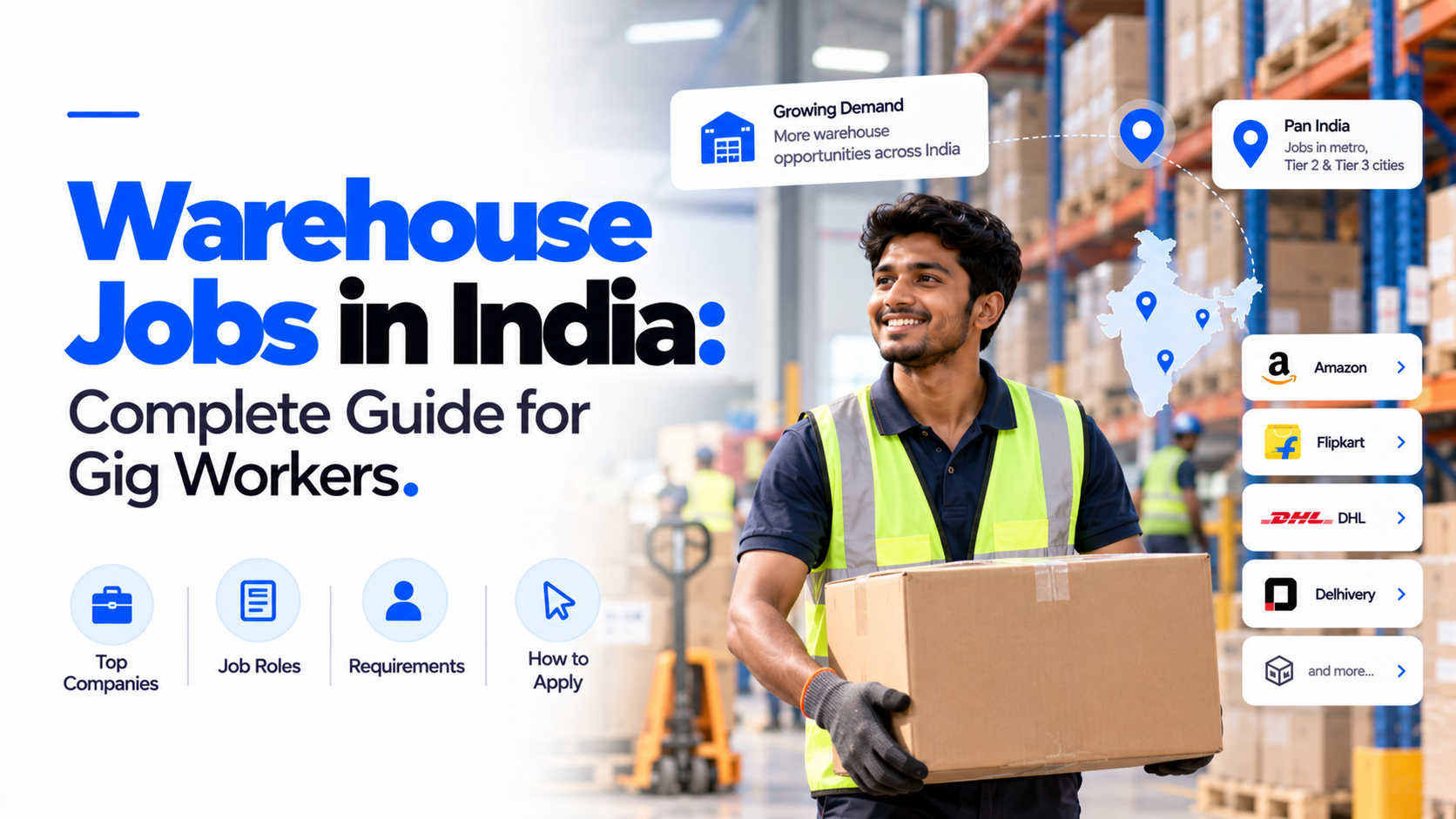
In Gurugram, a man lives on the service-lane side of the highway, where the sheds stand behind the expressway's noise. For a year he has watched the shift buses turn in at the gates - the first rolling in before dawn, the last leaving after the trailers go quiet - and this month he decided the work inside is his trade too. The question is not whether the sheds hire. It is what the gate will ask of him, and which question comes first.
A man from his hometown works inside a Faridabad shed - took a packer's job there last year. On the phone his advice holds three things: papers right, shift honest, shoes ready. The man in Gurugram has begun with the first - an alphabet of documents photographed clean on his phone.
That phone call, stretched long, is this guide: warehouse jobs in complete guide for gig workers - the kinds of sheds there are, the roles on the floor, what the gate asks for, the papers to keep ready, how the application runs, what the first days look like, and how a man picks the shed that fits him.
One Roof, Many Kinds of Work
Warehouse work in India is not one job under one roof; the roof changes with the load the company moves. The e-commerce sheds sort and stage the country's online orders. The parcel sheds run the night's boxes between the arriving trucks and the doorsteps. The 3PL sheds hold one brand's goods for months at a time. The cold stores move what will not wait. And every shed splits its work the same way: in at one gate, out at another, counted at every step.
There is a national frame behind the local gate. Government notes name the National Logistics Policy, GatiShakti, GST and logistics parks as the forces modernizing how goods are stored and moved, and put the sector's employment above 22 million people, millions of new jobs besides,as the commerce ministry's press note records. A man walking into a shed is entering the storage-and-distribution end of that trade.
That scale is why the floor suits gig workers. A shed's headcount is a moving number - crews flex, shifts open and close, and the same apps that list delivery shifts now list gig warehouse work in beside them, a day inside a shed booked like a shift. For a man deciding where his year goes, the floor offers what the road trades cannot: work that starts this week, in the city where he already stands.
The Roles on the Floor
Warehouse picker and packer jobs lead any listing board a newcomer reads: the picker walks the aisles and pulls what the order names; the packer stands the wrap line and seals what the picker pulled; between them run the loaders, who fill and empty the trailers at the dock doors, and the stock checkers, who keep the tall racks honest. One walk down the bay teaches more than a week of reading.
The formal names match the floor. A warehouse worker job description reads plainly - pick, pack, load, count, keep the record straight - which is why the country's newest centre of logistics training names its target roles as EXIM associate, forklift operator and warehouse associate executive,as the skill ministry's release notes. None asks for a degree; each asks for hands that finish what the scan starts.
The forklift line sits slightly apart. It pays better where it exists and wants a licence the shed usually arranges - but it is not the entry door, and a newcomer should not wait for it. The floor promotes from what it can see: the picker who never misses a scan becomes the man who runs the line.
Who Hires, and Where the Sheds Sit
The employers come in four kinds of sheds, each with its own door. The e-commerce networks hire straight to their own rolls at scale; the parcel firms fill their hubs for the night's sort; the 3PL sheds hire by way of the staffing agency that staffs them; the cold stores hire few and steady. One question should come early - whose roll will my name land on - because the answer decides the payslip, the extra hours, and who answers when the pay is short.
The sheds are not scattered; they follow the freight. An amazon warehouse job apply search lands a man in the same districts the parcel firms already work, because the big branded sheds sit where the corridors meet the cities - and the corridors are nearly built: of the 2,843 km they cover, 2,741 route km, 96.4%, is commissioned and running,as the rail ministry's briefing records. Where the corridor goes the shed follows, and the hiring follows the shed.
The city pages make this checkable.The Bengaluru listings page on the hiring network shows one market's live demand across categories; a man in any corridor city can open his own page to see which sheds are hiring around him this week before he spends a day on the highway.
What the Gate Asks For
The warehouse job requirements in compress to a short list, shorter than the road trades ask. He must be an adult, fit for the honest part of the work - lifting, standing, walking a shift on his feet. He needs enough reading to follow the screen - the floor runs on scans, and the scan gun speaks through it. Everything beyond that is the shed's own preference, not the trade's law.
The shifts are the real filter: day, evening, and the shift that runs after dark are the three windows a shed works in, and a man should choose the one his body and his commute can hold. A night shift warehouse jobs in search returns mostly the same sheds as the day search - what changes is the hour, the allowance on top, and the last bus home.
The rest varies by shed: some want experience for the count roles and none for the pick line; some run a fitness round; some prefer men who live within a short bus ride, because shift work punishes a long commute.The categories shelf on the hiring site lays warehouse work beside the other gig categories, so a man sees what else his city pays for before committing his month.
The Papers to Keep Ready
The documents required for warehouse job in fit on a phone: Aadhaar, because every check begins with identity; the PAN card, so the tax record follows the work; an account in his name for the pay to land in; a set of photographs; and at many sheds an education certificate for record-keeping roles. Some sheds add a police verification form the local station completes in days. Photographed clean and named correctly, the set survives every gate in the trade.
The gate reads papers before it reads faces, and two things stall more applications than any refusal: a name spelled differently across documents, and an account that is not the applicant's. Both are fixable at home inside an afternoon, and both are his to fix - no shed can repair a mismatched record for him.
Gig shift platforms slim the folder further: registration inside an app, a photo of the Aadhaar, a selfie, and the shift list opens. One clean document set travels from the walk-in interview at one shed to the app of another without re-shooting anything - papers done one time right follow him across the trade.
How the Application Runs
How to apply for warehouse job in openings comes down to four doors, and a man can knock on all four inside one week. Door one is the walk-in interview: many sheds announce a hiring day at the main gate; he carries his papers, wears shoes he can stand in, and asks for the shift he wants. Door two is the job portals, where the big sheds post under picker, packer and loader titles. Door three is the staffing agency desks on the industrial estates. Door four is the gig platforms, where warehouse shifts appear beside the delivery work he may already know.
Inside every door the run is similar: the form is short - name, age, address, the role he wants; the papers photographed or carried; the interview at the gate less an exam than a walk - can he lift, can he stand, can he read the screen. Then verification runs its days, and a date to report arrives by call or message, usually inside the week.
The read-before-the-write rule counts double here, because shed listings vary more than delivery listings do.The walkthrough on the hiring blog shows how to read a listing before aiming a form at it - which company holds the roll, which shift it names, whether the pay line says hourly, monthly or by the count. Reading first turns four doors into one decision.
The First Days Inside
The warehouse jobs for freshers in question answers itself on the floor: the entry roles assume no experience, and the shed expects to teach the route. The first days follow a set sequence - the induction, where the safety rules and shift times are read out; the aisle assignment, where a man already inside walks him through the pick path; and the shift itself, where the scanner does the supervising. A fresher who asks early is running his aisle alone by the third week.
The physical side deserves its honest read: the floor is hours on his feet. Steel-toe shoes, a water point he should actually use, a back that lifts with the legs - the work is not hard to learn, but it pays the men who build two habits early: a second pair of shoes that survives the week, and a lunch box for the meal break.
Two records should start on day one - the company's and the worker's own. The company's holds attendance, shift, payroll deductions, and the payslip date; a man should know when his first payslip lands before his first week ends. The worker's own is the e-Shram registration that follows him across sheds and cities - the one record no gate can take away.
Pay, Shifts and the Honest Count
Any warehouse job salary in search returns ranges that disagree with each other, and they are all telling the truth: the rate moves with the city, the role, the shift and the month. A count role that pays by accuracy can pay above the pick line in the same shed; the shift after midnight carries an allowance the day line never sees; the months around the festivals double the hours and the headcount together. Anyone quoting one number for every shed is guessing.
The honest read compares three lines: the rate, the payroll deductions, and the costs the shed silently transfers to him - travel to an estate far from the last bus, shoes that wear out in months, a phone battery the shift drains. The payslip lands clean where the roll is direct; agency rolls should be probed for the date and the mode of pay before joining, not after. The trade is formalizing around paperwork - the National Logistics Policy's platform has logged over 160 crore digital transactions across 30-plus connected systems,as the commerce ministry's review records - and a formalized trade pays against records, which is why the payslip line matters.
Gig shift work changes the arithmetic rather than escaping it: paid once a week, or paid by the shift, and the count on the screen decides how long the work runs. The rules are the same either way: watch what lands, not what is promised - and test the promise against the floor, where the men inside know which week the pay drifts.
Picking the Shed That Fits
The choice is four questions, asked in order. Does the shift fit his commute and his body? Does the roll sit with the company or the staffing agency - and does he know which? Does the pay line say what lands, and when? And is the shed reachable on the days the buses stop? Because the warehouse worker jobs in market concentrates along the corridors, four answers for one shed quietly map the district.
The instruments are public.The openings page on the hiring site shows which sheds and companies are asking for hands now;the locations page on the hiring site shows where the work sits by city;the Gurugram delivery page on the hiring network carries his market's live listings; andthe platform guide on the hiring blog explains the matching from the worker's side. A man who checks all four arrives at the gate already briefed.
Back in Gurugram, the watching turns into a plan: papers photographed clean, the shift chosen against his commute, the shoes bought, the first interview set for a hiring day the shed announced at its gate. The shed he enters will be the one whose requirements he met and whose payslip he checked - not the one that shouted loudest. That is what the year of watching was for: not to wait for the trade, but to enter it informed.
The trade will keep mechanizing - scans will get faster, racks taller, counts tighter - but the door does not move: be adult, be fit for the lift, hold the papers, choose the shift, read the pay line, and let the record follow the work. The machines on the floor sort the goods; the man still sorts the decision.
The sheds hire, the gate asks short questions, and the papers fit on a phone. The man who walks in with steel-toe shoes and one clean document set is counted from his first scan, paid from his first shift, and building the record that follows him shed by shed across a working life.