The Future of Work in India: Gig, Platform and Flexible Employment
India's next workforce is assembling outside the employment contract. What the official projections, the new state laws and the new global standard say about where the world's largest working-age population is heading - and what stands between flexibility and security.
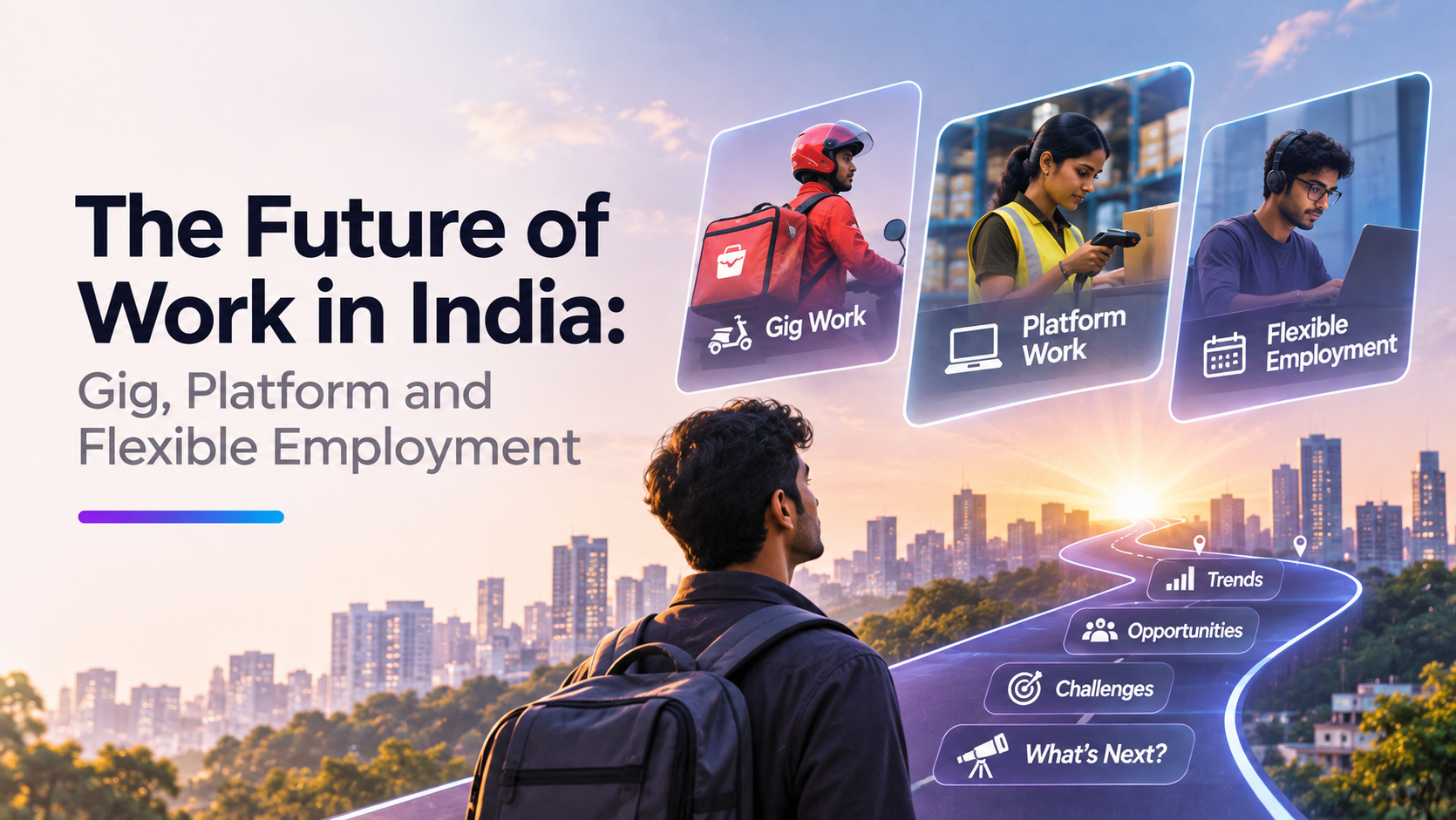
Every argument about the future of work in India eventually collides with the same fact: most of the country's work has never carried an employment contract, and the newest forms of work - the ones arranged by app, paid by task and scheduled by algorithm - are being invented inside that reality, not against it. The debate usually runs on three vocabularies. Gig describes work sold in units: a delivery, a ride, a shift. Platform describes the software layer that allocates, prices and monitors it. Flexible describes the staffing model that rents workers to enterprises by the month or the season. They sound like different subjects. They are one shift seen from three angles: work in India is increasingly organised in units smaller than a job.
This report assembles the forward view from the documents that will actually shape it - the official projections, the finance ministry's latest annual survey, the state welfare laws now on the books, the courtroom fights over how to fund them, the first global convention on platform work and the industry trackers counting the stores and the shifts. What emerges is not a forecast but a construction site: the scaffolding of the next Indian labour market - registries, welfare boards, transaction levies, portable accounts - is already standing, and the contest now is over what gets built inside it. The sections below cover the numbers, the demand engines, the supply side, the regulatory race, the global rulebook and the short list of things the next decade has to get right.
1. The numbers behind the drift
The official arithmetic makes the direction unambiguous. The government's own policy brief on the gig and platform economy estimated the workforce at77 lakh workers in the year it was first counted - about 1.5 per cent of India's total workforce - and projected it to reach 2.35 crore, some 4.1 per cent of all workers, by the end of the decade. The same brief found roughly 47 per cent of gig work in medium-skilled jobs, 22 per cent in high-skilled and 31 per cent in low-skilled, with the mix drifting toward both ends rather than settling in the middle.
The finance ministry's latest annual survey has since updated the ledger:from that 77 lakh base, the sector added 55 per cent in four years to reach 120 lakh workers, pushed past 2 per cent of the total workforce, and is projected to reach 6.7 per cent of the workforce while contributing Rs 2.35 lakh crore to GDP by the end of the decade - growth, the survey notes, that outpaces overall employment.
Gig work is only the visible edge. Parallel to it, the flexi-staffing industry - agency-employed workers deployed to client firms -puts its own workforce at 7.2 million, about 1.3 per cent of all workers and the world's third-largest, with a projection of 9.16 million at double-digit annual growth. Read together, the numbers describe a spectrum, not a niche: millions of Indians already work inside arrangements that are neither the standard salaried job nor the old informal day-rate, and every projection has the spectrum widening faster than employment as a whole.
2. One shift, three vocabularies
The three terms do different work, and the law has begun to treat them differently. A gig worker, in the framing the labour codes adopted, earns outside a conventional employer-employee relationship; a platform worker is the app-routed subset of that; a flexible worker sits on an agency's rolls and works on a client's floor. What the codes add is a bridge across the buckets:formal recognition for gig and platform workers, mandatory appointment letters, portable social security accounts for migrant workers, and equal benefits for fixed-term employees once a year of service is crossed.
That bridge is the real story. For most of the last century, the line that mattered in Indian work was formal versus informal. The line that will matter next is what carries over between engagements: an identity that survives a platform switch, a benefits account that follows the worker across state lines, a work history a lender can read. The future of flexible work in India will be decided less by how workers are classified than by what portable machinery attaches to the classification - because classification without portability is just a new way of being unseen.
3. The demand engines: the infrastructure of flexibility already exists
Flexibility at this scale is not an accident of culture; it sits on infrastructure. The finance ministry's survey credits the sector's acceleration tosmartphone penetration among more than 80 crore users and roughly 15 billion UPI transactions a month - the rails that make task-by-task work payable at all. On those rails, the fastest-building structure is quick commerce: an industry census of the sector now countsmore than 5,600 dark stores across the country, employing somewhere between 56,000 and 112,000 workers, and estimates the trade needs 150,000 to 300,000 new hires a year just to stay staffed. Every one of those stores is a node where flexible hours meet warehouse discipline - a format that did not exist in India a decade ago and is now a standard entry point into the urban workforce.
The wider map is similar in shape. The survey's own distribution of the gig workforceleads with e-commerce, manufacturing, retail and transportation. And the demand is not only domestic: by the Oxford Internet Institute's long-running count of the global online labour market,India holds a 24 per cent share - the world's largest - which makes the country simultaneously the biggest arena for location-based platform work and a leading supplier of remote gig labour. Demand, in short, is the part of the future that has already arrived; the open questions sit almost entirely on the supply side and the rules side.
4. The supply side: who flexible work is recruiting
Who is choosing this work is changing faster than the commentary about them. The most consequential movement is women's: the official labour survey recordsfemale participation rising from 23.3 per cent to 41.7 per cent across its recent rounds - a shift every projection of the flexible workforce quietly assumes. Whether platforms capture that shift depends on design rather than advertising: an earlier joint study by the Observer Research Foundation and the World Economic Forum found35 per cent of the women it surveyed were uninterested in gig work for one reason - the absence of job security and the uncertainty of employment status - and later studies keep locating the same brake, along with the phone-ownership and safety gaps underneath it.
Beyond gender, the supply story is about options at the margin. For a young worker weighing an informal day-rate job, a factory shift or two apps running side by side, the flexible model wins on activation speed and payout rhythm; it loses on everything that requires a horizon - credit, insurance, a pension, a career that compounds. The swing factor for the next decade is whether the model can keep the first set of advantages while repairing the second. That is not a platform problem or a policy problem alone; it is the joint problem the new laws are now attempting in public.
5. Regulation is racing to catch a moving workforce
Parliament moved first:the Code on Social Security put gig and platform workers inside a national social-security framework for the first time - and then stopped, because the rules that would switch the framework on have still not been notified. The states have not waited. Rajasthan passed the country's first state law for platform-based gig workers -registration for workers and aggregators, a unique ID valid across every platform, a welfare board, and a cess of one to two per cent of transaction value to fund it - and two years on, that law remains largely unimplemented because its rules were never framed. Bihar followed; Karnataka passed a fuller statute with a welfare fund financed by fees on aggregator payouts anda first-of-its-kind duty to tell workers how automated monitoring and decision-making systems shape their conditions; and Jharkhand became the fourth state to legislate.
The money is where the fight is. Karnataka's welfare fee is now challenged in the state high court by the platforms themselves, andwhile the case proceeds, the court has ordered the disputing aggregators to deposit the fee with the court registry - keeping the law alive but frozen, and turning a design question (who should fund social security, and on what base) into a contested one. The Union government has taken the administrative road instead:the latest Budget attached e-Shram registration, identity cards and Ayushman Bharat health cover to gig work, and the national registry's aggregator module has onboarded a dozen of the largest platforms, from food delivery and quick commerce to ride-hailing and logistics. The direction of travel is settled on all sides; the pace is not. The gap between a law passed and a life changed is where the future of work is currently being negotiated.
6. The rulebook is going global
India is not writing these rules alone. The International Labour Organization has adopteda dedicated convention on decent work in the platform economy - the first global labour standard aimed at digitally intermediated work - built around the two issues India's state laws are already testing: pathways to formalisation, and protections attached to platform-mediated work rather than to the employer relationship that platform work dissolves.
The demand side has its own global barometer. The World Economic Forum's employer survey -more than a thousand employers across 55 economies - expects two-fifths of workers' core skills to be transformed or outdated within five years, and puts delivery drivers among the roles adding the most jobs worldwide even as automation redraws the rest; on its arithmetic, structural change creates some 170 million jobs against 92 million displaced. For the country that leads the online labour market and is building the largest domestic platform workforce, those are not other people's numbers. India's registries, transaction levies and registry-linked health cover are becoming case material for every regulator facing the same wave - which means the quality of the Indian experiment will be judged well beyond India.
There is also a mirror being held up at home. The longest-running accountability scorecard of Indian platformsstill shows a board where the strongest scores reach six out of ten - respectable in a hard test, and far from the decade's promise that flexibility would arrive bundled with fairness.
The bottom line
The future of work in India is not a prediction to wait for; it is a build already under way, and the honest summary of the evidence is a short list of what has to hold. Benefits have to become portable, so that a worker's security account survives every platform switch and state border - the portable account exists on paper and now needs a working life. Financing has to be found that funds protection without taxing flexibility into flight, which is the exact question the courtroom fight over the welfare fee has made unavoidable. Measurement has to keep pace, because a national registry that can see the workforce is the difference between policy and guesswork. And participation has to widen on design rather than luck, with women's rising labour-force participation as the swing variable every projection depends on.
Get those four right and the same evidence base supports a different conclusion: India becomes the first large economy to make flexible work carry formal-work security - not by converting apps into factories, but by attaching identity, benefits and voice to work that changes shape every week. Miss them, and the country will have built the world's largest flexible workforce on top of the world's thinnest floor. Either way the shift is no longer speculative; the only genuinely open question is what it will feel like to work inside it.