India Gig Economy: From Traditional Employment to Platform Work
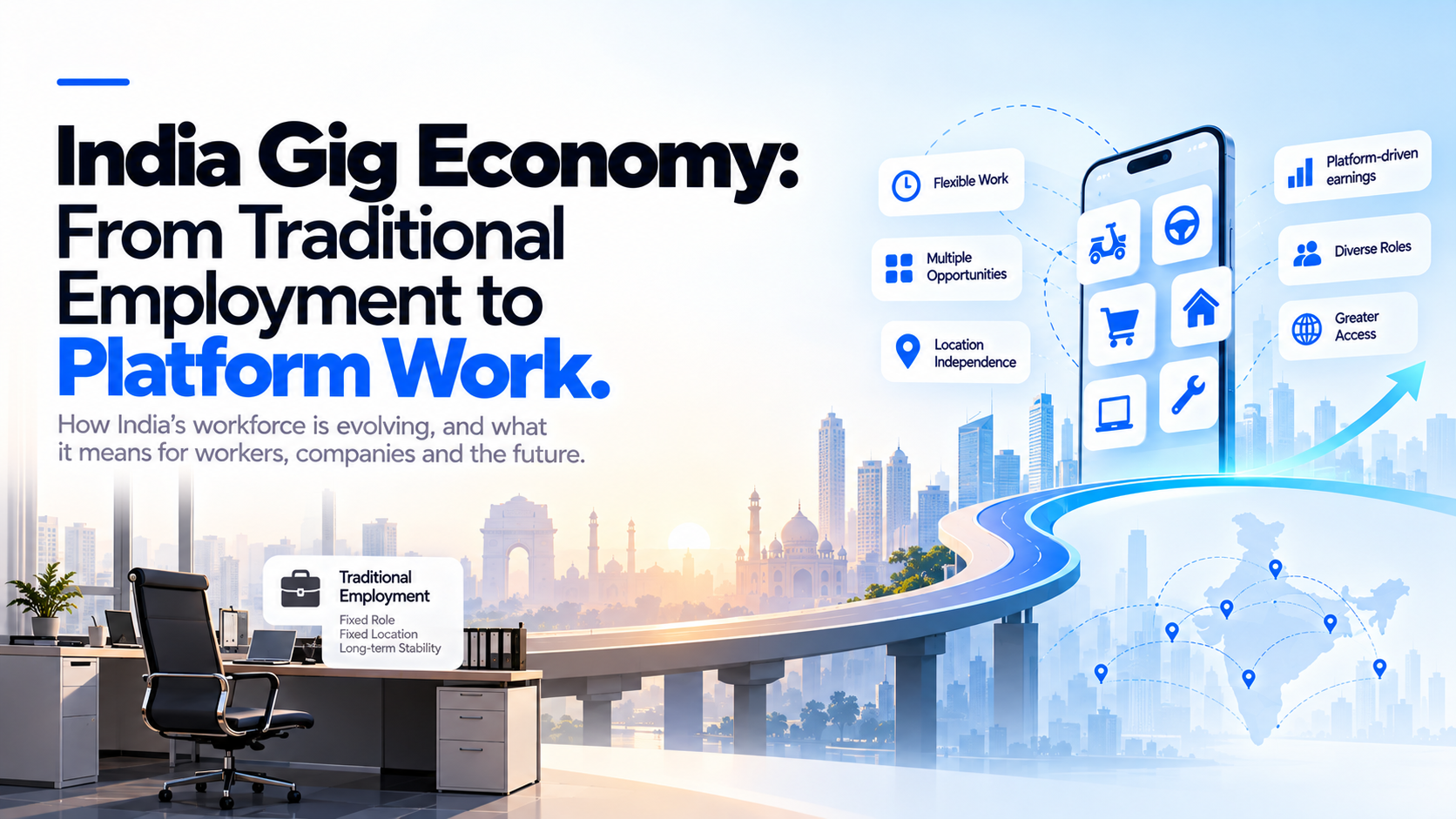
India's gig economy transition, walked frame by frame: what a working life carries from traditional employment into platform work, what it rebuilds, how pay and employers change, the state's own renames, the rebuilt institutions and the financed bridge - and how the crossing is made.
In Thiruvananthapuram the city answers to two names: the shorter one people grew up speaking, and the longer one the maps took in 1991. The post still arrives for both. Nothing moved when the name did - the buses, the banks and the houses kept their places under the rename.
A rename is the mildest transition there is: everything real stays where it stood, and only what people call it changes. The trade this blog follows is living through a harder version of the same event - the working life has taken a second name, platform work, and this one arrives with terms attached.
This is a walk through that transition, frame by frame: what a working life carries across the rename, what it has to rebuild on arrival, how the money and the employers change, what the state's own records say about names, and how the crossing is actually made - one decision at a time.
Two names for one working life
Leaving traditional work for gig work is the phrase the internet argues about; the working life itself is quieter about it. Very few people end the old frame in one afternoon. What actually happens is slower: a salaried worker takes one platform shift, then a weekend of them, then a month in which the platform income pays for the groceries and the salary pays the rent.
This blog treats the move as a transition, not a leap and not a verdict. The older frame - one employer, fixed hours, a monthly payslip, a gate to show up at - did real things for people, and the newer frame does different real things. The question worth asking is not which side wins; it is what survives the crossing.
Neither name covers the whole trade now: the platform frame sits inside the traditional economy - fleets inside logistics firms, counters inside shops - and the traditional side uses the platforms' tools every day. The two names share one working life the way the two names of a city share one set of streets.
What carries over
What carries over from a salaried job is more than most newcomers expect. The discipline of a fixed start time, the habit of finishing a shift rather than abandoning it, the way of handling a difficult customer - none of it needs relearning. The skills are portable, the body clock is portable, and the reputation travels in references and in the work itself.
What the old frame quietly taught - arriving on time, keeping records, staying reachable, finishing what was started - turns out to be the platform trade's real entry test. Candidates arriving from staff jobs usually clear it without noticing; the trade's churn has other causes entirely.
The newer frame also rewards what the old one taught about knowing your work: a person who already knows which kinds of work suit the hours and the vehicle owns half the decision before day one.The full work list on the hiring site sets the kinds side by side, every kind with its way in written out, so the carried-over skills can be matched to ground before the move.
What has to be rebuilt
What changes when the job becomes platform work is small in words and large in days. The payslip stops arriving; the employer's admin desk stops answering for the worker; the papers stop renewing themselves through someone else's office and become the worker's calendar. The platform work transition candidates talk about is mostly this: the administration moved into their hands.
The rebuild list is short and it is dull: a working id, the bank account, the licence where wheels are involved, and a reminder to check them before every season. None of it is hard; all of it now waits on nobody else.
The state's side of the rebuild is the piece most candidates underweight. The registration doors and the newer state laws exist precisely for this crossing, and they open at the worker's own initiative - nothing about the newer frame files itself.
How the money changes
How platform work pays differently is the page every newcomer opens first, so plain terms are owed. A monthly salary is a contract about a month; platform pay is a stream about a task. Money arrives in smaller, more frequent pieces, and the app's figure is the gross - the costs of the work come out of the same stream.
Two habits decide whether the transition runs smooth or rough. The first is reading the week, not the day: one bad day ends nothing, though it feels like a verdict at closing time. The second is knowing the costs before the first ride, because the stream that pays is also the stream that buys the fuel and the data.
A transition budget helps more than a resignation letter: one month of running both frames side by side, with the old salary still arriving, tells a worker what the newer frame truly pays before the older one is handed back. The people who skip that overlap month are the ones the horror stories are written about.
From one employer to many
From one employer to many is the sentence that describes the change's shape most precisely. The traditional frame concentrates a working life in one place; the platform frame distributes it - several apps, several dispatchers, several streams, with the worker as the one common point between them.
Distribution cuts both ways. The worker who would have lost a single employer's whole income in one dismissal now loses a day of one stream instead. Platform work for salaried workers runs the same logic in reverse: the salary stays, the platform adds a second stream, and the household's income stops hanging from one thread.
The multi-stream life is easier to see in one city than to describe in general.The Bengaluru page on the hiring site shows one market where food streams, grocery streams and ride streams run inside the same hours, and workers move between them as the week demands.
The state's own names change
The state has been making the same journey in its own paperwork as the rural development ministry's approval records, the cabinet has extended the national social assistance programme for another five years, 2026-27 to 2030-31, with Rs 53,428 crore set aside - and has renamed the programme and its sub-schemes under the Prime Minister's name: the old age, widow, disability and family benefit pensions now sit under one new heading.
The names changed; the entitlements did not. The pensions continue in their existing form, 3.20 crore people across every state and union territory draw from the programme, and the disability pension's rules were widened - Rs 375 up to seventy-nine, Rs 625 past eighty, and the qualifying disability cut from 80 per cent to 40.
The old job and the new work argues about every day sit inside this same pattern: the state renames its frame from time to time, and the protections travel with the name. The platform frame now has names of its own in state law - Rajasthan's law came first in 2023; Karnataka's and Bihar's came next; Telangana's assembly passed its act in March 2026 - each building, registration by registration, what the older frame took decades to build.
The old institutions, rebuilt
The traditional frame's institutions are not being left behind; they are being rebuilt for the newer one as the skills ministry's steering committee records, five investment plans worth Rs 1,194.92 crore were cleared for industrial training institute clusters in Maharashtra, Odisha and Jammu and Kashmir, taking the total approved under the scheme to Rs 3,687 crore, with industry partners named to run the upgrades.
The institutes that trained the traditional economy's electricians and mechanics are being turned, in the scheme's own words, into modern, industry-aligned, future-ready institutions - the same classrooms, new wiring. For a worker crossing frames this is practical news: the certificate the older system issued is being upgraded into the credential the newer system reads.
The partners attached to the new clusters - a steel company's foundation among them - tell the same story from the employer's side: the firms that intend to hire across both frames are paying to build the bridge between them.
The bridge and its financing
The shift from jobs to platform work gets measured mostly in cities, but the bridge into the newer frame is being built in the villages too as the rural skilling partnership records, more than 6 lakh rural youth will be trained this year, unified standards have been set for the country's rural self-employment training institutes, and attendance is now verified through Aadhaar-enabled biometrics.
The financing of that bridge took a new shape this month:as the stock exchange listing records, the national skill development corporation raised its first social investment on a public exchange, and the rural development bank put Rs 4 crore into an Rs 11.25-crore programme that trains 600 rural youth in Japanese and German for jobs abroad.
Read those two facts together and the direction of the transition shows plainly: the state is standardising the crossing from below - training, verification, credentials - while new financing routes pay for it. The bridge stopped being a metaphor in the records; it has a budget line.
Making the crossing
The practical sequence for a first platform job after a salaried job fits in five lines: run both frames for a month; check the papers before the first shift; pick the work that fits the hours already free; keep that overlap month's numbers honestly; and only then decide which name the working life carries forward.
The finder's guide on the hiring blog walks the whole first search;the current openings on the hiring site are where the seats sit;the city list on the hiring site lists them state by state; andThiruvananthapuram's delivery page on the hiring network carries this blog's own two-name city - the seats there, current and listed.
For employers reading the same transition from the other side, the crossing is a hiring route: candidates arriving from staff jobs bring the discipline the trade's churn keeps washing out, and the employers who price the overlap month - flexible hours, weekly pay that respects a notice period - hire them first.
What changes when the job becomes platform work, in the end, is the number of names the working life answers to. The older name still opens doors - the references, the discipline, the institutions that trained the hands. The newer name opens others - the multi-stream income, the state's new registrations, the bridge programmes financed on markets that did not exist a decade ago.
The working life under two names is not a loss and not a victory; it is the condition the trade lives in now. The city that keeps both its names keeps both its post offices; a worker holding both frames' habits keeps both their advantages - and the crossing, walked carefully, is how the trade's next decade gets staffed.The how-it-works page on the hiring blog shows the hiring side of the same crossing - and the two-name city, like the trade both names describe, keeps its doors open for the reader who learns both names.