Mover Jobs in India: How to Find Work
Mover jobs in india how to find work: what the designation covers, who hires, the papers a mover carries, the pay patterns, the craft, and the road to the first shift.
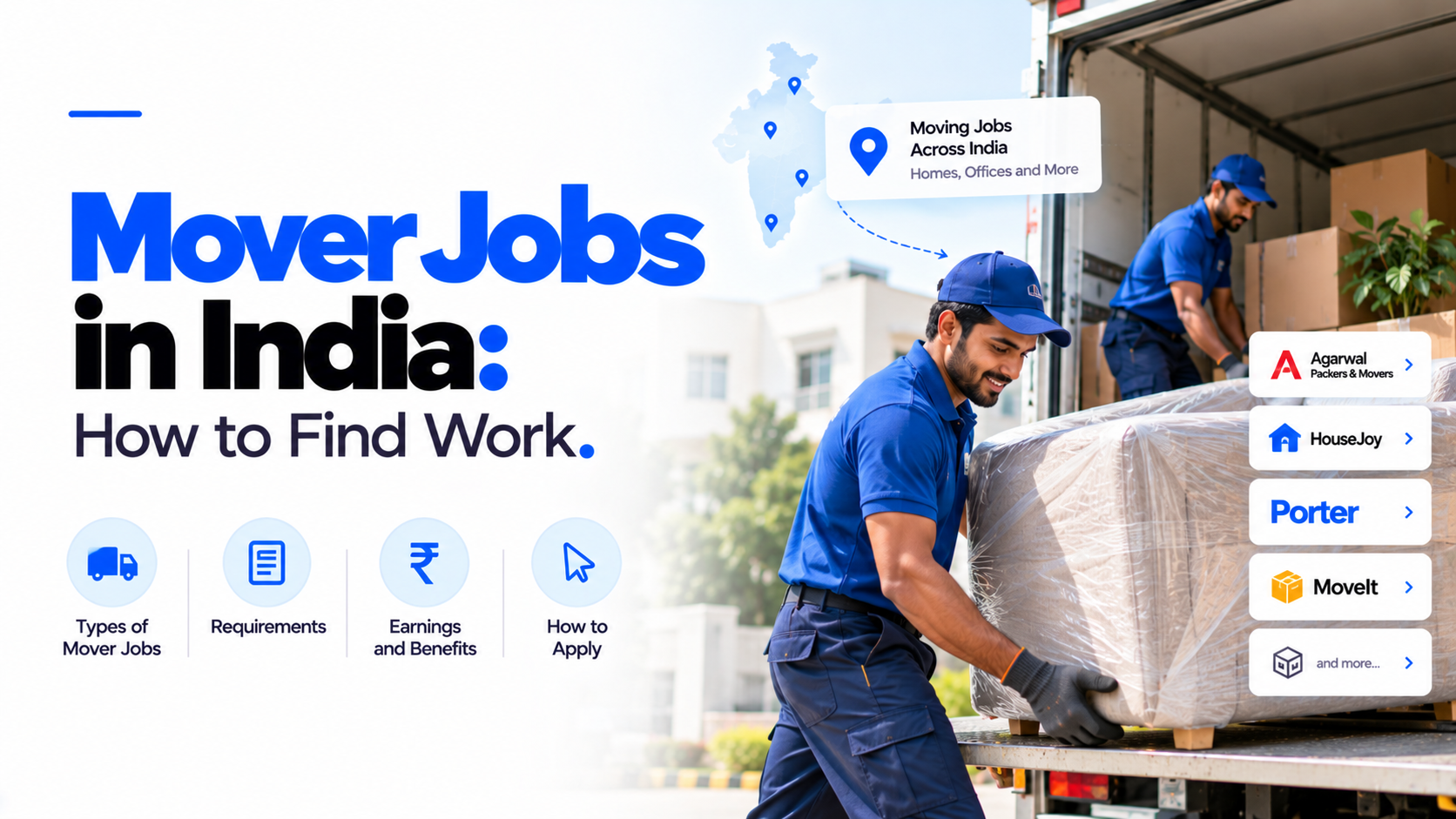
In Shillong, moving day begins with the lane, not the clock. By ten in the morning a three-room flat in Laitumkhrah has folded into boxes: wardrobes wrapped in quilted blankets, books packed flat, the fridge lashed upright at the front of the truck. The lane is too tight for the vehicle to enter, so the last hundred metres happen by hand, one carried piece at a time, while the new flat across town waits with its doors open.
The trade that moves households stays busy for a quiet reason: the country keeps changing addresses. Some of it is new housing - the urban housing mission has crossed another milestone, and every finished house puts a household on a truck. Some of it is work, study, marriage, the search for a fairer rent. None of it is advertised as work for the people who do the carrying, which is why the finding deserves a guide of its own.
Read one working day in the moving trade and the whole road opens: mover jobs in how to find work is a single route with clear stops - what the designation covers, where the seats sit, who signs the movers on, what the trade asks of the body, the papers, the pay patterns, the craft of the wrap and the lift, and the ladder after the first shift.
What the designation covers
Ask what is a mover job and the answer is a household in motion: the mover packs it, wraps it, carries it, loads it, travels with it, unloads it, and places it where the family points. The mover job description on any hiring portal says the same in plainer words - pack household goods with the right material, dismantle and reassemble furniture, load and unload the truck, deliver every piece without a scratch.
Mover duties and responsibilities follow a fixed order, and the order is the day: pack, wrap, carry, place. The household is what the whole day is planned around - a move has two ends, and the truck is the middle of the day. Between the ends sit the small judgments customers remember: the corner padded because the stairwell is tight, the mirror boxed on its edge, the doorway measured before the sofa argues with it.
The designation sits beside the gig families most workers know - it shares the road with delivery and driving without being either, because the goods travel with the household instead of toward somebody's doorstep.The work categories on the hiring site keep the families side by side, and a mover reading them will spot the difference in one line: the load changes address with the people who own it.
Where the moving work sits
Movers and packers jobs divide by distance before anything else. Local shifting is the daily bread - a flat across the city, packed after breakfast and reassembled by dinner. Intercity moving runs the long routes: a household loaded at night and travelling the highway while the family takes the train. Office relocation moves desks and files over a weekend, when the lifts are free and the floors are empty.
The floor beneath the trade is described by two government notes. The statistics office has proposed a dedicated migration survey for July 2026 to June 2027, to measure the extent and patterns of migration along with the reasons behind it,as the statistics ministry's migration note records - every migrating household is a shifting job at one end and an unpacking job at the other. The routes are long and paved: the national highway grid spans 1,46,560 km in the world's second-largest road network,as the road ministry's year-end note records.
City trade keeps its own rhythm: the rented rooms that turn over with eleven-month agreements, the families that upgrade, the offices that expand.The Bengaluru moving desk on the hiring network carries one big city's live listings; every other city keeps its own version of the same three markets, and the movers ride between them all year.
Who signs the movers on
Ask who hires movers in and the employers come in four kinds. National chains with branches across the states hire steady staff and train them in their own packing standards. Booking platforms gather the demand: a customer orders a move on an app, and the platform routes the job to a partner agency or a verified team.
Local agencies are the third kind - the offices near every market that run two trucks and know every lane in town - and the contractors between them fill a festive week's worth of extra hands. The demand side has a number now: more than 1 crore houses have been completed and delivered to beneficiaries under the urban housing mission,as the housing ministry's milestone note records. A delivered house is a truck booked and hands hired - the trade's demand line in one sentence.
The four kinds hire differently. Chains and big agencies keep interview days; platforms onboard through an app and a document check; the local office hires by word of mouth and a trial afternoon. For a candidate the practical meaning is simple: the packing habit travels - learn it at a local office and every kind of employer will pay for it.
What the trade asks of the body
Mover jobs without experience are the normal entry, because the body is the qualification. The trade asks for eighteen years of age, fitness that a trial afternoon will prove, and very little paper - most seats stop at an eighth or a tenth standard certificate, and many ask nothing written at all.
Neither a vehicle nor a licence is asked for the helper seat - the truck belongs to the company, and the tools are issued on joining: gloves, blankets, packing tape, the hand truck. What cannot be issued is the habit the foremen watch for across a newcomer's first days: arriving on time, lifting without drama, treating a stranger's crockery like your own.
There is one variant worth naming: the driver-cum-mover seat, where a licence converts the same packing skill into a better-paid role - the person who drives the truck on the highway and works the load at both ends. It is the trade's most common step upward, and it costs only the licence fee and the practice to reach.
The papers a mover carries
The documents required for mover job joining are light: an Aadhaar card, a bank account in the candidate's own name, a few photographs - and a tenth-standard certificate to settle the age line at the formal chains. Nothing else blocks a start; most local offices put a willing candidate on a truck the same week.
Verification is quick: one biometric check at joining and the name is on the payroll. Just as telling is what the trade never demands - no vehicle papers, no fuel card, no insurance renewals to track, no licence to keep current for the helper seat.
Two papers are worth adding on the candidate's own initiative. An e-Shram enrolment - the register built for unorganised workers, made once, carried everywhere - keeps the worker visible to every welfare window the government opens. And a simple health cover, private or public, earns its premium back the first time a finger gets pinched between cartons.
Paid by the move, paid by the month
Mover salary in arrives by one of two doors, and the door decides the texture of the month. The per-move door: a rate per move or per day of work, settled in cash before the truck returns - local agencies and contractors still pay this way. The monthly door: a salaried seat with a chain or a large agency, landing in the bank on the same date each month.
Each door has its own weather. Per-move pay climbs in the season - month-end and the summer holidays are when households change addresses, and the same mover can work three jobs in a weekend - and thins out when the calendar is quiet, so per-move men register with two or three agencies at once. A salaried seat trades the festive spikes for the guarantee of the quiet weeks.
Tips are real money here, because the work ends inside a customer's home: a careful team is remembered, and the remembering turns into tips. Three questions keep the month honest before the first job - what counts as a full day, what a late-cancelled booking pays, and which evening the money arrives.
How the finding actually happens
How to find work as a mover is a question with a short answer and four doors. The company office is still the front door: chains and big agencies take candidates at their city branches, and a morning spent visiting two or three offices beats a week of scrolling. Booking platforms list mover seats by area and onboard through the app.
The quietest of the four is referral: movers who leave an agency take their phone numbers with them, and the person who packed one house well is the first call when the next booking lands. Employment exchanges and job fairs make the public route, listing mover seats alongside every other trade; the last route is the notice board of the market itself, where local offices still paste their hiring sheets.The finding-work guide on the hiring blog follows one worker's road from the first search to the confirmed seat, and mover seats walk the same path.
However the door is found, the rule is the same: join where the terms are written. The trade serves households, and households complain when promises break - the National Consumer Helpline returned over 105 crore rupees to consumers in fifteen months and addressed 1,66,189 refund-related grievances across 35 sectors,as the consumer department's refund note records. A mover who works for employers that put the quote in writing sits on the right side of that record - and in movers and packers work in, the written quote marks the formal desks apart from the rest.
The craft of the wrap and the lift
The trade has a craft, and packing decides the day. Bubble wrap and corrugated sheets cost the agency pennies and save the customer's glass; a wardrobe dismantled into boards travels safe and is reassembled before the boxes are unpacked. Customers judge a move by two moments - how things left, and how they arrived - and the mover owns both.
Loading is geometry: weight rides low, boxes interlock, and the last piece in is the first piece out at the other end. The safe lift starts in the knees and keeps the load against the body; a turned ankle in a customer's stairwell costs the week's pay. Gloves and firm shoes are not the agency's formality - they are the mover's own equipment.
The craft is also why the trade stays hireable: machines lift pallets, but a staircase, a lane too tight for the truck, a piano on the first floor - these are moved by judgment and hands. The better the packing habit, the fewer the damage calls, and the fewer the damage calls, the longer the agency keeps the mover's number.
The ladder after the first shift
Mover career growth runs on the same engine as the trade itself: trust with households. The first step is the packing standard - movers whose boxes never open damaged get named in reviews. The second is responsibility - the mover who leads a team of three on the bigger houses, quotes the job, and answers the customer's questions.
The third is the licence: the driver-cum-mover seat, then the supervisor's desk at a branch, where the work is planning other people's moves. The fourth is the own-truck step - a used vehicle, a published number, and the trade's oldest truth: households recommend the team that broke nothing.
The seats update daily:the live seats on the hiring site track this week's mover openings,the state-wise list on the hiring site brings the search home to the candidate's state, andthe Shillong delivery page on the hiring network tracks one hill city's hiring week to week.
By evening the same flat is a home again across town - the wardrobe standing in the new bedroom, the fridge humming in its corner, the boxes flattened and gone. The trade that did it appears in nobody's photograph and in every family's memory of the day. India will keep changing addresses - the housing mission's delivered houses, the migration the statisticians measure, the job in the next city - and every change of address is a day's wage for the people who carry it.
For the candidate deciding where to start,the explainer on how the network hires shows how the hiring network joins the worker's search to the employer's opening. The trade asks little paper and pays in a skill that travels with the hands - and the first shift usually begins the way this guide did: one lane, one truck, one household trusting a stranger with everything it owns.