India Gig Hiring Startups: Complete Market Map
A company-by-company roster of India's gig-hiring startups - the marketplaces, the execution firms, the system-of-record software, the verification checks and the layer that funds the work - with the numbers each publishes.
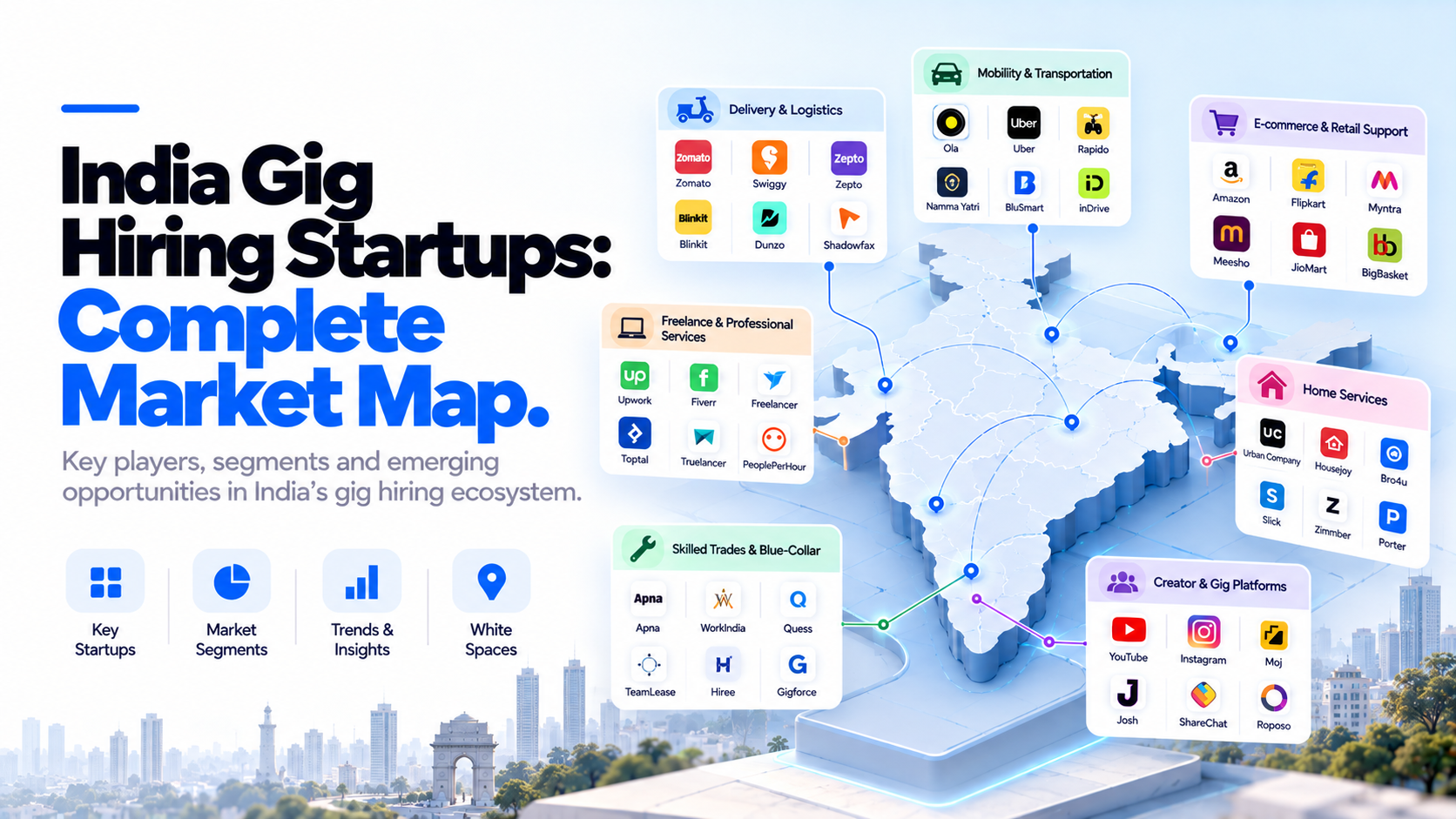
For most of a century the district gazetteer was the closest thing India had to a market map: a bound volume, compiled over years by patient compilers, listing every trade a district practised - who farmed what, who made what, who moved goods, who lent. The compilers were thorough and the presses were slow, and between those two facts lay the volume's flaw: by the time an edition came off the press, the district it described had moved on. Corrected by an errata slip, then out of print, then superseded - that was the natural life of the printed map.
The map of India's gig-hiring side is a different object now. It is not printed, not bound, and it does not age by the season; it is maintained live, daily, by companies whose product is the map itself - the platforms that list the openings, the firms that field crews, the software that keeps the record, the checks that confirm the names, the lenders that bridge the weeks between. Nobody waits for an edition. The edition is a front page that changed this morning.
This is a reading of that living edition: which firms are on it, which layer each occupies, the numbers each publishes, and what each layer changes about how the country hires.
What the map counts
A gig-hiring startup is a company whose product is the match or its management - not the meal, the ride or the parcel those workers move. The consumer platforms at the centre of the story sit outside this map's edge; what sits inside is everything that makes their hiring possible. Read that way, the question of how gig hiring startups work resolves into five layers, every one with a product, a buyer and published numbers of its own.
The five layers follow the order of the hiring week: marketplaces, which list openings and match jobseekers to employers; execution staffing, which fields a crew against a site and a date; the system of record, software that carries a worker from KYC to payout trail; verification, which confirms the name behind every listing; and the layer that funds the work - worker credit, vehicle leases, payroll advances - which sells time rather than matches.
The order matters because each layer sells to the next. A marketplace's listing is only as strong as the verification behind it; a staffing firm's crew is only as manageable as the software under it; the funding layer prices the earnings the first three produce. Reading down the stack is reading the hiring week in the sequence it actually happens.
The marketplaces
Start with the layer most jobseekers have already touched. Blue collar hiring startups host 113 of the 492 platforms the category tracker counts worldwide - second only to the United States at 119, ahead of China at 37; 141 of the 492 have raised, 41 have reached Series A or beyond, and ten were founded in 2026 against a decade average of seventeen a year as the category tracker counts, updated this month.
The dated entries give the roster its texture. WorkIndia, founded in 2015 out of Bengaluru, stands at Series B with $45.6 million raised from investors including Beenext and Asuka Asset Management, its latest round closing on December 18, 2025. Skillbee, founded in 2020 in Delhi, raised $3.56 million at Series A from Vibe Capital, Good Capital and twenty-nine others - its last entry January 2022.
The largest live entry is Apna, which publishes its own counts on its front page: 5 crore-plus active job seekers, more than 1 lakh active jobs across 160-plus departments, 7 lakh-plus companies hiring, a thousand-plus enterprises and 7 lakh-plus MSMEs served, and over 6 crore app downloads. Today's trending roles read like the market's own pulse - 4,267 field-sales openings, 4,093 telecalling, 3,187 delivery, 1,449 logistics and warehouse, 708 drivers as the platform's front page publishes, the entry updates daily.
The execution layer
On demand staffing startups occupy the second layer, and they sell a different thing: not openings but executed work - a crew on a site, a shift roster filled, an audit completed. The buyer is not a jobseeker but an enterprise that needs attendance rather than introductions. This is the staffing layer of gig work hires through when the demand has a deadline attached.
Awign, one of the layer's larger firms, states its own scale plainly: a network of 1.5 million-plus workers, serving nine functions across field and remote work in 1,000-plus cities, with on-field crews - sales executives, in-store promoters, shift-based staffing - beside a remote line of telecalling, transcription and content-moderation work as the staffing firm's own page states, the counts are the firm's.
Execution is where risk changes hands: compliance, delivery and replacement stop being the client's problem. The firm's page carries the marks the layer is judged by - ISO 9001:2015 for quality, ISO 27001:2022 for information security, a 24-hour initiation time - and a deployment that covered 230 cities in 43 days with 27 per cent faster turnaround and 18 per cent lower fixed costs than the vendor it replaced.
The system of record
Gig workforce platforms build the third layer: the software that turns a hired name into a managed record. The stack runs from KYC-based digital onboarding and digitised employee records through attendance, shifts and payroll - gig payroll platforms are the construction the layer is known by - to the trail an auditor can walk years later.
BetterPlace is the layer's reference case. In March 2025 the firm raised Rs 31.9 crore ($3.8 million) of Series D money led by Jungle Ventures, at a valuation the coverage put at roughly $250 million post-allotment - an instalment, two years after a $64 million Series C as the round's coverage records: the platform sells KYC-based onboarding, digitised records, background verification and skill-development training and assessment to more than 1,000 enterprises, Amazon, Ola, Uber, Swiggy and Zomato among them, under co-founder and chief executive Pravin Agarwala.
The layer's economics sit in the same coverage: FY23 revenue of Rs 533 crore against a loss of Rs 132 crore - software sold at scale, still paying to build. It is also the layer where the market's compliance load tends to land, because the record is what a regulator, an auditor or a client's legal team reads first.
The verification layer
Background verification for gig hiring is the fourth layer, and the quietest. Before day one, somebody confirms that the name on the listing has a face, an address, a licence, a clean court record. Every other layer assumes the answer: the marketplace's listing, the staffing firm's deployment, the record's first entry.
The layer is small in revenue and load-bearing in effect. Marketplaces sell trust per listing; execution firms carry the check into every deployment; system-of-record software logs its output where the whole market can read it. The management platforms have begun to bundle the check in-house - BetterPlace's own product list includes background verification - which says where the layer is heading: from a vendor's invoice to a checkbox inside the record.
Think of it as the map's error correction. The gazetteer corrected its misprints with an errata slip after the volume shipped; the verification layer runs the correction before the misprint reaches the street. One bad check propagates through every layer above it - the map's quietest line is the one every other line stands on.
The layer that funds the work
The fifth layer sells time. This is the layer gig worker credit startups occupy: advances against wages already earned, working-capital lines for fleet partners, credit scored on a platform earnings history instead of a payslip. The other four layers sell the match or its management; this one bridges the weeks between signing up and earning steadily.
Its most visible work is hardware. Ev leasing for gig fleets has put vehicles under riders whose savings would not buy one, with the lease priced against the same order stream the marketplace produces. A leased bike converts a jobseeker into a rider in a day; the lease and the earnings stream rise and fall together.
When the layer works, the roster keeps its workers past the first season; when it fails, the thinning shows up everywhere else - fewer riders to dispatch, emptier shifts, softer numbers on every front page above it. The layer the market notices least is the one the market's weekly numbers quietly depend on.
The state of the roster
The dates on the rounds tell their own story. The startups powering gig hiring raise in episodes, not in seasons: the tracker's most recent marketplace entry is WorkIndia's Series B of December 18, 2025; Skillbee's last dated entry is January 2022; BetterPlace's Series D is described in the coverage as part of an ongoing round, two years after the one before it. The gaps between entries are as informative as the entries.
The counts say the same thing at scale: 141 of 492 platforms funded, 41 past Series A, ten founded this year against seventeen a year over the decade. The roster builds by accretion, and the money that feeds it arrives selectively - the occasional deep round re-marking an incumbent while the long tail waits.
Each dated round is a capacity decision with a hiring shadow. A marketplace that closes a round adds cities and tightens its screening; an execution firm that raises extends its worker network; a software layer that raises deepens the record it can carry. A company waiting for money does none of these - and the map, which is the market, simply updates.
What the map changes
An employer reads the map as a purchasing guide. Openings to fill: buy at the marketplace. A crew on site by Friday: buy at the execution layer. Proof of who showed up and what it cost: buy the system of record. Names you do not know: buy verification first. A fleet without vehicles: start at the layer that funds the work. Misreading the need is how hiring budgets arrive late - the map exists so the diagnosis happens before the spend.
The layers converge where the demand is dense the Mumbai page on the hiring network shows one deep market whole - delivery, driver, warehouse and field work posted live, all five layers moving at once - andthe work categories index on the hiring site shows which lines of work each layer of the map serves across the country.
The same convergence is why the map stays live: every layer updates at the speed of its own front page. A printed volume promised completeness; the living edition promises something more useful - currency - and prices it honestly, one refresh at a time.
Using the map
For the worker, the map works as a set of doors, and the order of trying them matters less than starting through one the jobseeker's walkthrough on the hiring blog opens the search step by step;the openings list on the hiring network lists the seats open today;the locations shelf on the hiring site shows how far the map reaches, state by state.
Depth shows in single markets the Bengaluru demand page on the hiring network is the deepest single entry - one city where every layer of the stack moves daily. The practical habit the map suggests: pick the layer, then the city, then the day. The printed gazetteer made you read the whole district to find your trade; the living edition lets you start with your trade.
For the employer the same pages read as reconnaissance: what the demand cities carry, what the openings look like today, how the competition describes the same job. The map is the market's own documentation, and unlike most documentation it stays current, because the companies on it are competing on it.
The gazetteer's compilers accepted a flaw they could not fix: by press day, the district had moved. The living edition's flaw is the reverse - it never stops moving - and the fix was a business model. The map is maintained by the parties that benefit from being found on it.
The companies behind gig hiring are that maintenance crew; their incentives and the map's accuracy point the same way, which is why this edition does not age like the printed one the employer's playbook on the hiring blog carries the employer's side of the same market. Read the map before you hire through it, or before you sign up on it - the reading is the whole discipline.