India EV Driver Hiring Ecosystem: Market Intelligence Report
Who hires India's electric drivers, how the hiring funnel works, what the jobs pay, and the rental, swapping and skilling rails beneath them.
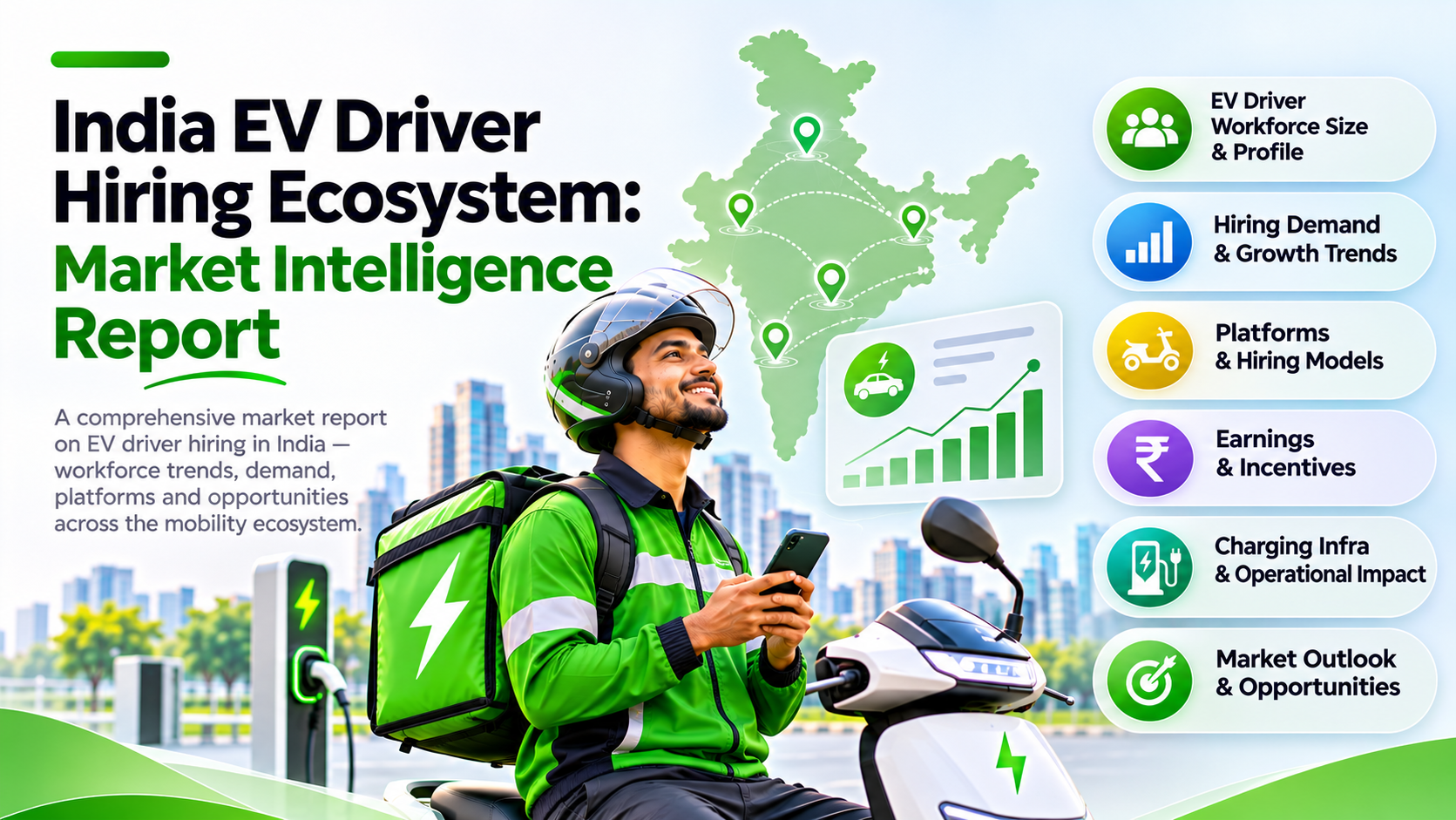
India's driver labour market is being rebuilt around the plug, and the hiring is already visible. The platform workforce that ride-hail and delivery companies recruit from reached about 12 million workers in FY25, up 55 per cent from 7.7 million in FY21, according to Economic Survey 2025-26 data ([swadeshi]). Into that pool, electrification has introduced a new cast of employers: cab companies that own their fleets and pay fixed salaries, leasing firms that hand a driver a car and a route to ownership, rental platforms that turn a scooter into a job, and e-commerce giants converting their delivery seats to electric.
Earlier instalments in this series measured the delivery workforce, the hiring machine behind it, fleet economics and the EV jobs market's demand side. This report stays with the driver: who actually hires EV drivers, how the funnel runs from Aadhaar verification to the first paid trip, what each pay model delivers, how drivers access vehicles without buying them, and which risks — platform collapse, repossession, gender exclusion — sit underneath the ecosystem.
1. The snapshot: a driver market converting to electric
The conversion is being driven by clockwork, not sentiment. Delhi's transport department ordered in November 2023 that aggregators' four-wheeler fleets reach 5 per cent electric within six months, 50 per cent within three years and 100 per cent within five ([delhimandate]) — a ladder that turns every deadline into a hiring wave, because an electric cab needs an onboarded driver no matter how a platform staffs the rest of its fleet. Comparable pressure runs through two-wheelers, where delivery and bike-taxi fleets electrify fastest.
E-commerce commitments compound the effect. Amazon India crossed 10,000 electric vehicles in its delivery fleet by September 2025, part of a 100,000-EV global target for 2030 ([amzmag]); those vehicles were already running deliveries in 500 Indian cities as of December 2024 ([amzdrive]). Flipkart expanded to 10,000 EVs by November 2024 on a pledge to go fully electric by 2030 ([electrive]). Every converted seat must be filled by a driver who is verified, briefed on range and charging, and onboarded through a funnel the petrol era never needed.
2. Who hires EV drivers: five employer archetypes
The first archetype is the platform-owned fleet, and 2026 supplied its biggest test case. Green SM, backed by Vietnam's VinFast, launched in Delhi-NCR on June 5 with about 1,000 VinFast Limo Green electric SUVs and plans to scale to 10,000 vehicles in the region ([et]); industry trackers expect the fleet to reach 15,000 by the end of the year, with Bengaluru and Hyderabad next ([autopunditz]). The model is fleet-owned and company-managed — cars, drivers, charging discipline and vehicle uptime controlled by the operator, with fixed driver salaries instead of pure commission work ([autopunditz]). Recruitment runs through the company's own driver-partner community portal, backed by a dedicated driver hotline ([greensm]). Evera, the Delhi-based electric cab service founded in 2019, sits in the same camp: unlike most ride-hailing companies it employs full-time drivers rather than gig workers, so drivers cannot cancel rides because they are paid to complete them ([inc42list]).
The other four archetypes share the market between them. Fleet management companies hire drivers in volume for platforms: Everest Fleet, India's largest with 23,500-plus vehicles across seven cities since 2016, offers drivers the car, insurance and permit to drive on Uber, weekly payouts, a path to ownership and advertised earnings of up to Rs 40,000 a month ([everest]); Uber's pledge of 25,000 electric vehicles across seven cities rides on fleet partners Lithium, Everest and Moove ([uber]). EV-as-a-service platforms such as Zypp Electric run 25,000-plus EVs with 23,000-plus pilots and a stated mission of 5,00,000 vehicles ([zypp]). E-commerce fleets hire and train directly as they electrify ([amzmag]). And inclusion-first fleets are emerging as a fifth type: inDrive partnered with Evera in July 2024 to field an EV fleet operated solely by women under its DrivingNaari programme ([drivingnaari]).
3. The hiring funnel: from Aadhaar to first trip
The funnel starts on blue-collar job boards and ends at a hub. A WorkIndia listing for a Green SM cab driver in Gurgaon advertises Rs 30,000-37,000 a month, eight-hour fully flexible shifts and walk-in interviews six days a week ([workindia]) — evidence that EV cab employers now recruit through the same mass-market channels as any large employer. Companies also run direct recruitment: Green SM's driver-partner community page invites applicants to join its first cohort of pioneering drivers, supported by a dedicated driver hotline ([greensm]).
Onboarding itself has become a product. Bounce Daily's Android app handles Aadhaar verification, document upload, plan selection, payment, pickup and renewals, so a rider can begin delivery work the same day ([bounce]). The licence gate is tiered: the high-speed variant, a 55 km/h scooter with 70 km of range, requires a driving licence, while the low-speed variant — 25 km/h with 85 km of range — does not, and hubs offer licence assistance for a nominal Rs 200-230 ([bounce]). Formal training is thin but institutionalising: the Automotive Skills Development Council, set up in 2011 by the government together with SIAM, ACMA and FADA, runs e-learning that covers EV basics and commercial vehicle driving ([asdc]).
4. Pay models: what EV drivers actually earn
Pay now runs on three distinct architectures. The first is the fixed salary. Green SM's Gurgaon listings sit at Rs 30,000-37,000 a month ([workindia]); BluSmart, before its collapse, paid salaried cab drivers Rs 2.6-3.7 lakh a year — about 13 per cent below the average Indian cab driver wage, which is the price of a company car and predictable pay ([ambitionbox]). Salaried EV driving trades upside for stability, and the market prices that trade openly.
The second is lease-and-drive, where earnings depend on trips: Everest advertises up to Rs 40,000 a month with weekly payouts ([everest]), and Moove's drive-to-own contracts run on weekly instalments — one Mumbai driver paid Rs 5,500 a week per car over four years until the vehicle became his ([row]). The third is pure gig on a rented EV: Zypp delivery pilots report Rs 25,000-35,000 a month ([alphareach1]), while e-auto owner-operators gross Rs 40,000-60,000 a month per vehicle and hired drivers pay the owner Rs 300-500 a day in rent ([eauto]). Across the gig band, the EV dividend arrives as cost avoidance rather than a wage premium — with petrol spend eliminated, riders keep nearly all of their gross payouts as net earnings ([alphareach2]).
5. The vehicle access layer: rent, lease, drive-to-own
Vehicle access is the gate that decides who gets to be an EV driver, and rental subscriptions are the volume on-ramp. Commercial EV fleets rent at roughly Rs 130-220 a day with refundable deposits of Rs 500-2,500, maintenance and battery swaps bundled in; Zypp's cargo subscription runs about Rs 4,200-5,200 a month with unlimited swaps at partner hubs, and low-speed scooters need no licence at all ([alphareach2]). Bounce Daily bundles insurance, GPS tracking, anti-theft support and breakdown help into every rental, and swaps a faulty vehicle at a hub in minutes ([bounce]).
Drive-to-own turns the rental into an asset. Moove finances vehicles exclusively for Uber drivers — apply, get verified, start driving within five days — and commits to a 50 per cent female customer base and a 60 per cent clean-energy fleet ([moove]); its India operation is profitable, though reporting on vehicle recovery shows the model's hard edge, with the company saying repossessions affect fewer than 5 per cent of Indian customers ([row]). Fleet recycling moves jobs around too: after BluSmart's collapse, Evera bought about 220 of its EVs and plans to take up to 1,000, absorbing the fleet and driver network ([inc42evera]), while early-stage money keeps flowing into gig-worker mobility — Baaz Bikes raised $2 million for electric micro-mobility aimed at gig workers ([inc42list]).
6. The support stack: charging and swapping as hiring infrastructure
An EV driver's earning day is a battery-management day, which makes charging infrastructure a hiring asset. Sun Mobility's joint venture with Indian Oil plans to scale to 10,000 battery-swapping stations across more than 40 cities ([sunmob]), and Bangalore's metro authority is installing swap stations at 69 metro stations — in parking areas and auto stands — for two- and three-wheelers ([bmrcl]). Fleets build on the same rails: Zypp's operations run with battery-swapping partners such as Gogoro and Sun Mobility ([zypp]), and Bounce hub swaps exist precisely to cut charging downtime during peak delivery windows ([bounce]).
The hiring logic is simple: uptime equals income. A two-minute swap preserves the full-day shift that makes electric delivery work pay; a long charge does not. That is why fleet employers site hubs and swap points where demand lives — near metro stations, markets and dark-store clusters — and why the geographic spread of swap networks now effectively draws the map of where EV driver jobs open next.
7. Skilling and inclusion: the women-driver gap
The women-driver gap is the ecosystem's most measurable exclusion. Women hold only 6.3 per cent of driving licences issued in India as of March 2020, and just 2 per cent of women receive formal driving lessons against 8 per cent of men; The Urban Catalysts' WE2 research adds finance, training and safety barriers specific to electric two-wheelers ([women]). A hiring ecosystem built on licences and vehicle access inherits that gap unless it actively intervenes.
Interventions are arriving from three directions. Employers are building dedicated seats: the inDrive-Evera DrivingNaari fleet puts women behind the wheel of an all-electric taxi service ([drivingnaari]), and Moove commits to a 50 per cent female customer base ([moove]). Funders are targeting the pipeline: Shell Foundation's partnership with Zypp Electric, announced in October 2025, supports transporter livelihoods, EV rental solutions and women's EV adoption ([shell]). And the skilling layer lowers the entry barrier: ASDC's short e-learning courses give a first-time driver a certificate route into EV work without a formal degree ([asdc]).
8. Risk register and the 2027 outlook
BluSmart is the ecosystem's stress test. In April 2025 the company — which claimed India's largest all-electric ride-hailing fleet of more than 8,000 cars — halted services in Bengaluru, Mumbai and Delhi after the market regulator alleged fund diversion by its founders ([bbc]). Salaried drivers lost their employer overnight; the partial rescue came through Evera's acquisition of about 220 BluSmart EVs, with plans to absorb up to 1,000 ([inc42evera]). The lesson cuts both ways: the salary model concentrates risk on the company's balance sheet, while rental-and-gig models shift it onto the driver.
Beyond platform failure, the sharpest edge for individual drivers is drive-to-own debt: repossession follows missed instalments, however small the reported share ([row]). Meanwhile the demand clock keeps tightening. Green SM's fleet plan runs from 1,000 cars towards 10,000 in Delhi-NCR ([et]) and 15,000 by year-end ([autopunditz]); Delhi's aggregator mandate climbs its 5-50-100 ladder to 2030 ([delhimandate]); and Green SM itself is weighing a hybrid driver model that mixes company cars with externally attached drivers ([et]). Between now and 2027, expect EV driver hiring to arrive in waves — pegged to mandate deadlines, fleet funding rounds and swap-network buildouts.
The bottom line
Read as a market, India's EV driver hiring ecosystem is five employer types, three pay models and one shared infrastructure layer. Its measurable edges: a 12-million platform workforce to draw from ([swadeshi]); Green SM scaling from 1,000 cars towards 10,000-15,000 salaried seats ([et]; [autopunditz]); Everest's 23,500-vehicle, seven-city hiring machine ([everest]); Zypp's 23,000-plus pilots on rented EVs ([zypp]); and Amazon's 10,000-plus electric delivery vehicles ([amzmag]).
For drivers, the rental on-ramp is the fastest entry, salaried seats at Rs 30,000-40,000 a month are scarce but real, and drive-to-own is an asset with a repayment schedule attached. For employers, funnel speed and uptime — Aadhaar-to-first-trip in a day, battery swaps in minutes — now decide who scales. India is effectively running three employment experiments — salaried, leased and gig — on the same electric vehicles, and the pay models drivers actually accept will settle which mix wins.