Hindi, English and Local-Language Phrases for Delivery Partners in a New State
Moving to a new state as a delivery partner means new roads, new pincodes - and often a language you did not grow up speaking. This guide gives you the phrases that actually get used on the job: a Hindi starter pack, service English, digit-by-digit number habits, and local-language.
1. Why language is part of the job
India runs on many languages, and the government's own statement counts them: 'At present, the Eighth Schedule consists of 22 languages' covering Assamese to Dogriper the Home Ministry's statement in Lok Sabha. Research on migrant platform work puts the problem plainly: language barriers are documented as a major hurdle for migrants looking for work, while gig platforms soften them - their apps come in a variety of languages and let workers complete the job with far less verbal communication (findings published through the US National Institutes of Health's research library). The app speaks many languages; the door still does not. Gatekeepers, customers and one nervous phone call remain stubbornly verbal.
And the friction is not hypothetical. A Bengaluru customer publicly complained about being sent a rider who was 'neither speaking nor understanding Kannada, not even English'as Moneycontrol reported - and in an earlier incident that made national news, a Zomato agent who told a Tamil Nadu customer to 'learn Hindi' was fired, and the company apologised in Tamil, opening with 'Vanakkam Vikash'as The Independent documented. The numbers explain why: Census 2011 put Hindi's mother-tongue share at 43.63%as the Times of India reported from the official language data - meaning most Indians' first language is something else. If you are moving states anyway, start from the pincode, not the language:GigKaro's pincode-wise gig search shows what is hiring where you plan to land, and the phrases below handle everything after that.
2. The Hindi starter pack
Hindi is the widest first language in the country and a workable bridge across much of the north, centre and west - as long as you offer it politely rather than assume it. Your work sentences: Greeting: 'Namaste' or 'Namaskar' works everywhere Hindi does, with a nod. On the phone, open with the one word every Indian customer recognises: 'Delivery'.
The five sentences you will use daily: 'Ye raha aapka order' (here is your order); 'Kripya yahin rukiye' (please wait here); 'Kripya apna OTP batayein' (please share your OTP); 'Kripya flat number batayein' (please tell me your flat number); 'Main gate par hoon' (I am at the main gate).
Repair phrases - the ones that save bad moments: 'Maaf kijiye' (sorry); 'Shukriya' or 'Dhanyavaad' (thank you); 'Mujhe Hindi thodi aati hai' (I know a little Hindi); 'Kya aap English bol sakte hain?' (can you speak English?); 'Thoda dheere boliye' (please speak slowly). Admitting the gap early flips most customers into helper mode.
Building words: upar / neeche (up / down); baayen / daayen (left / right); seedha (straight); peeche / saamne (behind / in front); gate; chowkidaar (watchman); lift; seedhi (stairs).
Numbers ek se das: ek, do, teen, chaar, paanch, chhe, saat, aath, nau, das - and shunya for zero. Numbers are the highest-value vocabulary in this whole guide, because the next section shows why digits decide your day.
3. Service English that always works
English is the second official working language of Indian business, and it travels: restaurant counters, mall security desks, corporate receptions and a large share of app customers will take it. Short beats fluent. Learn these eight lines exactly: The eight lines: 'Your order is here.' / 'Please share the OTP.' / 'I am at the gate - please come down.' / 'Two minutes, please.' / 'Where should I keep it?' / 'Please write your flat number in the chat.' / 'Sorry, I am new to this city - please say it slowly.' / 'I will call you from this number.' Every line is under ten words on purpose: short sentences survive bad phone lines and loud lobbies.
Two habits make English work harder. First, keep numbers, street names and order codes in English on both sides - they are the parts nobody translates well. Second, put anything the customer must act on into the app chat as well ('Please write your flat number in the chat'), because written text can be re-read, shown to a watchman, and understood when the call quality drops. Spoken words evaporate; chat text is a record you can point at.
4. Numbers, pincodes and addresses
You will rarely need to discuss politics in your new state - you will constantly need to say and hear digits: flat numbers, floor numbers, phone numbers, OTPs. Make digit-by-digit your default accent in every language: say 'paanch - do - shunya' for 520, not 'five hundred twenty', and ask the customer to confirm by repeating back the last two digits. When voice keeps failing, switch mediums and type it: 'OTP chat mein likhiye' (write the OTP in chat) or in English, 'Please type it in the chat.'
The habit is worth drilling because platforms price failed handoffs. Ekart's own FAQ gives an undelivered parcelthree delivery reattempts before it is marked for return - every botched door conversation is a repeat trip out of your own time. A landmark check closes the gap: confirm the door against a fixed reference ('main gate ke paas?', 'near the lift?') before you hang up, and write down your own delivery-area words once - your locality's name as locals say it, the bus stop, the market - then reuse them in every call. Addresses in India are landmarks first and numbers second; locals navigate by both at once.
5. South India phrase cards: Tamil, Telugu, Kannada and Malayalam
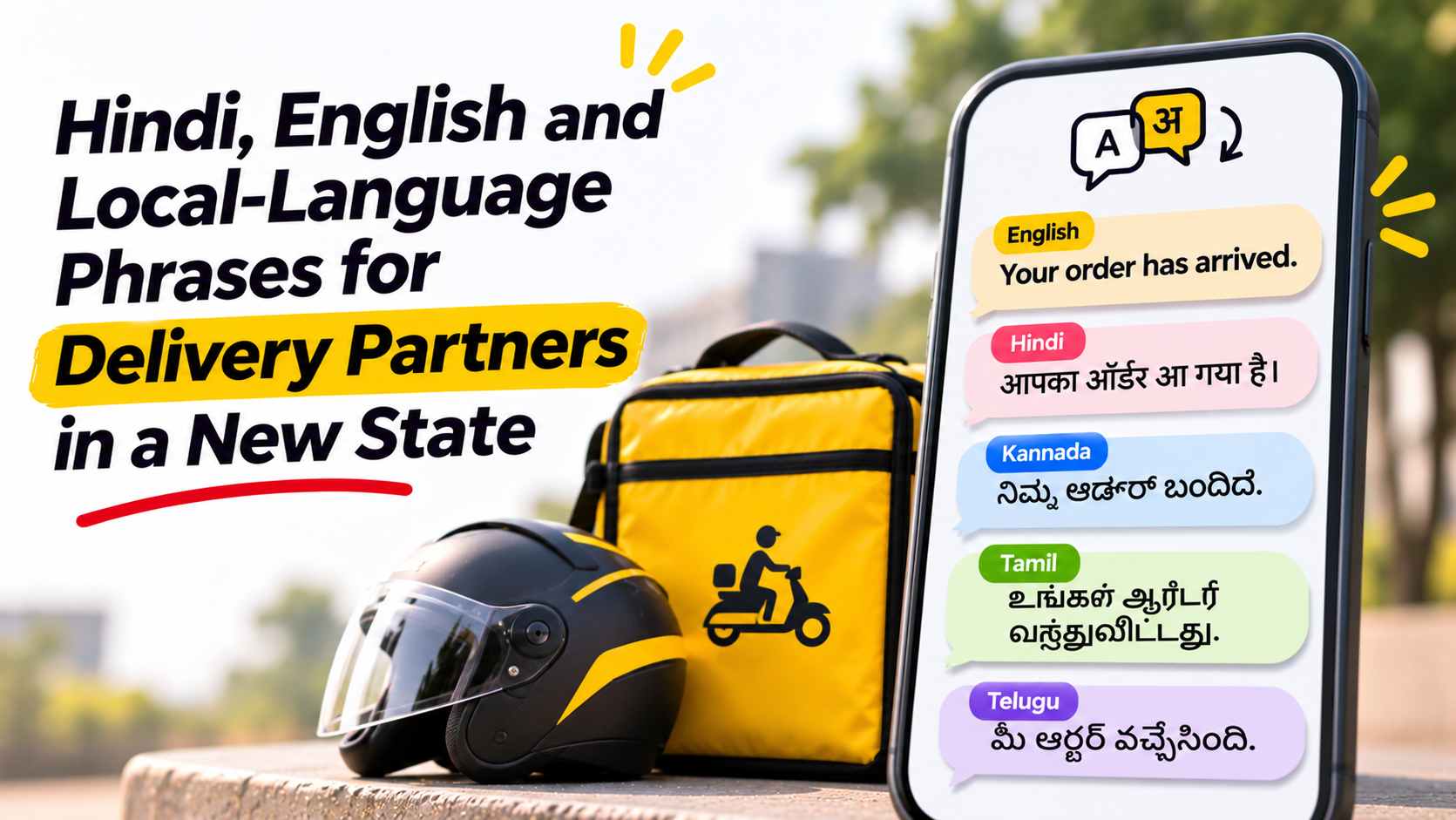
All four languages below are among the Constitution's scheduled listin the government's Eighth Schedule statement, and each dominates the states where most quick-commerce dark stores and food peaks now sit. Learn one card per state you ride in - six lines each: Tamil (Chennai and Tamil Nadu): Vanakkam (hello); Nandri (thank you); Mannichuvidam (sorry); 'Tamil teriyillai' (I don't know Tamil); 'Unga order ithu' (here is your order); 'Konjam wait pannunga' (please wait a bit); vaasal (door).
Telugu (Hyderabad, Andhra Pradesh): Namaskaram (hello); Dhanyavadalu (thank you); Kshaminchandi (sorry); 'Telugu raadhu' (I don't know Telugu); 'Order ikkada undhi' (the order is here); 'Konchem wait cheyandi' (please wait); talupu (door).
Kannada (Bengaluru and Karnataka): Namaskara (hello); Dhanyavada (thank you); Kshamisi (sorry); 'Kannada gottilla' (I don't know Kannada); 'Nimma order illi' (your order is here); 'Swalpa wait maadi' (please wait); bagilu (door). The 'gottilla' line matters in Bengaluru specifically - the city runs on Kannada-first expectation and migrant labour, which is exactly why the language-row stories start there.
Malayalam (Kerala): Namaskaram (hello); Nanni (thank you); Kshamikkanam (sorry); 'Malayalam ariyilla' (I don't know Malayalam); 'Ningalude order ivide' (your order is here); 'Kurachu kaath irikkoo' (please wait a bit); vaathil (door).
One pattern opens every door in all four states: greeting, then the 'I don't know (language)' line, then your English work sentence. Three short sentences, in that order - respect first, honesty second, business third. That order is the whole lesson of the Bengaluru and Zomato stories in section 1.
6. West and East phrase cards: Marathi, Gujarati, Bengali, Odia, Punjabi
Five more cards for the west and east - every language below sits in the sameEighth Schedule list of 22: Marathi (Mumbai, Pune, Nagpur): Namaskar (hello); Dhanyavaad (thank you); 'Mala Marathi yet nahi' (I don't know Marathi); 'Tumcha order itha' (your order is here); 'Thoda wait kara' (please wait).
Gujarati (Ahmedabad, Surat, Vadodara): Namaste (hello); 'Kem cho?' (how are you - the natural icebreaker); Aabhar (thank you); 'Maru Gujarati avtu nathi' (I don't know Gujarati); 'Tamaru order ahi chhe' (your order is here); 'Thodi vaat raho' (please wait a moment).
Bengali (Kolkata and West Bengal): Nomoshkar (hello); Dhonnobad (thank you); 'Ami Bangla bujhi na' (I don't understand Bengali); 'Apnar order ekhane' (your order is here); 'Ektu wait korun' (please wait a bit).
Odia (Bhubaneswar and Odisha): Namaskar (hello); Dhanyabad (thank you); 'Mu Odia jani na' (I don't know Odia); 'Au order ethi' (the order is here).
Punjabi (Delhi NCR, Ludhiana, Amritsar): Sat Sri Akal (the greeting); Dhanwaad (thank you); 'Mainu Punjabi thodi aundi hai' (I know a little Punjabi); 'Tuhada order ethe' (your order is here).
In the biggest metros the languages stack on the same staircase: a Mumbai drop can start in Marathi ('Namaskar'), fall back to the Hindi line ('Ye raha aapka order'), and finish in English ('Please share the OTP'). That three-layer fallback - local greeting, Hindi sentence, English instruction - is the single most reusable skill in this guide, and it works the same in Kolkata, Ahmedabad and Delhi.
7. Calls, gatekeepers and OTP moments without a shared language
Phone calls are where language gaps do real damage, so run a script. Open with 'Delivery' - the word is understood pan-India. Then the order code or flat number digit by digit. Then 'two minutes'. Then stop talking and let the other person work. If the customer's language defeats the call, move to the chat: 'Please type it in the chat' works in every state, and written digits survive accents.
With security guards and reception desks, three lines carry most visits: 'guest entry hai' (this is a guest entry), 'register mein likhiye' (please write in the register), 'sir/madam ke liye delivery hai' (this is a delivery for sir/madam) - or in English: 'Delivery for flat 704, may I sign the register?' Hold your phone screen with the order photo facing out; a screenshot answers half the questions a lobby can ask.
For everything else, carry the pocket interpreter: Google Translate. Its listing promises 'Translate between 108 languages by typing', 'Tap to Translate: Copy text in any app and tap the Google Translate icon to translate', instant camera translation across 94 languages for signboards, offline translation in 59 languages for basement drops, and'Conversations: Translate bilingual conversations on the fly (70 languages)' - plus a Phrasebook to 'star and save translated words and phrases for future reference', which is where your five-sentence card from sections 5 and 6 should live.
8. Set your apps to the language you think in
The platforms have already built for multilingual riders - claim it. Porter's driver app advertises'Training videos in multiple local languages', and Zepto's onboarding flow starts with 'Complete Online Training'per its rider app listing - pick the training and support language you actually understand rather than the one you think you should know. Onboarding you skimmed in an unfamiliar language is onboarding you will pay for later at a dark-store pickup.
Navigation should speak your language too: Google's help page gives the path - profile picture, Settings, Navigation settings, Voice selection - and says to 'select a voice and language'for turn-by-turn directions. The national direction is the same: the government's latest language-technology backgrounder highlights'Support for all 22 scheduled languages through AI platforms like Bhashini and BharatGen', with translation models being built for every scheduled language - the public infrastructure is converging on exactly the multilingual layer this guide asks you to use.
9. FAQ: language questions delivery partners ask
Do I need to know the local language to get hired? No formal requirement stands between you and the work: research on platform labour documents that gig apps come in a variety of languages and reduce the need for verbal communication, and platforms train in local languagesas Porter advertises. But hiring is not the same as thriving - the six-line cards in sections 5 and 6 are what make doors open smoothly once you start.
Is Hindi enough everywhere? No. Census 2011 put Hindi at 43.63% of mother tonguesper the Times of India's report on the official data, so a majority of Indians speak something else first - and the Bengaluru complaint about a rider with 'neither Kannada nor English'reported by Moneycontrol shows what assuming otherwise costs. Learn the state greeting first, then fall back.
Is Hindi the 'national language'? The Constitution names none. The government's own statement covers the 22 scheduled languages and Article 344(1)'s 'progressive use of Hindi for official purposes of the Union'per the Home Ministry's Lok Sabha statement - and the Zomato incident, where an agent's 'learn Hindi' line triggered a national backlash and a Tamil apology, shows exactly why the assumption misfires on the jobas The Independent documented.
What if the customer and I share no language at all? Layer the tools: type in the app chat, hold up the order screen, say digits one by one, and use Translate's live mode - 'Conversations: Translate bilingual conversations on the fly (70 languages)'per the app listing. Point the camera at signboards for the 94-language instant translation when the building itself is labelled in the local script.
How do I keep the phrases fresh? Star your work sentences in Translate's Phrasebook - the listing describes saving 'translated words and phrases for future reference'on the app listing - repeat back every digit you hear, and say the local greeting to the security guard on your first visit each day. Two weeks of that routine beats two months of passive listening.
Does any of this actually change my earnings? No official rate card prices politeness - but the cost of failed handoffs is measurable: Ekart grantsthree delivery reattempts before a parcel returns, and every reattempt is a trip you make again for the same pay. Fewer confused doors, fewer repeat trips, cleaner completion rates - the phrase card is the cheapest efficiency you will buy this year.
10. The first-week language checklist
Day 1 - the trio and the digits: greeting, thank you and sorry in your new state's language; numbers to ten in Hindi. That is the whole first assignment.
Day 1 - the pocket card: write your three scripts in three languages - arrival call, OTP line, keep-at-door line - Hindi, the local language, English. Paper survives dead batteries.
Day 2 - the apps: set Maps voice to the language you think in under Navigation settings; choose your training and support language in the platform app; star five phrases per state in Translate's Phrasebook.
Day 3 - the people: use the greeting with the security guard; use the 'I don't know (language), one minute' line the first time you need it - out loud, on purpose; run digits one-by-one on every call.
Every drop after: repeat back the flat number before you hang up, confirm one landmark ('near the main gate?'), and thank the customer in the local word before you leave. The last word of every delivery is remembered.
Between shifts: the language stack earns inside the pincode you ride -search gigs pincode-wise on GigKaro to make sure your new state pays you back for the learning curve ner, local language, gig work, new state