The EV Workforce of India: Drivers, Delivery Partners and Fleet Workers
Who actually powers India's electric mobility shift — and what the job pays, costs and promises.
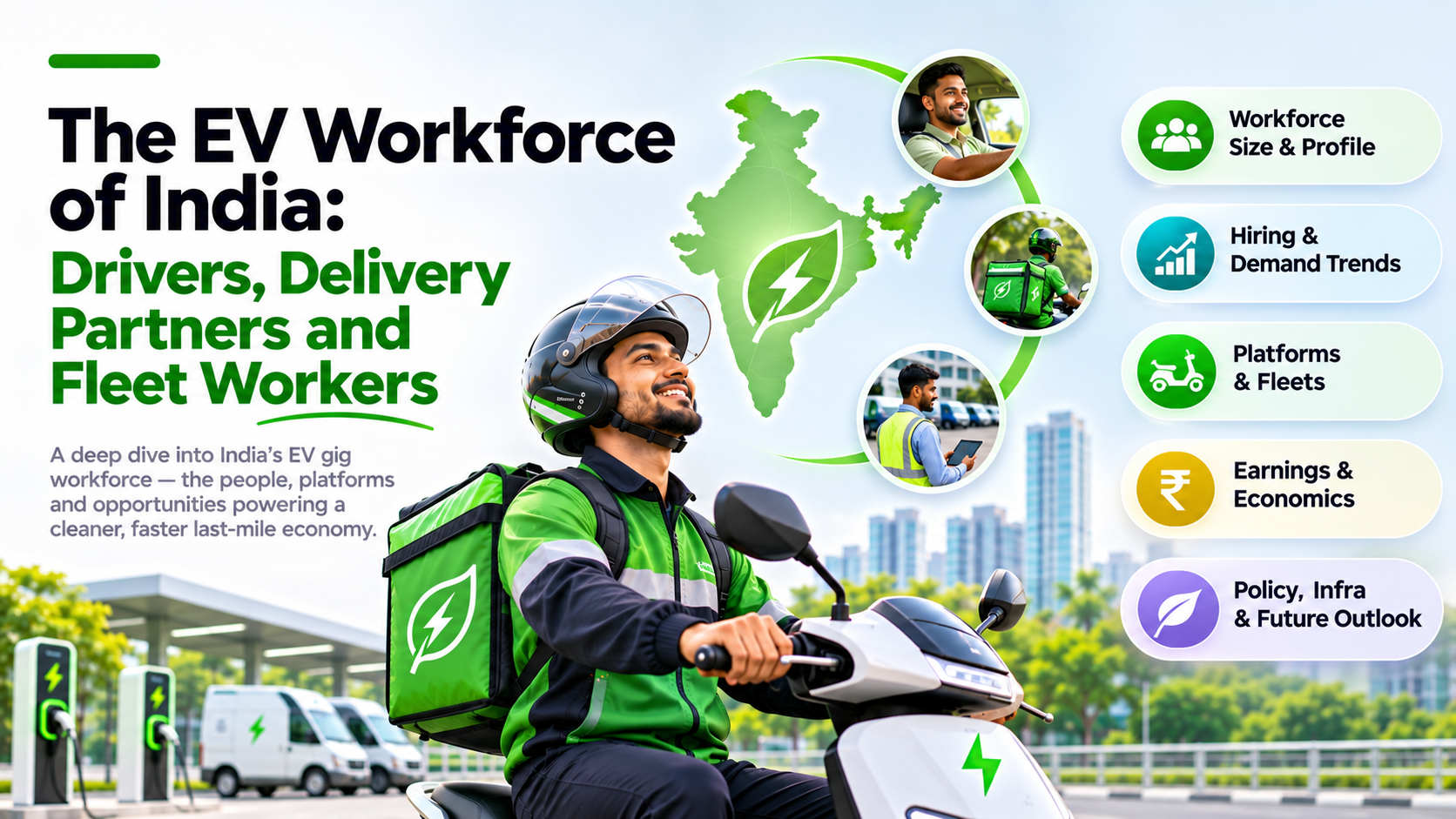
Every electric vehicle sold in India arrives with a job attached. In September 2026 alone, the country registered about 3.33 lakh EVs, with nearly 50,000 of them higher-speed electric three-wheelers (finology);EV registrations nearly doubled year on year in the quarter just ended. Behind each of those numbers sits somebody's working day — the e-rickshaw puller charging his batteries at a roadside kiosk, the delivery partner on a rented scooter, the salaried cab driver in a company-owned EV, the woman running a battery-swap station, the technician servicing packs, the factory operator building the vehicles themselves.
Our series has previously measured the delivery workforce, the hiring machine behind it and the EV market it is moving onto. This instalment profiles the people: who counts as India's EV workforce, how the biggest blocks earn, what the new fleet and charging jobs look like, who is entering the sector, and what the BluSmart collapse taught everyone about security in an electric livelihood.
1. Counting the crew: what the EV workforce is
The EV workforce is best understood as five overlapping circles. First, drivers — millions of e-rickshaw, e-auto and e-cab operators. Second, delivery and ride-hail partners who work on rented or financed electric two-wheelers. Third, fleet and depot workers — charging, cleaning, parking, routing and maintaining vehicles for operators. Fourth, energy workers: battery-swap station partners, charge-point operators and field electricians. Fifth, the industrial workforce that assembles vehicles, packs and chargers, and services them after sale.
The scale estimates are large and still softening at the edges.Adecco India projects the EV industry could create 30-40 million jobs by 2030 across battery manufacturing, charging infrastructure, fleet operations and software — with EV-sector roles paying roughly a 45 per cent premium over comparable jobs.The Climate Policy Initiative's mobility-jobs outlook (January 2026) projects EV sales of 44-59 million units by FY2047 and millions of jobs across assembly, component manufacturing and operations. Against those projections, the here-and-now anchor is humbler: India's roads already carry an estimated2.4 million battery-powered e-rickshaws, each one a self-created job — andNITI Aayog projects the wider gig workforce, the EV workforce's closest cousin, to reach 2.35 crore by 2029-30.
2. E-rickshaw and e-auto drivers: the biggest bloc, the thinnest cushion
The largest EV occupation in India never appears in corporate headcounts. The estimated2.4 million e-rickshaws are owned or rented by drivers who found the vehicles, batteries and charging points themselves, in an ecosystem that grew almost entirely outside formal employment. The economics are real but fragile: research and reporting consistently place earnings in the range of a few hundred rupees a day, with no paid leave, no insurance and vehicle finance as the biggest fixed cost.A woman e-rickshaw driver in Tinsukia told Behanbox her daily income hovers around Rs 600 — and that a trip to the doctor means a day's wages simply gone.
What would change the bloc's fortunes is formalisation from two directions. Scheduled bus operations are one:the PM e-Bus Sewa scheme is deploying 10,000 electric buses across 169 cities on public-private contracts with ten-year operations support, anddedicated e-bus training programmes — covering driving, energy management and depot safety — have been designed to turn informal drivers into certified operators. Individual ownership is the other: cheaper electric autos and better financing convert renters into owners, which is where the biggest jumps in driver income historically happen.
3. Cab and bus drivers: schedules, salaries and the new fleets
The fully electric professional driver is a newer Indian occupation — and 2026 made it mainstream. The regulatory foundation was laid back in2019, when India ordered ride-hailing platforms to electrify 40 per cent of their fleets by 2026.Uber launched Uber Green in Delhi, Mumbai and Bengaluru in June 2023, tied its global commitment to a zero-emission fleet by 2040, lined up fleet partners Lithium, Everest Fleet and Moove to deploy 25,000 EVs across the top seven cities, and signed an MoU with SIDBI for Rs 1,000 crore of low-interest loans so fleet partners can buy electric.
The newest entrant has gone further:VinFast-backed Green SM launched its all-electric Green SM Limo taxi service in New Delhi in June 2026, operating seven-seater VinFast Limo Green vehicles with a company-operated fleet anda dedicated driver centre that recruits and trains what it calls pioneering driver partners. For drivers, the difference between these models matters more than the badge on the bonnet: a company fleet offers a salary, training and a maintained vehicle, while platform-plus-loan models offer independence with instalments. Both are expanding exactly where the demand is — airports, business districts and the growing set of customers who filter for electric rides.
4. Delivery partners on electric: the rented-vehicle workforce
The quick-commerce boom has quietly built India's largest rented-EV workforce.Blinkit counted roughly 50,000 EV delivery partners by March 2025 and targets 100 per cent EV deliveries by 2030;in Gurugram, about 80 per cent of its last-mile fleet was already electric by early 2025, most of it on Yulu's shared bikes.Fleet-as-a-service operator Zypp Electric runs more than 20,000 electric two-wheelers and 800-plus cargo three-wheelers, with its riders serving Zepto, Flipkart, Zomato, Myntra, Blinkit and BigBasket.
The rental model is the gateway.Commercial EV scooters in the Zepto ecosystem rent for Rs 120-170 a day with unlimited battery swaps and maintenance included, anddelivery partners riding 120-150 kilometres a day save an estimated Rs 8,000-15,000 a month by working on an EV instead of petrol. That arithmetic explains why rental fleets rarely have empty scooters: for a migrant worker with no credit history, a Rs 200-a-day rental is the difference between joining the electric workforce now or waiting years to own a vehicle.
5. Charging, swapping and depot jobs: the new blue collar
Every electric fleet needs a service economy around it, and that economy is becoming a jobs engine of its own. The clearest example is the swap-station partner:Battery Smart's partner model advertises income potential rising from about Rs 700-800 per day for a starter station to Rs 1,200-1,300 per day as utilisation grows — micro-entrepreneurship built on a few kilowatts and a shopfront.The network itself has scaled to about 1,500 stations across 50 cities, processing over 125,000 swaps a day, and every one of those stations means site partners, attendants and field-technician work.
The skills infrastructure is being standardised.The Automotive Skills Development Council owns the National Occupational Standards for EV technicians, charge-point operators and powertrain engineers — every ITI-level EV certification in India routes through them. The pay gap is visible in the market:job listings for EV technicians in India cluster around Rs 26,000-28,000 a month for experienced hands, andemployer forums list battery specialists, BMS engineers and power-electronics roles among the country's most in-demand careers. For a mechanic trained on carburettors, a certified EV course is becoming the cheapest available upgrade.
6. The factory floor and the workshop: making and fixing EVs
Manufacturing is the EV workforce's most visible layer.Ola Electric's Futurefactory in Krishnagiri, Tamil Nadu, was announced in 2021 as the world's largest women-only manufacturing floor, with plans for roughly 10,000 jobs — a claim that reshaped how the industry thought about assembly-line hiring. But factory jobs are not guaranteed employment:in January 2026, Ola Electric announced a fresh 5 per cent layoff as part of a restructuring aimed at profitability, a reminder that EV manufacturing runs on the same boom-and-correct cycles as any other industry.
After-sales is where the steady work sits.Estimates indicate the sector will need over 200,000 skilled workers by 2030 across technology, manufacturing and after-sales service, and servicing is the least automatable part of that demand. Workshops need battery diagnostics, high-voltage safety practice and software troubleshooting — skills that barely existed in the Indian garage trade five years ago. For every lakh of EVs sold, the country needs more trained hands holding multimeters than holding spanners, and the training pipeline is only now catching up.
7. Women in the EV workforce: a narrow but real lead
The EV sector is doing something the wider auto industry has not: hiring women above the industry baseline.Women hold an estimated 11-15 per cent of India's EV workforce — nearly double their 8.7 per cent share of the broader automotive industry — and Good Business Lab argues the share could reach much higher by 2030. The reasons are structural: EVs remove the clutch, the kick-start, the gearbox and much of the physical maintenance burden, lowering entry barriers for two- and three-wheeler work, while new factories and swap networks hire on fresh terms without legacy biases.
The gap between potential and practice is still wide.CEEW's research asks directly how India can make the electric three-wheeler transition gender-inclusive, anda GIZ-backed assessment maps the early-stage interventions — training, financing access, safety design — needed to raise female labour force participation across the EV value chain. On the ground,the Mowo Social Initiatives programme is training 500 women as electric auto drivers across Karnataka, Madhya Pradesh, Telangana, Maharashtra and Delhi. Women's share of the EV workforce is the single best early indicator of whether electric mobility widens livelihoods or simply replaces one male-dominated job with another.
8. Shocks, safety nets and the road ahead
The sector's first big employment shock has already happened.When BluSmart suspended operations in April 2025 amid fund-diversion allegations against its parent, thousands of drivers were left without work overnight (the BBC's account traces how fast the collapse moved). The people hit hardest were the least cushioned:Behanbox documented how many of the affected drivers were women who had joined precisely because the salaried, company-fleet model felt safer than gig work. The lesson is structural — a company-owned EV fleet transfers vehicle risk away from drivers but concentrates employer risk, while own-asset e-rickshaw drivers carry the opposite trade-off.
The forward agenda follows from that lesson. Projections of30-40 million EV jobs by 2030 mean little without the skilling pipeline to fill them —the 200,000-strong skilled-worker shortfall by 2030 is the binding constraint, and occupational standards for technicians and charge-point operators are the certification backbone (ASDC). For workers, the practical guidance is to treat EV careers as portfolios: stack a certification, keep savings outside the vehicle, prefer employers with audited balance sheets, and check whether a welfare board or e-Shram registration covers the job. The EV workforce of India will be large; whether it is secure is still being decided.
The bottom line
India's electric transition is usually counted in vehicles sold and petrol displaced. Counted in people, it is a 2.4-million-strong e-rickshaw bloc with no cushion, a rented-EV delivery army whose savings arrive as a monthly pay rise, a new class of salaried electric cab drivers, a swap-station economy paying shopfront micro-incomes, and a factory-and-workshop layer that needs 200,000 skilled workers by 2030.
The EV workforce already exists; the task now is formalising it — certifications for technicians, scheduled employment for drivers, financing that treats women and migrants as bankable, and safety nets that survive a fleet's collapse. For the millions who will drive, swap, charge, fix and build India's electric decade, the vehicles are ready. The employment architecture is the part still under construction.