Driver Hiring for EV Fleet Companies
In Satara, across from the RTO office, a documents desk has handled drivers' papers for more than two decades - and lately its files have begun to sort the town's drivers into electric fleets by the paper they carry. This guide follows the desk's oldest lesson: an EV fleet company never hires a driver, it hires into a
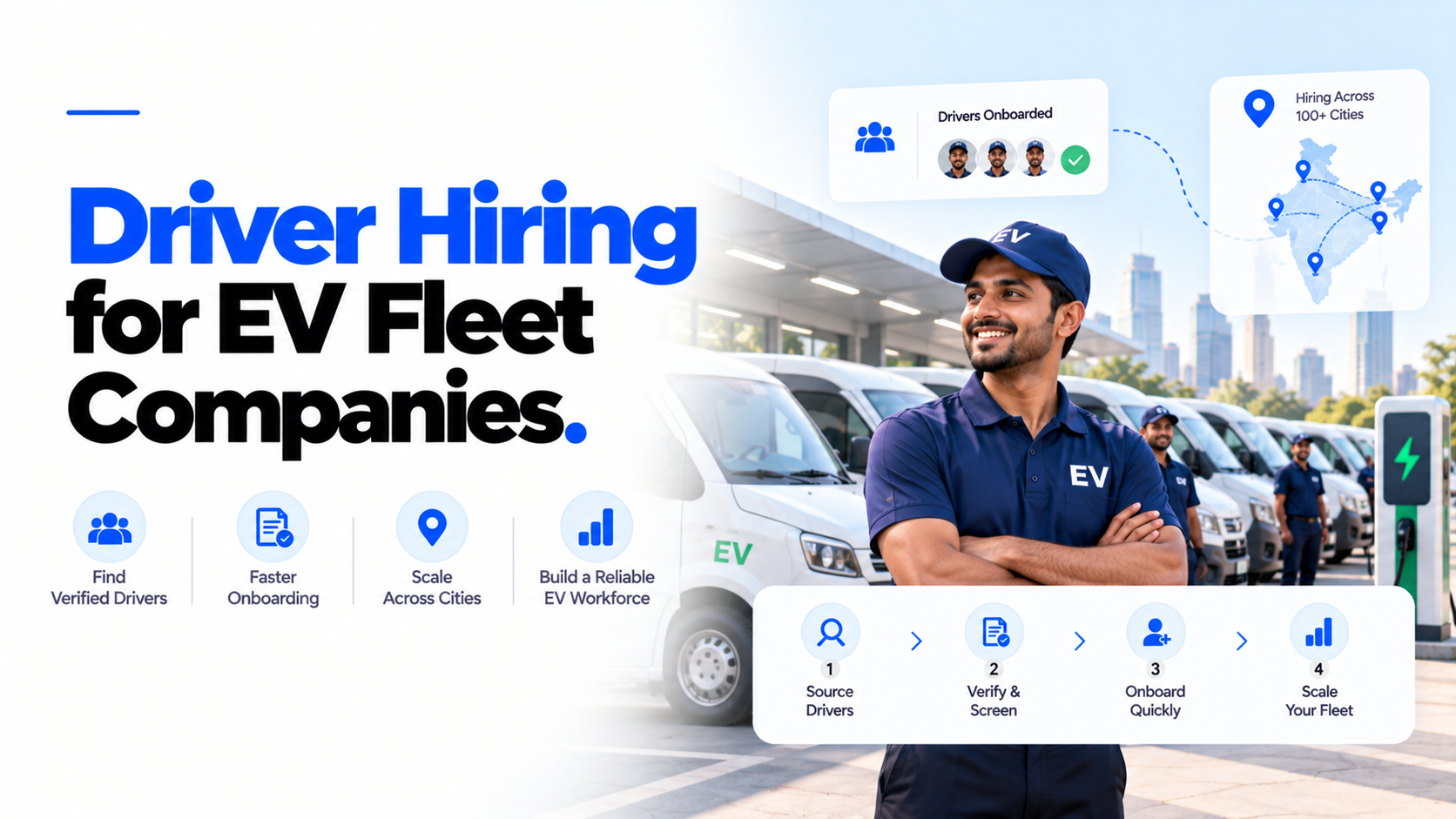
In Satara, across the road from the RTO office, a small agency desk has handled drivers' papers for more than two decades - licence renewals, duplicates, address corrections, badge applications, the medical certificates that keep a transport licence alive. The man behind the desk has carried the town's driving files since the fathers of today's drivers first held a licence, and he can read a working life from a file the way other men read a face: what machine the man drives, whom he drives it for, how many years stand behind the licence, and which fleet he is headed toward next.
Lately the files have begun to sort themselves into new shapes. The heavy-licence men have been leaving for the electric bus operations opening on the state's city contracts. The badge men who drove cabs all their lives are being asked by the app fleets whether their papers will carry onto an electric sedan. The goods men arrive asking for transport validity to be renewed, because a logistics firm will not seat them on an electric goods machine without it. And the young men with fresh licences keep asking the question that now defines the whole market: which paper gets me which seat?
What the desk has taught him settles the argument this guide opens with: driver hiring for EV fleet companies India-wide is not one hiring problem in five disguises - it is five different seats, each carrying its own licence bar, its own screen, its own road test and its own pay logic, and the companies that hire well are the ones that hire by seat rather than by the word driver. The chapters ahead walk the five seats one at a time, then the paper stack every seat shares, the road test each seat runs, and what each seat pays and keeps.
One Hiring Desk, Five Different Seats
The word driver flattens a market that is actually five markets standing side by side. A fleet company that advertises for drivers receives applications from every kind of man - bus hands, cab men, goods drivers, riders - and cannot tell from the pile which man fits which seat. The machine decides the licence the seat demands. The duty decides the temperament it needs. The customer riding in the back decides the manners it assumes. The contract behind the seat decides the pay shape it can offer. Hiring that ignores all of this is not hiring - it is sorting mail into unmarked boxes.
The ev fleet driver hiring process India's serious operators actually run divides along five lines, and each line is a seat. There is the e-bus seat, on city contracts, with its badges and its depot discipline. There is the corporate seat, moving employees along fixed office loops for enterprise clients. There is the airport and premium seat, where the ride itself is the product. There is the goods seat, on electric LCVs running the mid-mile between hubs. And there are the volume seats on two and three wheels, where most fleet drivers begin. The difference between them shows even on ahiring platform's categories page - the seats are listed as separate trades because that is what they are.
What goes wrong when a company hires by the word instead of by the seat is predictable. The cab man placed on a bus seat struggles with passengers and timetables he was never tempered by. The goods man put on a client-facing loop frightens the very clients he was hired to carry. The mismatch rarely shows up as an accident; it shows up as complaints, sick days and quiet resignations, and by the time the pattern is visible, a hiring season has been spent. The fix costs nothing: name the seat first, write the seat's demands down honestly, and only then open the file pile.
The E-Bus Seat: Badge, Depot and Duty
The e-bus seat is the most certified seat in the fleet market. It asks for a heavy-transport licence, years of road work on large machines, and the temperament of a man who carries passengers on a clock - school runs at eight, office crowds at six, and no mood among any of them for a driver who is learning on the job. On top of the licence sits the psv badge India requires of public service vehicle work, the state's own attestation that this particular man may carry fare-paying passengers, and the depot adds its own layer: inspection before duty, the charging handover at shift's edge, the log that follows the machine.
The electric bus driver recruitment India's city contracts have set in motion follows a recognizable pattern: the operators who run the routes hold walk-in drives and depot-level interviews, and the men they meet first are the ones the diesel era already trained - ex-state-transport hands, ex-city-bus men, drivers with a decade of heavy machines behind them. For these men the electric machine is a re-learnt craft, not a new one; the fleet's own programmes handle that part. What the drive cannot manufacture is the temperament, which is why experience floors exist: the seat assumes a man who has already been tempered by years of passengers.
The screen that filters men out of the e-bus seat is mostly a paper screen, and it is unforgiving precisely because the seat is so certified. A licence a class short of the machine, a badge that lapsed two renewals ago, a medical that was never filed - any one of these ends an otherwise strong candidacy before the man ever touches the machine. Operators who say the seat is hard to fill are usually saying something narrower and more useful: the men exist, but the papers and the men have drifted apart, and the fleet that helps a good man repair his file often wins him for years.
The Corporate Seat: Office Loops and Fixed Duty
The corporate seat moves employees, not fares. The employee transport driver jobs India's corporate fleets post sit apart from the app-cab trade: enterprise clients sign for staff transportation, the operator runs fixed office loops with published timings, and the driver becomes part of the client's daily ritual - the same faces every morning, the same gates, the same small courtesies. The scale of this seat is easy to underestimate:India's largest electric mobility-as-a-service provider runs a hundred per cent electric business-to-business fleet for employee transportation across fifteen cities, with Tata Motors set to deploy 5,000 electric vehicles with the operator - each of those machines is a corporate seat, and each seat is a hire.
This is also the seat that opened the fleet market's door to women.Programmes such as the Azad Foundation's Women with Wheels train women to work as professional drivers, supporting them through licences and into employment in the transport sector, and the graduates now drive corporate shuttles, app cabs and institutional fleets in the metros. The corporate seat suits them for structural reasons: fixed routes, published duty, client premises with security and reception desks, and work that ends when the loop ends. A fleet hiring for this seat that does not open its files to women is competing with one hand tied.
The screen for the corporate seat adds a service layer the bus seat never asks for. The man is alone with the client's employees in a closed cabin twice a day, so the checks run deeper than mileage: how he handles a schedule slip on a morning loop, whether he can take a client complaint without taking it personally, how he treats the guard at the gate and the cleaner in the basement. References matter more here than in any other seat, because the previous client's experience is the truest forecast of the next one.
The Airport and Premium Seat
The premium seat sells the ride itself. The customer who books an airport transfer in an electric cab is buying quiet, punctuality and a man who treats luggage as his own responsibility, and the hire has to be made with that product in mind. The ev chauffeur jobs India's premium segment now posts are chauffeur jobs in the old sense - grooming, discretion, route knowledge, the drive judged from the back seat - and the fleet that fills them well is the one that screens for hospitality as seriously as it screens for driving.
The market behind the seat is scaling fast.Evera, the Delhi-NCR electric cab service, is expanding its fleet from around five hundred vehicles toward 4,500 by June 2026, with airport transfers forming the largest part of its consumer operations and corporate clients using the platform mainly for employee transportation. Every expansion of that size is a hiring programme in disguise: thousands of new premium seats, each needing a man whose papers, temperament and manners all clear a bar that app-cab volume hiring never has to clear.
The screen for the premium seat runs on three tracks. The papers: a commercial licence that covers the machine he will drive, the permits the state hangs on contract-carriage work, and police verification, which the seat treats as a floor rather than a formality. The craft: a test drive judged from the rear seat, where a smooth lift-off, an unhurried lane change and a quiet regen tell the examiner more than any speed. The manners: a man who speaks when spoken to, never discusses one passenger with another, and understands that the airport run is a service, not a favour. A man who clears all three is rare, and premium fleets pay to keep him.
The Goods Seat on the Mid-Mile
The goods seat runs the middle of the market: electric LCVs carrying loads between warehouse gates, hubs and dark stores, all day and often well into the night. The e lcv driver hiring India's logistics operators track a distinct profile - men with goods-vehicle experience who already understand loading, weight, route clocks and the paperwork of a delivery - because the electric machine changes the fuel, not the trade. What the seat adds beyond the trade is the energy layer: what a full load does to the range, where the machine charges inside the duty window, and how the day re-plans when a pack runs low.
The screen for the goods seat tests the trade, not just the licence. A loaded run over real roads shows what no empty-yard demonstration can: whether the man reads weight honestly, whether he brakes early enough with a bed full of cartons, whether he can pace a charge inside a waiting window instead of treating it as lost time. Fleets that test with an empty machine learn the man's habits only after the cartons arrive, which is the most expensive classroom in the business.
The sourcing for this seat hardly needed reinventing for electric, and it still works: the goods yards where transporters gather, the references that move between men who have shared loading bays, and the openings listed where logistics work is listed - the warehouse-jobs listings, theBengaluru warehouse jobs pages among them, where the same men who load the bays read those listings for driving seats on the machines that leave those bays. A fleet that posts its goods seats with honest load weights, honest duty hours, and the range the machine really delivers collects applications from precisely the men built for the seat.
The Volume Seats on Two and Three Wheels
The volume seats are where fleets and drivers meet at scale. On two wheels, the delivery fleet's machine belongs to the fleet itself in most organized operations - handed over at the start of duty, returned and plugged in at the end - which collapses the biggest entry barrier the petrol years put up: the man no longer has to own a machine to hold the seat. On three wheels, the e-auto fleets attach riders to city routes with the same logic. The licence floor is the lowest in the market, but the seat teaches the fleet's craft to more future drivers than every other seat combined.
Hiring for the volume seats is a machinery of its own: walk-in days, bulk screening, documents checked in batches, and machines allocated the way a store allocates shelves. The candidates, meanwhile, do their own hunting - they read theguide to finding gig work near you, scan thestructured jobs board and thedelivery jobs in Bengaluru listings, and compare fleet offers the way they compare anything: by what the week actually pays and what the machine actually costs them. A fleet whose posting states the duty hours, the week's real take and the machine terms plainly wins that comparison without spending a rupee more.
The volume seat's real function in the seat map is as a school. A rider who spends two years on a fleet machine arrives at the corporate and premium seats already fluent in the electric craft - the charge discipline, the range honesty, the care signs - and the fleets that promote from within their volume seats build their premium benches for free. The seat pays the least and teaches the most, and a hiring desk that sees it only as entry-level labour misses what it is actually running: the industry's largest training floor.
The Paper Stack Every Seat Shares
Under every seat sits the same foundation: the licence, and everything the state staples to it. The class of the licence has to match the machine - light motor vehicle for the cab seats, heavy for the bus. Transport work demands the commercial endorsement, andParivahan's own services on driver licensing set out how the public service vehicle badge is applied for through the Sarathi portal, alongside the fact that a commercial driving licence is valid for five years from issue. The ev fleet driver licence India's fleets verify is therefore not one document but a stack: licence class, transport endorsement, badge where the seat demands one, the medical certificate that keeps the transport validity alive, identity, and police verification for the seats that carry passengers.
The desk's rejection file shows the stack from its failure side. The licence is a class short of the machine. The transport validity lapsed while the man worked a non-transport job. The badge was never renewed after a state move. The experience letter describes a company that cannot be traced. None of these men cannot drive; not one of them can be seated, though, until the file is repaired. The verification itself has become the easy half - a licence's truth can be pulled up on a screen before the interview ends - which is why the fleets that hire fastest are the ones that tell candidates exactly which papers to bring, so the repair happens before the drive, not after.
The ev fleet driver documents India's operators ask for have thus become a hiring tool in themselves: the fleets that print the full list into the job posting - licence class, badge status, medical, identity, verification letter - watch weak files repair themselves at home, and their walk-in days fill with men who can actually be seated. The fleets that spring the list at the gate spend their screening days sending good men home to fetch one more paper, and the men they send home often do not come back.
The Road Test, Rewritten for the Seat
The last screen is the machine itself, and the ev fleet driver road test India's fleets run is not one test but five. The bus seat is tested at the depot: maneuvering a long machine through tight gates, braking with the smoothness passengers need, a full route run with a clock. The corporate seat is tested on the office loop: schedule discipline, gate etiquette, the morning temperament of a man clients will see daily. The premium seat is tested from the rear bench, where ride smoothness speaks. The goods seat is tested with a load. The volume seats are tested on a real delivery loop with a full pack and a real set of drops.
Whatever the seat, the electric machine adds its own lines to the examiner's sheet. The surge away from rest, which punishes the habits a diesel machine forgave. What the machine gives back when the driver lifts off, and whether he lifts off early enough to collect it. The silence, which asks the driver to assume pedestrians have not heard him. And range honesty: whether the man reads the energy gauge the way an experienced goods driver reads a fuel needle - as a budget to be spent, not a number to be watched. A candidate strong on the road but careless with the pack is a poor hire in every seat, for the machine is the fleet's earning asset and the driver its custodian.
The examiner's judgment should be seat-specific all the way down, and the passing mark on one seat should never imply fitness for another. The smooth premium chauffeur may lack the depot's tight-gate craft; the superb goods man may lack the temperament the corporate loop assumes. Fleets that keep one generic pass-fail sheet quietly rebuild the mismatch problem this guide opened with, one polite failure at a time. The sheet costs nothing to fix; the mismatched hire costs a seat, a machine's dignity and a customer's patience.