Delivery Jobs in India: Companies, Requirements and How to Apply
In Bhopal, a man counts the company bags passing the market crossing and decides the trade is his. The sections ahead walk the whole route in order: the companies, the requirements every one shares, the papers that decide, the application, the joining, and the choice at the end of it.
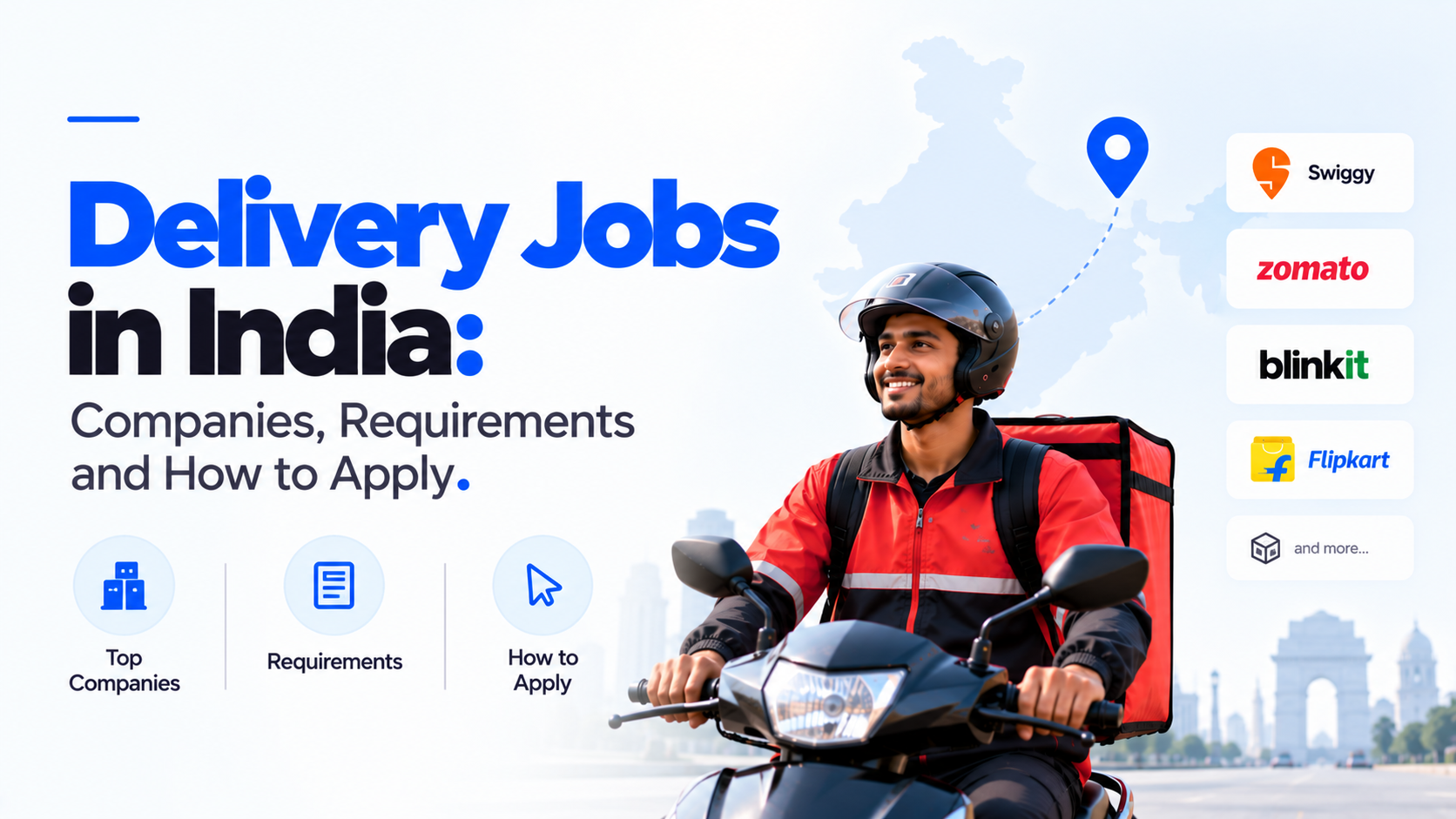
In Bhopal, a man decided last month that the trade is his: he will ride for a living. What he has not settled is which company to approach first. At the market crossing near his lane, he counted the bags that passed him one evening - red food bags, yellow grocery crates, blue parcel boxes - and each belongs to a different employer with a different door. The first question is not whether the work exists. It is which company is his to approach.
One of his neighbours moved to Meerut for the same work two years ago and now rides a parcel network there. On the phone the order stays simple: papers first, vehicle next, the app last - no company reads a name until the papers are right. The man in Bhopal wrote the list on the back of a calendar page.
This guide is that page written out in full: delivery jobs in companies requirements and how to apply - the companies that hire, the requirements every company shares, the papers that decide, the application step by step, what happens after the form goes in, and how a man picks the company that fits him.
One Trade, Many Companies
Delivery work in India is not one employer; it is a market of companies, and the delivery companies in list reads as four families. The food apps move hot meals from restaurants to doorsteps. The quick commerce firms rush groceries across town against the clock. The parcel networks carry the country's e-commerce boxes between hub and home. And the intra-city movers shift what a bike cannot.
There is a paper behind every one of these names. The road transport ministry's guidelines for aggregators - the firms behind app-based delivery - were issued under the amended Motor Vehicles Act and make a licence from the state government a precondition for running the business at all,as the road transport ministry's release records. The guidelines name customer safety and driver welfare among their objectives. A rider's employer is not a handshake but a licensed business - and the licence is his first protection.
That is why the choice of company matters. Two firms may wear the same colours on one street and still differ in pay, demands and treatment. The families below are read the way a man reads them on the ground - by what each one moves, and what each one wants from him before his first pickup.
The Apps That Feed the Cities
Companies hiring delivery riders in at scale began with food. The rider joins through the company's own app, submits his papers, waits out a check, and starts collecting orders from restaurants he already knows. The work runs on the city's meal hours - lunch, dinner, and the orders that come after both - and the density lets a man work the wards he knows.
Joining either of the two big names is a near-identical drill, which is why every zomato swiggy delivery job apply search lands on the same steps: download the app, fill a short form in the app, photograph the papers, and book a slot.The category index on the hiring site lays out where food work sits beside the other kinds, so a man sees the whole trade before giving one company his week.
Food work rewards the rider who learns his patch: which restaurants cook slow, which gates make him wait, which societies hold the lift. It is steady, dense, and in the big cities it runs seven days - but it is the most crowded door in the trade, and it suits the man whose hours match the meal clock.
The Grocery and Parcel Companies
The second and third families live by different clocks. Quick commerce runs against the timer: dark stores stacked with groceries, riders picking and dropping inside a small radius, orders arriving in short, sharp peaks. The quick commerce delivery job requirements follow that shape - find an address fast, ride gentle with a loaded crate, stay calm when the app's clock is honest.
The parcel networks are the scheduled side of the trade: warehouses, hub scans, and the last leg to the doorstep. Men who like a route over a rush do well here - the beats repeat, the customers become faces, and the day is shaped by loads rather than mealtimes. Add the intra-city movers, who ride bigger vehicles, and the best delivery companies to work for in stop being one answer: the honest version is whichever family matches his vehicle and his hours.
From city to city the mix changes: the metros carry every family at full weight, while smaller cities may run parcels wide and quick commerce thin.The Bengaluru listings on the hiring network show one market where all the families work the same ground; a man can open his own city's page and see which families are actually hiring around him before he chooses a door.
What Every Company Asks For
Strip the brands away and the delivery job requirements in collapse to one short list. He must be an adult - eighteen or more. He needs a two-wheeler he can lawfully ride and a licence that says so. He needs a smartphone that holds the company's app and a bank account the pay can land in. Everything else is garnish on that core.
The variations sit at the edges, not the middle. Quick commerce wants a rider who can carry a loaded crate up a stairwell; the parcel networks prize a clean record with addresses; the movers need the bigger vehicle class. None of it changes the core - the man who owns the bike, the licence and the phone is eligible at nearly every door in the trade before he fills anything in.
Companies do differ in how strictly they check the same papers, and in how long the checks take. A man with everything in line can be riding for one app this week and another the next; a man missing one paper stalls at every door equally. That asymmetry is the quiet case for reading the requirements side first - it is the part of the trade a rider fully controls.
The Papers That Decide
The documents required for delivery job in form a folder, not a file. Aadhaar for identity. PAN for the tax trail. The driving licence for the vehicle class he will ride. A bank passbook or a cancelled cheque so the pay has somewhere to land. A photograph, and the bike's registration papers. Every company draws from the same folder; some ask for all of it at signup, others in slices.
The folder is lighter than it used to be, because the papers themselves went digital. DigiLocker holds more than 72.43 crore registered users, with 5,437 document types and services - 661 from central government, 4,776 from the states - on the platform,as the electronics ministry's statement notes. The licence and the Aadhaar a rider stores there carry the same standing as the plastic in his pocket - and cannot be lost to rain, which has ruined more folders than any office.
A man assembling the folder should work in a single afternoon: papers photographed clean, names matching across documents, the bike's registration current. Mismatches are the most common reason a check stalls - not refusal, just a field the company cannot tick. An afternoon spent aligning it saves weeks of waiting.
The Application, Step by Step
The delivery job application process in has quietly become a phone routine, and it runs in five steps. One: choose the company and the category that fit his vehicle and his hours. Two: download the company's app or open its partner page and fill a short form - name, city, category. Three: upload the papers from the folder. Four: book the verification slot the app offers. Five: wait for the confirmation - a message, not a letter.
The licence step is easier than it has ever been, because the licence services themselves moved online. A 2022 notification put 58 citizen-centric services - driving licence, vehicle registration, permits among them - completely online with Aadhaar authentication,as the ministry's notification on citizen services notes, eliminating the need to visit the RTO. A man whose licence is expiring, or whose address has drifted from where he lives, can fix the paper from home before any company sees it.
The step most men skip is the read before the write:the how-to walkthrough on the hiring network shows how to check a listing before a form is aimed at it. A search for how to apply for delivery boy job openings and a search for the work itself end at those five steps - and the man who reads first applies once, to a door that is actually open.
After the Form Goes In
The delivery job joining process in runs itself once the form is in: the company checks the papers, runs its own background step, and confirms the slot where the man and his bike are seen in person. Bring the folder in its original form - copies got him this far, the real papers finish it. Then the kit: the bag, sometimes the t-shirt, and the app switched from applicant mode to rider mode.
There is a second register running alongside the company's own, and it belongs to the worker rather than the employer. Over 30.58 crore unorganised workers have registered on the e-Shram portal, more than 1.23 crore of them in 2024 alone - an average of 33.7 thousand registrations a day - and the portal now speaks 22 Indian languages,as the labour ministry's bulletin records. For a delivery worker, e-Shram is the portable identity that follows him across companies and cities.
The men who apply for delivery job online and stop there have joined a company; the men who also register on e-Shram have joined a system. The company register pays this month. The worker register pays across a working life, because it stays with the man when he changes companies, changes cities, or claims a scheme.
Pay, Costs and the Plain Arithmetic
No two companies pay alike, and no two cities pay alike within one company. Per-order pay moves with the city, the category, the distance band and the hour; incentives layer on top during busy weeks; cancellation rules decide how much of the promise survives a real day. Anyone quoting one monthly number for the whole trade is selling something - the honest arithmetic runs rider by rider, week by week.
The costs side is what newcomers forget to subtract. Petrol, service and repairs come off the top of every week's earnings, and a phone that runs the app all day ages fast. The men who last treat the bike and the phone as business assets with a maintenance line - and they price a company's pay against those costs rather than against zero.The openings board on the hiring site shows what companies are asking for right now, which is where any pay conversation should start.
The rest of the check happens on the street, not the screen. A half-hour with riders outside a restaurant or a dark store - asking which payouts arrive clean and which drift - tells him more than any advertisement will. The arithmetic is local; test it locally.
Picking the Company That Fits
The choice, in the end, is a fit problem with four honest questions. Does his vehicle match the family - a bike for food and parcels, patience for grocery crates, something bigger for the movers? Do the company's busy hours match the hours he can actually hold? Does it hire in his city at the strength its recruiter implies? And does its pay land the way its pitch says it does?
The instruments for all four are public.The locations index on the hiring site shows which cities carry which work;the Bhopal delivery page on the hiring network carries live listings a man can read before he commits a week to any company; andthe platform explainer on the hiring blog explains how the matching works from the worker's side. A man who checks those three arrives at his first verification having already surveyed the market - not as a guess on wheels.
Back in Bhopal, the calendar page is full now: four families, one folder of papers, five application steps, two registers to join. The door he finally walks through is his own call - but it is no longer a guess. It is the one company whose requirements he meets, whose category fits his bike, and whose work he has read with his own eyes. That is what the list was for: not to pick for him, but to make the picking informed.
The trade will keep changing - companies will merge, new apps will arrive, pay cards will be recut - but the route through it does not age: know the families, hold the papers, apply cleanly, register as a worker, and test every promise against the street it was made on.
The companies are hiring, the requirements are public, and the application is five steps on a phone. The man at the crossing with a phone in his hand and a folder in his bag is not waiting for the trade to choose him. He is choosing the trade back - one company, one folder, one form at a time.