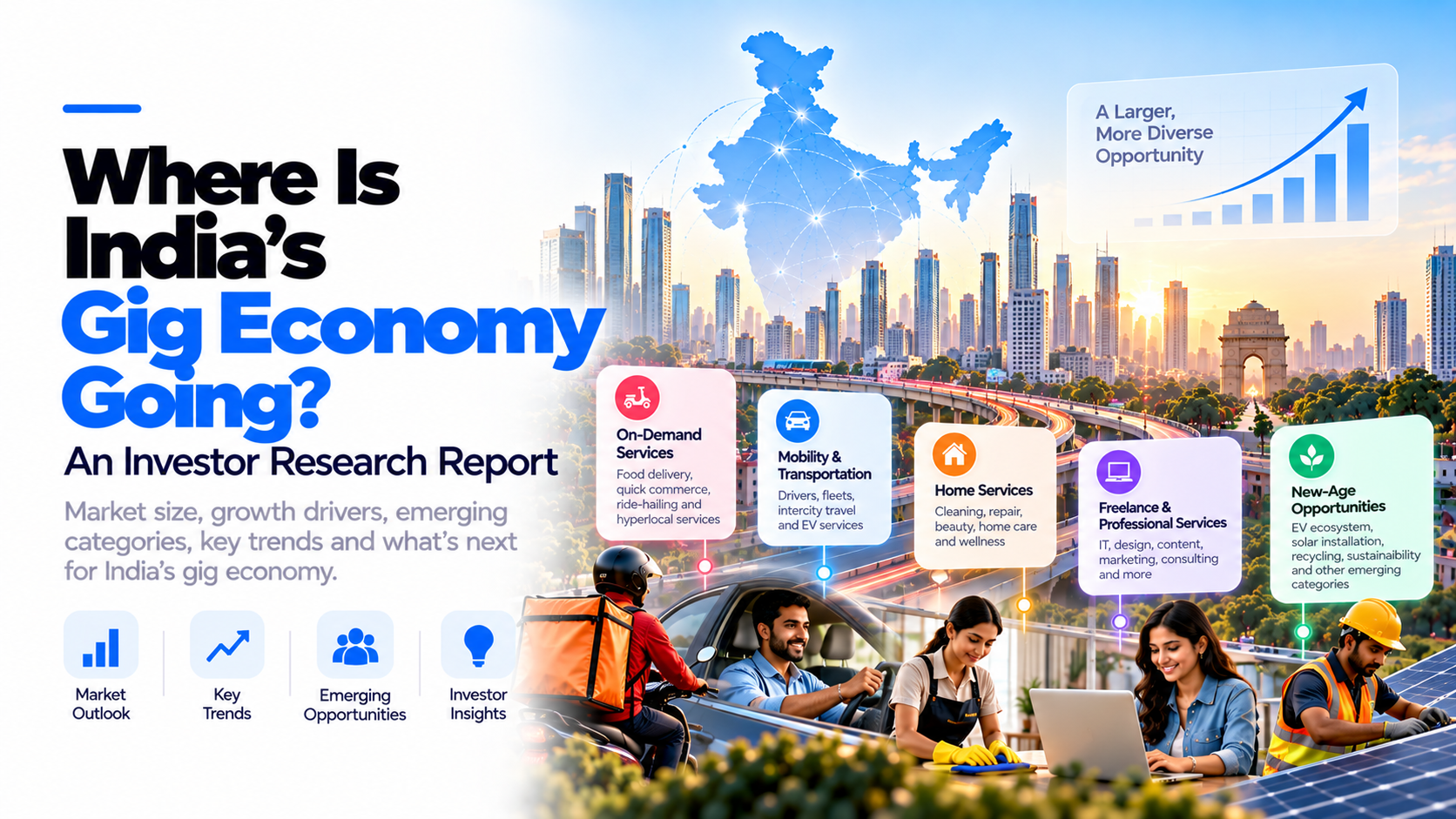
Where Is India's Gig Economy Going? An Investor Research Report
Four 2026 first-party filings - the newest consumption letter, a rival's quarterly letter, an electric maker's annual report and the investor house's annual report - read for the direction lines they set out for India's gig economy.
In 1986 the Bombay Stock Exchange gave investors their first index: thirty leading companies, published every day since - the number India calls the Sensex. The base was set deliberately: a value of 100 on 1 April 1979, the year 1978-79 fixed as the base year, and a name coined by Deepak Mohoni, a portmanteau of Sensitive and Index. A number that only means something against the year someone chose to remember.
The base was the useful half: an ordinary year, fixed on purpose, that every later reading stands on. Direction is a comparison: no number can say where it is going until someone writes down where it stood. The exchange was far older - established in 1875, Asia's oldest - but the Sensitive Index was the day its investors learned to read direction where is 's gig economy going an investor research report fixes a base before it draws a line. Four 2026 filings serve as that base - the newest consumption letter, a rival's quarterly letter, an electric scooter maker's annual report and the investor house's own report. Each states a direction line in its own words; together they are what the next few years will be measured against.
How a research report reads direction
A research report earns its keep by separating a direction line from a wish. The difference is paperwork: a filer, a date, a number somebody must answer for. This one reads four filings from 2026 - two quarterly letters, the electric maker's annual report and the investor house's own report - and takes each line as the base year took 1978-79: the place the measuring starts.
The pages beside this one hold the ledger of ranked openings, the balance of arguments, the category screens and the money documents. This page reads the gig market trajectory will be priced on - not the sector's size, not its categories, but the gradient: whether the lines the operators file point up, level out, or bend.
Three disciplines hold the page together: every number below is the filer's own, every direction claim the filer's own words. The cautions come from the same pages, not from the mood around them - and where the filings are silent, the report says so.
The demand line runs ahead of the map
The first line belongs to demand. Eternal's shareholders' letter for Q2 FY27, dated 21 October 2026, records consumer order value up 54 per cent to INR 35,644 crore and adjusted EBITDA nearly tripled to INR 666 crore,as the newest letter guides it - then raises its building plan: 3,500 stores crossed by March 2027, about 5,000 by March 2028, a target lifted from the 3,000 set months earlier. Demand runs ahead of every map the operator had drawn.
Gig economy direction is rarely stated this cleanly by an operator. Food delivery's order value accelerated for a fifth straight quarter, up 21.5 per cent to INR 11,445 crore, and the progress is broad-based: cities carrying about 96 per cent of order value are contribution positive, those carrying about 70 per cent are EBITDA positive. Demand is not spreading thin - it is deepening in every city class at once.
For an investor the line matters twice. The letter says its cash balance and profits from both arms fund the pace comfortably - demand is no longer carried by raised capital but by its own earnings. And the 60 per cent compound-growth guidance set over three years is two quarters old and holding.
Where the next store goes
The letter's most forward passage is not about metros. Answering the scepticism that smaller cities lack the density for the economics, the management lays three readings on the table: new stores reach 1,000 orders a day in about the time metros take, sometimes faster; basket values sit within 85 to 90 per cent of metro levels; retention comparable. 'In metros, we usually compete for a market that already exists,' the letter says. 'In smaller cities, we are building the market and the supply.'
That is a direction statement about geography. The demand the sector will serve for the rest of the decade is being built rather than found - organised retail never fully developed in these cities, so the assortment arrives by delivery. Future direction of gig work is being decided store by store in places the first decade of apps treated as edge territory.
The same passage carries its own governor: 'We do not expect every small city to look like a metro. Some will stay subscale.' A direction line with a stated exclusion is worth more than one without - the build-out is real, and so is the sieve it passes through.
The quarter the losses turned
The second filing is the rival's ledger. Swiggy's letter for Q1 FY27 records a year-old promise kept: quick commerce reached contribution-margin break-even in May 2026, the quarter's contribution landing at -0.2 per cent of order value, a 440 basis-point year-on-year improvement,as the rival's letter states it - while adjusted EBITDA losses narrowed to INR 778 crore. The letter calls the milestone pivotal: growth now serves profitability rather than compromising against it.
The food-delivery arm already pays its way: order value up 17.4 per cent, monthly users up 17.8 per cent to 19.2 million, adjusted EBITDA of INR 292 crore at 3.1 per cent. Where gig work is heading depends on the second camp's turn as much as the first's - a sector goes somewhere different once both engines fund themselves, and this quarter is where the letters agree.
The network now counts 1,171 darkstores across 131 cities, and the plan is densification rather than retreat. Read as direction, the quarter closes the era of buying growth with losses; what replaces it is a slower build where a new dark store opens because the maths allows it, not because capital demands it.
The affordability line
Both letters agree on where the next users come from. Swiggy's letter names affordability the biggest lever to unlock the next 100 million users, and built for it: Toing, a standalone affordable-meals app, runs in 50 cities on delivery infrastructure that already exists, at a fraction of the cost a new entrant would pay. Where the gig money goes follows the same line - the next crore of orders is priced lower than the last.
Eternal's answer runs through assortment and supply: premium beverages, branded diapers and gaming consoles in smaller-city baskets at 85 to 90 per cent of metro values, stocked because organised retail never arrived and the mother warehouses had to be built. Separate filings, one direction: the coming hundred million will be served by building supply, not by waiting.
The investor's translation is unglamorous: a sector that expands through affordable orders earns thinner rupees per order and needs volume to pay its way - hence the same letters reporting revenue per order rising to INR 108 and store paybacks holding shape. The affordability line and the profit line are pulled taut together, and both filers claim neither has snapped.
The machine under the rider
Under every delivery route sits a machine; its own report is the third filing. Ather Energy's annual report for FY26 records 2,62,942 vehicles sold, up 69 per cent, with share rising from 7.6 per cent in early FY25 to 18.0 per cent in the final one,as the maker's report counts it. The Rizta became the company's fastest-selling product - its second hundred thousand units took seven months against eleven for the first - and the fleet on Indian roads crossed half a million.
Two details make this a direction line for gig work. Selling prices held even as subsidies were rationalised - the report's own proof that scale now comes from product strength, not incentives. And Middle India followed the south's sequence: share reached 17.3 per cent in the fourth quarter across Gujarat, Madhya Pradesh and the states around them - what works in Bengaluru and Chennai works just as well elsewhere. The gig economy course runs is being set as much by chargers as by apps.
The quiet line is the charging build-out: more than 6,000 charging points across India, 1,143 added in FY26, the country's largest two-wheeler fast-charging network. A gig fleet converts to electric only when charging stops being a risk; the machine under the rider is being replaced infrastructure-first.
The capital reads the same map
The fourth filing belongs to the money. Info Edge - founded in 1995, listed since 2006, the house whose best-known outcomes include the public listings of Eternal and PB Fintech - states its position in the FY26 annual report: 135 companies backed, about INR 49 billion deployed, now valued at about INR 413 billion, with INR 464 billion more in listed holdings,as the investor's report shows it.
The investor's read on gig has compounded for two decades, and the report is the receipt. More telling is where the house builds now: Job Hai, its platform for the blue- and grey-collar market, spans more than 640 cities and 45 job categories with over 18 million jobseekers - and the demand reading to keep: hiring volumes in the value segment are growing rapidly across warehousing, logistics, manufacturing, delivery, retail and healthcare support.
The build-out is the tell. Job Hai's Delhi NCR leadership is being extended to Mumbai, Bengaluru and other major markets over the next twelve months - the report calls FY26 the year the business moved from early-stage validation to establishment at scale. Capital follows the stores' sequence - prove the unit, then densify - and when the sector's oldest investor files that sentence, a direction line stops being a claim and starts being a record.
What could bend the lines
A research report that only reads upsides is a brochure, and the filings carry their own cautions. Eternal's letter devotes a section to agentic commerce - software ordering on the customer's behalf - and concludes both ways: an agent can place an order, the letter argues, but it cannot own the outcome; only whoever runs the fulfilment can. The letter still parks its going-out business in the medium-to-high risk zone for agent-led demand; the defence is the handoff, not the app.
The second caution is geography. The letter that makes the smaller-city case also caps it - not every city will look like a metro, some will stay subscale. Reading the gig market responsibly means carrying both halves at once: the build-out is real, and so is the sieve it passes through.
The third caution is monetisation at the base of the pyramid. Info Edge's report is blunt about the value segment: digital penetration is low, employers hire urgently rather than periodically, workers rarely hold formal resumes, search is largely local - which keeps ARPUs lower and churn higher. Demand rises fast and the money is harder to collect; a direction report holds both clauses in one line.
What to watch and where the work lands
The watchlist writes itself from the four filings: store counts against the 3,500 and 5,000 marks, revenue per order against INR 108, margins against zero and beyond, charging points against the 6,000 line, jobseekers against the 18 million count. The gig investment thesis reduces to those five readouts - each printed by a filer who must answer for it next quarter.
Every readout lands somewhere specific. In Udaipur, a city of lakes and tourist streets whose rider fleets serve visitors and doorsteps alike, the electric shift the machine report describes is already on the road, andthe Udaipur page on the hiring network collects the EV rider work posted in the city today. A direction line, read locally, is a seat with a street address the first app decade never had.
Then the housekeeping the category counter on the hiring site sets the categories out for comparison,the first-step guide on the hiring blog walks a first visit through to a filed application,the full board on the hiring network holds the newest postings together,the state counter on the hiring site separates the listings by state, andthe city board on the hiring network holds one city's whole hiring floor in a single stop.
'Where is 's gig economy going an investor research report' closes on the base year's lesson - fix a base, then measure the line. The four filings of 2026 set the bases: demand compounding out of profits rather than raises, a second engine past its break-even turn, the machine going electric one city at a time, the capital's ledger agreeing the employer guide on the hiring blog carries the hiring side of the same reading.
A base year does not predict; it makes direction readable. That is the standing offer the four filings make: the lines they filed in 2026 - demand, break-even, machine, capital - are the gig direction lines the gig economy next five years will be read against, and a reader who learns the habit on one quarter can read every quarter after, for as long as the filers keep filing.