Night-Shift Gig Work: Safety Rules, Earnings Trade-offs and Who Should Avoid It
After dark, the gig economy changes shape: orders thin out, premiums appear, and the risks - and the rules - change with them. This guide handles night-shift gig work the way this series handles every topic.
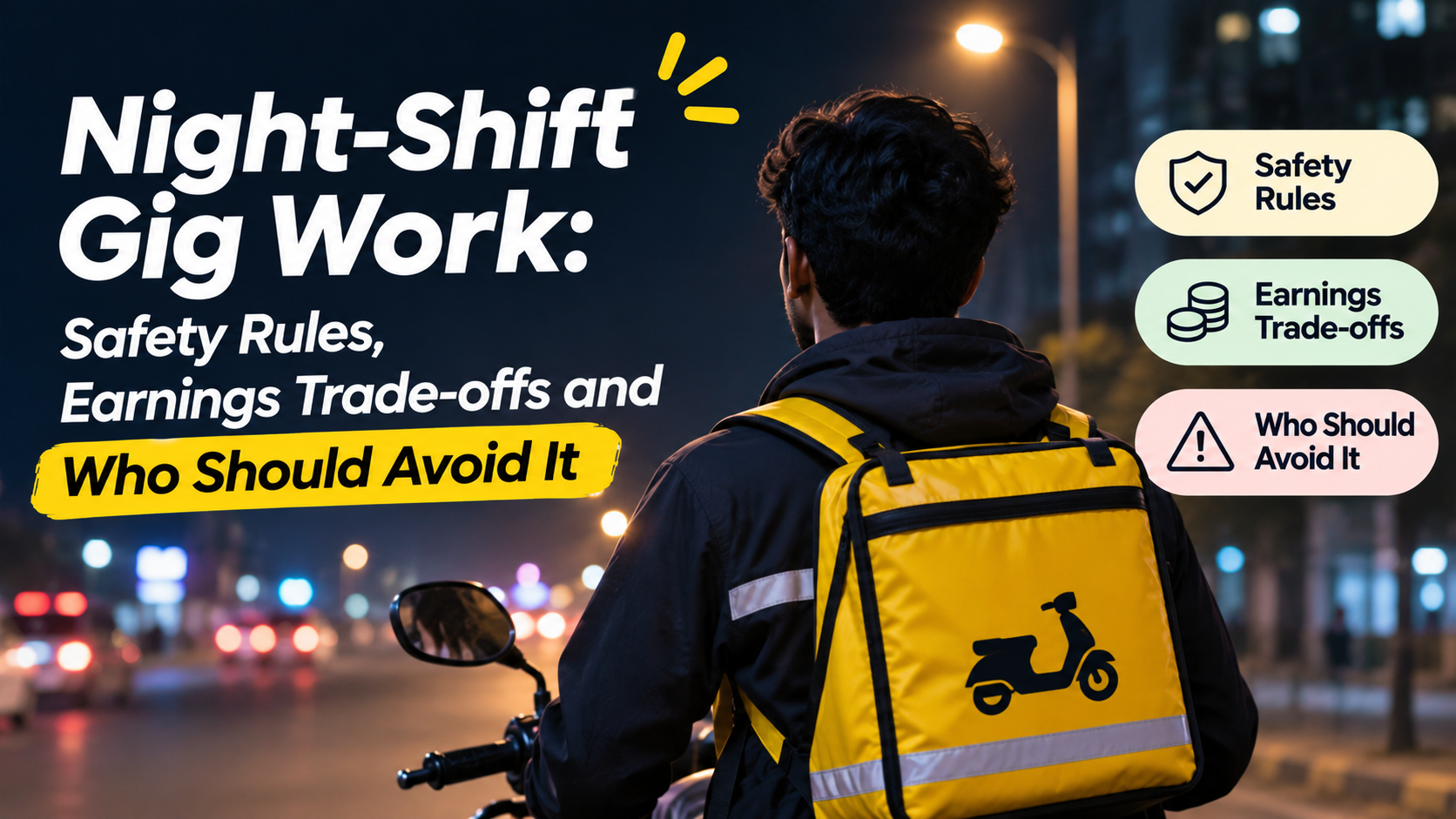
1. What night-shift gig work actually covers
Night shift in gig work is not one schedule but three. The food-delivery night is now an official product: Swiggy's own press release describes Late Night Eats,'available between 10 PM and 5 AM across 4000+ office locations and 30,000+ restaurants in top 30 cities in India', launched in July 2026. For a rider, that means a real wave of orders between dinner's end and dawn in the zones that host those offices and late kitchens.
Quick commerce runs the night differently: dark stores keep working when residential demand fades, because shelves must be restocked and late orders still promised. Blinkit's warehouse-partner page describes two work shifts - day and night, each of nine working hours - so store-side night duties are a standard part of the model; the rider lane around those stores runs as fixed duties of 7-8 hrs/day with monthly earnings up to ₹30,000 onAwign's BB Now listing, and Zepto offers both full-time and part-time rider options onits rider page.
Courier's night belongs to the hubs. Parcels from the day's e-commerce sales are sorted between roughly 11 PM and 8 AM so that morning routes can start clean - job listings across the sector advertise exactly those shift windows. Delhivery's partner model attaches you tothe closest dispatch centre with weekly payouts, and whichever arm of the night you pick, the segment shapes what your dark hours are actually for.
2. Where night demand comes from
The night food wave has a specific engine: offices. Swiggy's release reports that25% of corporate employees in those locations place food orders after 10 PM while at the office, serving professionals on 'extended schedules or global time zones', with a '2 AM Club' of restaurants that stay open till at least 2 AM. More than one third of the restaurants servicing those office zones accept orders from 10 PM to 6 AM.
The demand is spreading beyond the metros too: the same release notes double-digit growth in late-night office ordering across tier-2 cities - Bhubaneswar, Goa, Kochi, Lucknow, Vizag and Ahmedabad. And under the courier network, night sorting at hubs is what feeds the next morning's deliveries, which is why Ekart's Wishmaster program of over 1,20,000 partners runs its network on planned routes and shiftsdescribed on its delivery-partner page.
Outside those anchors, night demand is honest but thin: dinner-peak spillover that runs past 11 PM, weekend late nights, and pockets built around hospitals, stations and party districts. Order density after roughly 1 AM drops in most cities - which is exactly why the pay trade-offs of section 3 need a test, not a rumour.
3. The earnings trade-offs of working dark hours
Start with what is official: no platform in this series publishes a separate night rate card. The advertised caps stay as they are - Swiggy's 'Earn Up to ₹30,000/month' onits partner page, up to ₹45,000 on Zepto's rider page, 'monthly earnings of up to ₹50,000' onBigBasket's rider page, and 'Earn up to ₹45,000 every month' onShadowfax's delivery-partners page. Night money, where it exists, lives in incentives - and those are zone-level, shown in the app, not on a website.
What the market shows is thinner but real: delivery job listings recovered from search results advertise 'night shift (10 PM to 7 AM, 11 PM to 8 AM)' duty windows, night-shift allowances of around ₹120/day in some warehouse and last-mile roles, and fixed monthly pay of about ₹22,500 for 11 PM-8 AM last-mile duties. Treat all of those as listing signals, not platform policy - rates are set locally and change often.
The trade-off itself is a balance of two forces. Fewer riders work dark hours, so competition per order can drop and allowances appear; but order density also drops, especially after 1 AM, and a fast empty road only pays if orders keep arriving. Office clusters defy the pattern - the 4,000-plus locations in Swiggy's night programme generate steady late orders - so your night economics depend far more on your zone than on any headline premium. The reliable method of this series applies: run the same weekday day and night for two weeks, then judge from your payout statements, not from advertisements.
4. The risk ledger: what official data says
India's own road-safety statistics give the night question a firm base. The Ministry of Road Transport and Highways' report,Road Accidents in India 2024, records 4,87,707 road accidents for the year and breaks them by time of day. The single worst slot on the country's roads is 6 PM to 9 PM - which the report itself labels night - with 1,02,897 accidents, 21.1% of the national total.
Add the 9 PM to midnight slot and the picture sharpens: 11.5% more of the year's accidents fall there, so six evening-and-night hours carry 32.6% of all accidents on Indian roads. The deep-night hours run the other way - midnight to 3 AM accounts for 5.1% and 3 AM to 6 AM for 4.8%, the quietest slots of the day, because traffic itself thins out. Read that honestly: aggregate accident counts are not a per-kilometre risk score, and fewer vehicles also means higher speeds when something does go wrong.
For a gig rider the practical translation is simple. The hours that carry the most accidents - the dinner peak through late evening - are exactly the hours that carry the most orders, so evening riding needs your sharpest attention: helmet strapped, lights working, visible gear, and speeds that respect what you cannot see. Deep-night riding swaps traffic risk for fatigue risk, which is a different tax on the same body.
5. Safety rules to set up before your first night
Work the platform layer first. Zomato has published a Delivery Partner Well-being Framework built around five areas - financial, social, physical, mental and professional - with nine elements that includehealth and safety and grievance redressal, so know where those channels sit in your app before you need them. Swiggy pairs 'complete flexibility to choose your shifts' with'insurance of up to Rs 12 lakhs for you and your family' - and group accident covers of this kind pay when an accident happens during duty, the way Rapido's Acko policy describes injuries that occur during the travel periodin its certificate wording. The certificate inside your own app is the document that governs - read it before your first dark shift, not after your first scare.
Then set the personal layer, and start with the one number that works everywhere: 112. The Ministry of Home Affairs launched the Emergency Response Support System as'a single emergency services number 112 which will combine Police, Fire, Health and other helplines' - save it as a favourite, and test your delivery app's SOS button once in daylight. Install only the official app - for instance theSwiggy Delivery Partner app on Google Play - keep your documents and a charged power bank on you, and share your shift window with family so someone always knows where you are.
Night habits finish the setup: choose lit routes over shortcuts, keep the helmet strapped with reflective elements visible, avoid highways when a city road can do the same job, and treat your first weeks as evening work rather than midnight work while you learn your zone's real geometry. None of this is fear - it is the same discipline the safety frameworks above assume you already have.
6. Women and night shifts: the current position
The legal backdrop has moved decisively. Section 43 of the Occupational Safety, Health and Working Conditions Code, in force since November 21, 2025, permits women to be employed in all establishments and for all types of work,including before 6:00 a.m. and beyond 7:00 p.m., with their consent - a shift from the old Factories Act restrictions towards conditional inclusion. India's labour law now starts from women's right to choose night work, not from a blanket ban.
The rules around that right matter more than the headline. The Central Rules notified in May 2026 prescribe the safeguards employers must run for women on night shifts: written consent, safe transportation, adequate lighting, CCTV surveillance in specified areas, emergency contact arrangements, and compliance with maternity and POSH-Act obligations. Consent without those safeguards is not the law's offer - the package is the point.
One honest boundary: the Code governs employment in establishments, and gig delivery partners are typically engaged as contractors, so platform rosters still vary by company and city - some do not assign women the darkest duties at all, whatever the legal direction. The practical move is to ask at onboarding which shifts are open to you and what arrangements exist for late finishes. And whether or not any rule covers you, the safeguard list doubles as a personal checklist: if a night duty cannot answer for transport, lighting and an emergency contact, take the daytime options instead.
7. Health, sleep and the commute gap
Night work does not only move your working hours - it moves your sleep, your meals and your social clock, and the adjustment cost is real even for people who enjoy dark hours. The most under-appreciated hazard is not the shift itself but the commute gap around it: after midnight, buses thin out, trains stop, and the ride home becomes the riskiest part of the day.
The platforms' own operations teams treat that gap as a constraint, not a detail. Zepto's engineering team has written that its rosters guarantee a weekly off for every employee and a minimum 12-hour gap between consecutive shifts, and that its scheduling deliberately avoids recommending shifts during periods when commuting options are limited. You can borrow the same logic: plan the return journey before you accept a dark shift, not after it ends.
Two rules keep the rest of it manageable. First, protect sleep deliberately - a night shift you chase into a daytime scramble costs you more than it pays within a week. Second, be honest with yourself about health: if any condition you manage is sensitive to sleep timing or medication schedules, discuss the change with your doctor before booking dark shifts. Gig platforms will roster you at any hour; your body is the one that has to show up.
8. Who should avoid night gigs - and who they suit
Some situations should simply say no, or not yet. You have no safe, reliable ride home after midnight - a night allowance that depends on an unsafe commute is not a bonus, it is a trap. You hold fixed morning commitments - classes, a day job, family duties that a flipped sleep schedule will collide with. You are a brand-new rider still learning your city's routes: learn them in daylight first, because navigation stress doubles in the dark. You manage a health condition that sleep timing affects - clear it with your doctor first. And if you feel uneasy in your own area after dark, trust that signal; no incentive line item is worth working scared.
For the right profile, night work is genuinely good money on quieter roads. It suits riders who live or park near office clusters and late-night zones - the exact demand Swiggy's night programme is built on - late chronotypes who are naturally awake, and experienced riders who know their zone well enough to chase low-competition windows profitably. It also stacks well as a second shift: parcel and hyperlocal work such as Rapido's delivery servicesdescribed on its captain onboarding page can fill the quiet hours between dinner and dawn without a new vehicle.
Availability decides it before preference does. Night duties concentrate in specific zones - office districts, hubs, dark stores - and the first filter is what actually exists near your home. OnGigKaro you can search what is hiring in your pincode, see which platforms run night duties nearby, and shortlist before you ever commit to a dark shift. Then verify each one inside the official app: which shifts are open, whether a night incentive exists in your zone, and what the return journey looks like at 2 AM.
9. Frequently asked questions
Do night shifts really pay more? There is no official night rate card - the advertised caps stay the same day and night. Listing signals show night allowances of around ₹120/day in some roles and 11 PM-8 AM fixed duties near ₹22,500 a month. The honest answer: night pay is zone-specific incentive money, and your payout statements are the only verdict.
What hours actually count as night shift? It depends on the segment: Swiggy's official late-night window runs 10 PM to 5 AM, hub sorting shifts are typically advertised at 10 PM-7 AM or 11 PM-8 AM, and India's road-safety report labels 6 PM onwards as night. For your planning, count the hours you actually ride or work in the dark.
Is night delivery work safe? It is risk you can manage, not risk you can ignore. Official data shows the evening peak (6 PM-9 PM) carries the most accidents of the day while deep-night hours carry the fewest; fatigue and the commute home are the night-specific hazards. Set up platform insurance, the 112 emergency number, lit routes and a return plan before your first shift.
Can women work night shifts in gig delivery? The law has moved: section 43 of the OSH Code allows women to work before 6 AM and beyond 7 PM with consent, and the 2026 Central Rules prescribe safeguards - written consent, safe transport, lighting, CCTV and emergency contacts. Gig rosters still vary by platform and city, so ask at onboarding and treat the safeguard list as your personal checklist.
What insurance applies at night? The same covers that apply in daylight: platform-linked group accident policies that pay for accidents during duty, plus any family health or term cover the platform advertises - Swiggy, for example, cites up to ₹12 lakhs for you and your family. The certificate of insurance inside your app is the governing document; read its duty-period wording before your first dark shift.
How do I test night work without committing? Run a two-week comparison: keep your daytime schedule as the base, add the same two weeknights each week in your best zone, and reconcile both payout statements against the effort. Test the ride home once before you work the shift, not after. If night math wins for two weeks straight, scale up; if not, you have lost nothing.
10. The bottom line: a one-week night trial plan
Run night work as an experiment with a verdict date, not a leap of faith. Pick two weeknights in your strongest zone; open the app and read your city's rate card plus any night incentive it actually shows; set up the safety layer the same day - 112 saved and tested, in-app SOS checked, trip sharing on, insurance certificate read. Papers first, as always: licence, registration, insurance, Aadhaar or PAN, and a bank account that matches your ID, because a night payout that cannot settle is just fatigue with paperwork.
Then ride the trial honestly. Do the commute test before your first shift - travel the route home at the exact hour you would finish, not at noon. Work the shifts, log the orders and the waits, and compare the payout against your daytime baseline before you change anything. Watch the fatigue markers: slower decisions on day three matter more than a strong first night. Keep your daytime shifts as the anchor until the night numbers prove themselves for two straight weeks.
Last, let the pincode decide before the premium does. Night demand lives in specific zones - office clusters, hubs, dark stores - and the best night plan is the one that starts and ends safely at your own door. OnGigKaro you can search gig openings pincode-wise, see which platforms are hiring for night duties near you, and then verify each inside the official app before you commit a single dark shift. Whichever hours you choose, the series' closing rule still runs the night: clean papers, honest training, and a payout statement - not an advertisement - as the final judge.