Linking Aadhaar, PAN and Bank Account for Platform Payouts: Fixing Common Errors
Your weekly payout only leaves the platform after three databases agree that you are you: Aadhaar, PAN and the bank account in your name. When one of them goes stale, payouts stall, tax is deducted at 20 per cent instead of a fraction of a per cent, and refunds freeze
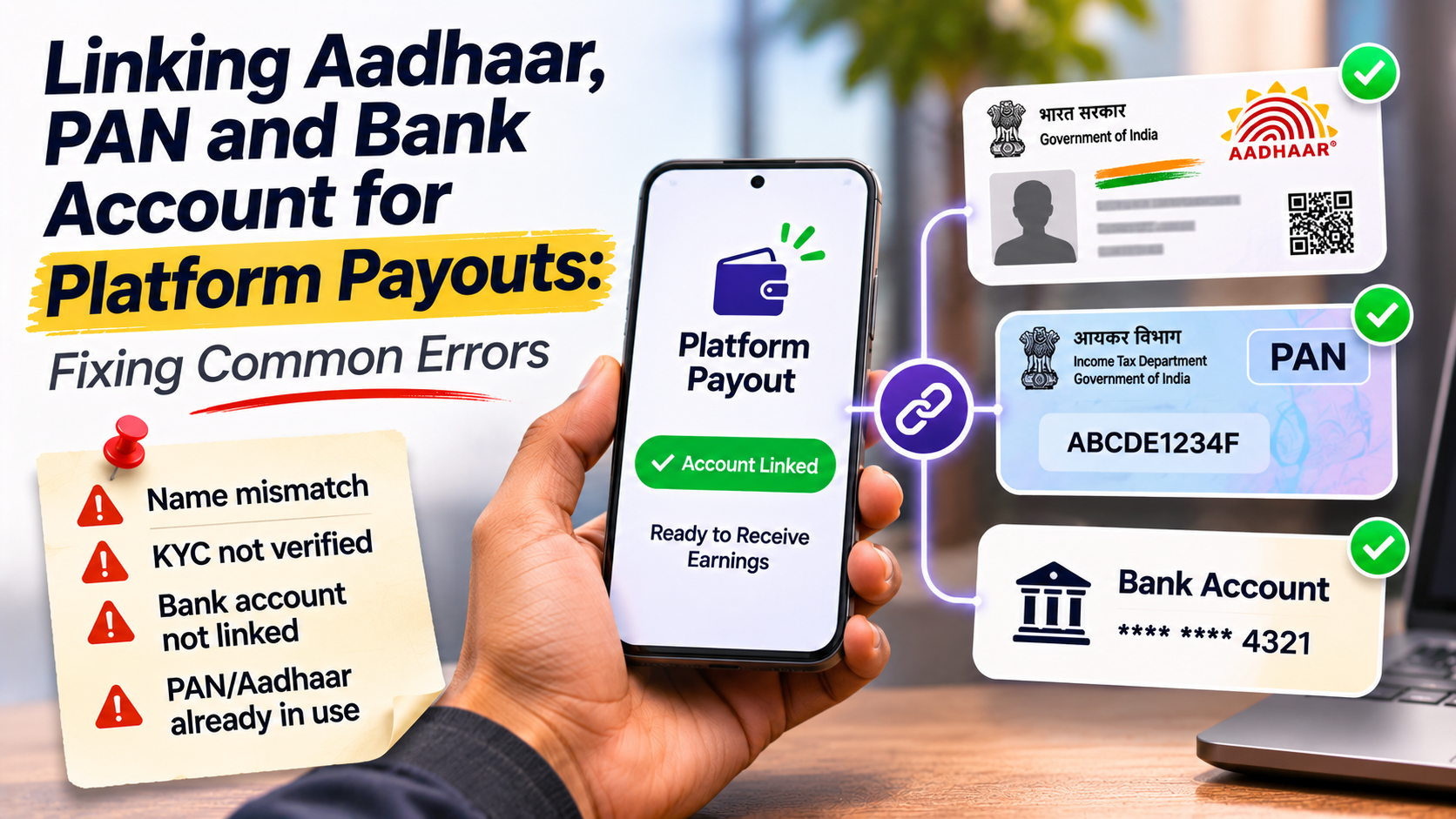
1. The three-way chain behind every payout
Every week, money leaves a platform's ledger and lands in your bank account - but only after three checks agree. The payment file carries your PAN; the tax system expects that PAN to be valid and linked to Aadhaar; the bank transfer is matched against the account holder's name the bank has on record. The three documents are one identity in three databases: Aadhaar proves who you are, PAN is your tax identity, the bank account is where the money lands. Verification vendors and onboarding teams cross-check them against each other, which is why a payout problem is rarely fixed inside the payout screen itself.
In practice the chain snaps in one of four places: a PAN that turned inoperative for want of an Aadhaar link (Section 3), three different spellings of your name across the documents (Section 4), a sleeping bank account or a retired IFSC code (Section 5), or an Aadhaar carrying an old mobile number so no OTP ever arrives (Section 6). Each has a known fix, a small fee and a predictable clock - and none of them needs a middleman.
2. What Swiggy, Zomato, Rapido and Uber actually verify
The document lists at sign-up are short and nearly identical across platforms. Swiggy asks for an Aadhaar or voter card, PAN card and driving licence, charges an onboarding fee of around Rs 1,500 that varies by city, and transfers earnings every week directly into your bank account(Swiggy partner page). Zomato requires a valid PAN and bank account proof at registration, runs a background check after you register, and pays out weekly to your bank(Zomato delivery FAQ); its app listing asks you to upload Aadhaar and PAN and finish a short online training(Google Play listing). Rapido captains need a driving licence, a profile photo, vehicle RC, PAN or Aadhaar card and bank details(Rapido captain page). Uber's standard list is a driving licence, vehicle registration, insurance and a background check(Uber documents page), and some cities' fleet partners additionally ask for a police verification certificate(Everest Fleet checklist).
The bank account itself is verified by a penny drop: the platform's payments vendor sends Re 1 or a similar micro-amount from a pooled account to your account number and IFSC, and reads back the account holder name registered at the bank(Cashfree penny drop docs)(Razorpay bank 1 verification). The transfer only succeeds if the name the platform holds and the name the bank holds agree. Industry failure data puts name mismatch at the very top of the list - ahead of wrong account numbers - precisely because the account number and IFSC look correct on screen (bondscanner explainer); unsupported account types, blocked or closed accounts and network failures make up the rest(Sign3 decoder).
3. Error one: PAN not linked to Aadhaar - the 20 per cent trap
Section 139AA of the Income-tax Act requires every PAN holder eligible for Aadhaar to link the two, and PANs not linked by 30 June 2023 became inoperative. The tax department's FAQ lists exactly what an inoperative PAN loses: no refund of any tax due, no interest on refunds, tax deducted at source at the higher rate under Section 206AA, and tax collected at source at the higher rate under Section 206CC(Link Aadhaar FAQ). The exemptions are narrow - residents of Assam, Jammu and Kashmir and Meghalaya, non-residents, people aged eighty or more, and non-citizens.
Why this bites payouts: Section 194-O obliges e-commerce operators to deduct tax on the gross amounts they pay to the participants who provide services through their platforms. The rate is 0.1 per cent since 1 October 2024, down from 1 per cent(statute text), and individuals whose gross receipts from a platform do not exceed Rs 5 lakh a year and who have furnished PAN or Aadhaar to it are exempt from the deduction. In practice, food delivery platforms deducted the tax anyway - Zomato's chief executive publicly noted the company was 'mandated by the government to deduct 1% as TDS from the delivery partner payouts' and had paid over Rs 4,000 crore of it(Deepinder Goyal on X)(Indian Startup News) - which is why the platforms built in-app ITR filing: over 50,000 Swiggy partners filed returns claiming Rs 6.5 crore of refunds(ThePrint), and Zomato and Blinkit helped one lakh partners claim Rs 18 crore(NDTV Profit). Every rupee of that refund flow depends on a valid, operative PAN.
If your PAN is inoperative, Circular 3 of 2023 treats it as if you had furnished no PAN at all, and Section 206AA then forces the deductor to apply the higher of the section's rate, the rate in force, or 20 per cent(Section 206AA text) - twenty per cent against 0.1 per cent on a payout cycle. The fix is a single paid transaction on the e-filing portal: pay Rs 1,000 under e-Pay Tax, selecting the current assessment year, 'Other Receipts (500)' as the type of payment and 'Fee for delay in linking PAN with Aadhaar' as the sub-type; then open the Link Aadhaar quick link - it works without login - enter PAN and Aadhaar, validate and confirm the OTP on your Aadhaar-registered mobile; finally check Link Aadhaar Status on the home page(official guide). Reactivation typically completes in about a week - Groww's help desk puts it at 6-7 business days(Groww) - and Protean's guidance allows up to 30 days for the PAN to become operative again(Protean).
4. Error two: your three names do not match
2 The linking OTP validates demographic details, so a PAN in one spelling and an Aadhaar in another simply fails to link. The FAQ's instruction is blunt: correct the details in either database until they match(Link Aadhaar FAQ). To fix the PAN side, file a change or correction application with Protean or UTIITSL, the two PAN service providers; the fee runs roughly Rs 50-110 depending on the service and whether you want a physical card(fee guide)(Protean correction portal)(UTIITSL).
On the Aadhaar side, name and address can be updated online through the SSUP portal, but know the lifetime limits before you spend them: UIDAI allows a name update only twice in a lifetime, and date of birth and gender once(UIDAI update FAQ). Beyond those limits you need a Gazette notification or court order and an exception approval at a UIDAI regional office. Marriage-name changes are the classic case - keep the Gazette or marriage certificate scanned and ready.
The same spelling discipline protects the penny drop: use one canonical name everywhere - the full name on PAN, Aadhaar and the bank passbook, not a short form on one and initials on another. If corrected records still refuse to link, the FAQ offers an in-person fallback: carry your PAN, Aadhaar and the Rs 1,000 fee challan copy to a dedicated Protean or UTIITSL centre and complete biometric-based authentication there(Link Aadhaar FAQ).
5. Error three: the bank account fails the penny drop
A bank account with no customer-initiated transaction for two years turns inoperative, and an inoperative account quietly eats payouts - the penny drop fails or the credit bounces. The Reserve Bank's June 2025 framework made the repair easier: banks must now accept re-KYC for inoperative accounts at any branch including non-home branches, through video KYC, and through business correspondents(Economic Times). Reactivation itself is routine: a reactivation form, fresh KYC documents - PAN and Aadhaar - and one transaction to bring the account alive.
The second bank-side failure is the IFSC code. Bank mergers retired thousands of codes, and a code that worked in 2018 can fail in 2026 even though the branch is still on the same road(IFSC merger guide); transfers bounce with a 'beneficiary bank invalid' error(desiutils explainer). Successor banks publish new-code lists - Indian Bank, for one, maintains the updated IFSC and MICR list for erstwhile Allahabad Bank branches(Indian Bank page) - and the RBI's NEFT branch list, refreshed monthly and updated as on 31 October 2026, is the authoritative lookup(RBI list). If your passbook carries a pre-merger code, update the IFSC on the platform app the same day.
Two more quiet killers: joint accounts, which many payout systems reject because the beneficiary name must match a single KYC record, and accounts closed or converted without notice. A savings account used only for payouts still needs one transaction a year to stay awake. If a payout fails, repair the account first, update the details in the platform app, and let a fresh penny drop clear before the next weekly cycle.
6. Error four: the Aadhaar side blocks the OTP
3 Every platform KYC and the PAN-Aadhaar link itself lean on the OTP sent to your Aadhaar-registered mobile number. If that number is an old, surrendered SIM, nothing downstream works. UIDAI's current position is friendlier than the old rulebook: the official Aadhaar app now offers mobile number update alongside address update, biometric lock and e-Aadhaar download(UIDAI update page), and demographic updates can also be filed online on the SSUP portal at Rs 50 per request(SSUP).
At an Aadhaar centre a demographic update costs Rs 50, and a biometric update - photo, fingerprints, iris - costs Rs 125 inclusive of all taxes(UIDAI's published charges)(fee summary). Name is capped at two lifetime updates and date of birth at one, as Section 4 noted, so spend them wisely; address updates are unlimited. UIDAI's own guidance allows 30 to 90 days for an update to fully reflect, though most demographic changes clear far sooner(UIDAI FAQ).
While you are inside the government stack, keep DigiLocker current: platforms and verification vendors increasingly pull Aadhaar, PAN and driving licence documents from it during KYC(NSDL Trust DigiLocker verification), so a corrected document there propagates cleanly to onboarding checks.
7. No PAN yet - and what each fix costs and takes
No PAN at all? The e-filing portal issues an instant e-PAN free of cost, paperless, using your Aadhaar, and a regular PAN application costs Rs 91 excluding GST for an Indian communication address(official PAN services page). Get the PAN first, link it to Aadhaar while the e-PAN is fresh, and then onboard - the order matters, because both the platform KYC and the payout tax chain hang off the PAN.
The repair bill, itemised: Rs 1,000 to link an overdue PAN to Aadhaar, Rs 50-110 for a PAN correction, Rs 50 for an online Aadhaar demographic update or Rs 125 for biometrics at a centre, and nothing for a bank re-KYC or an IFSC update. The clock, itemised: PAN reactivation 6-30 days after linking; Aadhaar updates 30-90 days officially, usually days in practice; bank reactivation within one branch visit; the IFSC fix in minutes. None of these fees go to middlemen - every portal above takes payment itself and issues a receipt, so an agent promising a faster link for extra cash is selling nothing.
8. A payout-health checklist
Before you onboard anywhere, run this five-minute audit: the name on PAN, Aadhaar and the bank passbook is spelled identically; Link Aadhaar Status on the e-filing portal shows your PAN linked; your Aadhaar-registered mobile is a live SIM in your hand; the payout account is your own, single-name, active account, with the IFSC taken from your latest passbook or cheque leaf.
4 After onboarding, check the app's Payments section after the first weekly cycle - Zomato pays weekly and Swiggy transfers weekly. Once a quarter, open Form 26AS or the Annual Information Statement on the e-filing portal: the TDS platforms deducted appears against your PAN there, and it is the paper trail behind the ITR refunds Swiggy's and Zomato's partners have been claiming by the tens of thousands. Keep the Rs 1,000 challan, the fee receipts and the acknowledgment slips in one folder. If a payout still fails after the chain is repaired, escalate through the platform's grievance officer with those receipts attached.