India EV Gig Workforce Report 2026
How electric two-wheelers are rewriting the pay, costs and careers of India's delivery and ride-hailing riders.
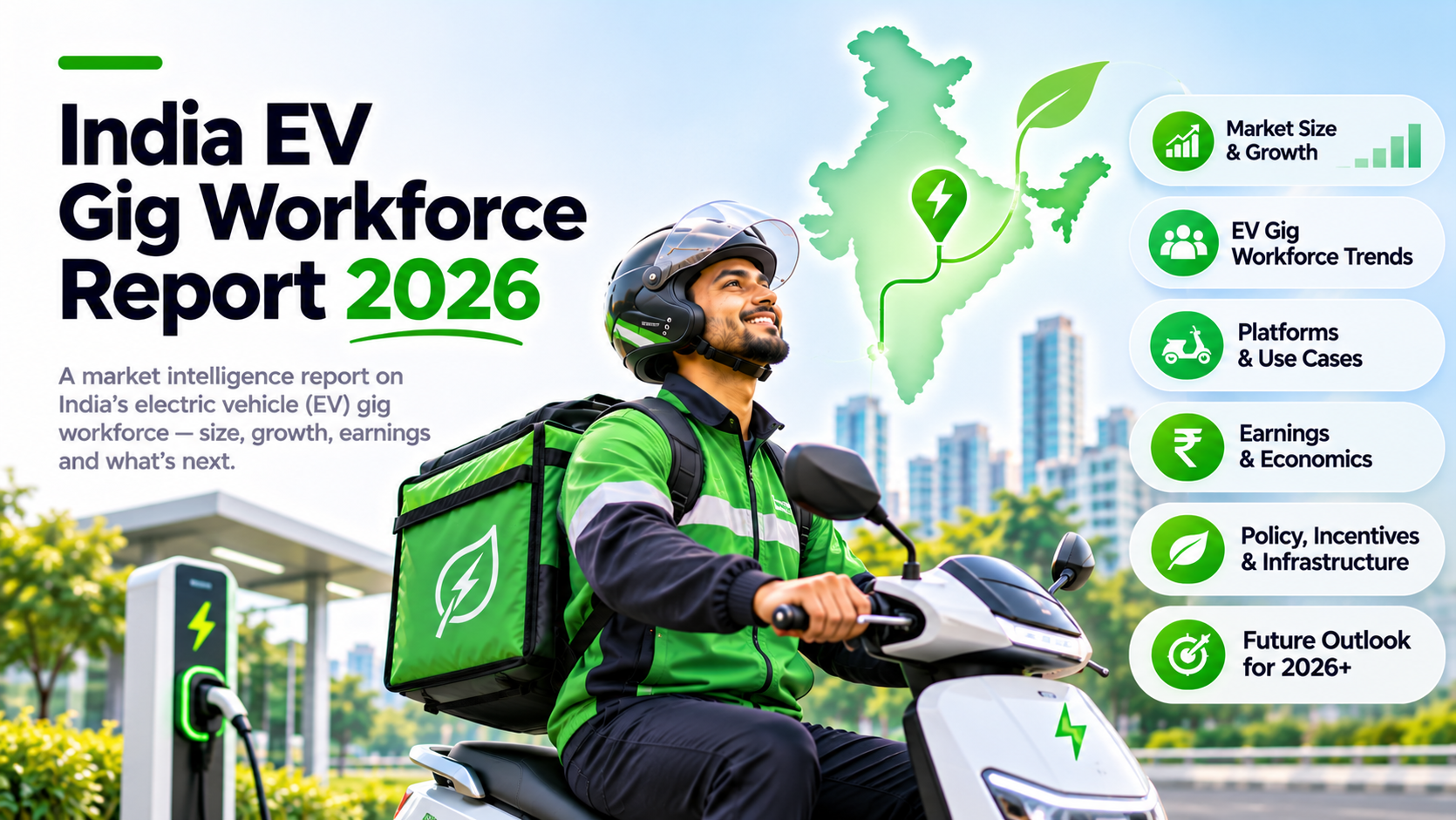
Every delivery job in India runs on a two-wheeler, and in 2026 that two-wheeler is going electric faster than almost any other vehicle class in the country. The backdrop is a gig workforce thatNITI Aayog projects will grow from an estimated 77 lakh workers in 2020-21 to 2.35 crore by 2029-30, inside an economy wheremore than 31.7 crore unorganised workers had been registered on the e-Shram portal by mid-July 2026. Delivery and ride-hailing sit at the sharpest edge of that workforce — and the scooter under the rider is both the sector's biggest daily cost and, increasingly, its biggest earning lever.
This instalment of our gig-economy series — after earlier reports on the workforce, the hiring funnel, the job market, hiring economics, the ecosystem map and the future of delivery work — is dedicated to the machine itself. Where the future-focused report treated electrification as one trend among many, this one follows the vehicle all the way through: what India actually bought in 2026, what a rider saves per kilometre, how the purchase is financed, where batteries get charged and swapped, what the subsidy and state rulebooks say, how platform pledges are being executed on the ground, and where the friction still sits.
1. The 2026 snapshot: electric two-wheelers go mainstream
The demand base is no longer a niche.India retailed about 13.4 lakh electric two-wheelers in 2025, a 6 per cent share of all two-wheelers sold;in the first five months of 2026, sales reached 8,01,277 units, up 49 per cent year on year, lifting the electric share of the two-wheeler market to 8.17 per cent and putting the segment on course for 2 million annual sales.September 2026 alone saw 2,07,314 electric two-wheeler registrations, up nearly 89 per cent year on year on FADA data. Over the past decade,electric two-wheelers have accounted for 56 per cent of every EV sold in India, making them the country's largest EV category by volume.
Gig riders are the anchor customers of this curve.Blinkit counted roughly 50,000 EV delivery partners by March 2025 and targets 100 per cent EV deliveries by 2030;by early 2025, about 80 per cent of Blinkit's last-mile fleet in Gurugram was already electric, with most of those riders on Yulu's shared electric bikes.EV-as-a-service operator Zypp Electric runs a fleet of over 20,000 electric two-wheelers and 800-plus cargo three-wheelers serving Zepto, Flipkart, Zomato, Myntra, Blinkit and BigBasket. The delivery rider's 120-150 kilometre working day, once done on a petrol scooter, is now the core commercial use case around which the electric two-wheeler industry designs its products.
2. The per-kilometre pay rise: why riders switch
For a gig worker the EV case is arithmetic, not ideology.A 2025 study put the running cost of an electric two-wheeler at about Rs 1.48 per kilometre, against roughly Rs 2.46 for a petrol model.
Delivery partners typically ride 120-150 kilometres a day, so moving to a rented or financed EV can save a rider between Rs 8,000 and Rs 15,000 a month — money that lands as an instant pay raise.Battery Smart, whose swap network serves some 70,000 drivers a day, reports its users earn 1.5 times more than comparable petrol drivers — a commercial claim, but one that tracks the fuel arithmetic closely.
Two recent shocks sharpened the maths.Petrol and CNG price hikes in May 2026 acted as a significant demand catalyst for electric two-wheelers. Andunder GST 2.0, effective September 22, 2025, electric vehicles kept their 5 per cent GST while combustion two-wheelers moved to 18 per cent — narrowing the upfront price gap at exactly the moment running costs were diverging. For riders paying both an EMI and a fuel bill, the switch decision in 2026 metro delivery zones is close to self-executing.
3. Financing the switch: loans, leases and Rs 250-a-day rentals
The barrier is not fuel maths but credit maths. Most new riders are recent migrants with thin credit files and no collateral, which is why a parallel financing industry has grown up.EV-focused lender Revfin underwrites two-wheeler loans on business use case and expected daily earnings rather than credit history alone;green lender Ecofy structures small-ticket, zero-collateral loans around gig workers and micro-fleet owners; andNITI Aayog's EV-financing study with ADB recommends bringing commercial EV loans for driver-owners under priority sector lending and decoupling battery from vehicle to cut risk.
Renting is the other door, and it is getting crowded.In the Zepto delivery ecosystem, commercial EV scooters rent for Rs 120-170 a day with unlimited battery swaps and maintenance included;dedicated delivery-rental fleets advertise delivery-spec electric scooters from about Rs 250 a day; andrental operators such as Bijliride, running 4,000-plus vehicles and deploying 2,500 more to gig workers in 90 days, are building businesses around exactly this gap. The catch is the cost of money:IEEFA's feedback on Delhi's draft EV policy notes that commercial EVs are financed at 15-20 per cent or more, which can swamp modest purchase incentives. Interest, not sticker price, is the EV worker's real tax.
4. Charging and swapping: the network that keeps riders earning
Public charging is growing but still thin for commercial duty:India had 52,718 public EV charging stations as of late July 2026 — a large number, spread across a country where a parked scooter cannot earn. High-utilisation riders therefore lean on two other rails: overnight home or dark-store charging, and battery swapping.Battery Smart has scaled India's largest swap network to about 1,500 stations across 50 cities, processing over 125,000 swaps a day for roughly 70,000 drivers, andraised a $19.5 million Series C in August 2026 at a $430 million valuation to keep expanding.SUN Mobility runs interoperable swapping across 23-plus cities and has begun exporting the model to Africa.
Policy has caught up with the model:India formally recognised the battery-as-a-service model in 2025 and simplified power-connection approvals for swap stations, which matters because a swap network's economics depend on cheap, fast commercial electricity. For a rider the appeal is blunt: the network owns the battery, the rider buys kilometres, and a vehicle that would otherwise sit charging at midnight is back on the road in about two minutes. For fleets running 20,000-unit operations, uptime is the entire business.
5. Policy: PM E-DRIVE, the subsidy squeeze and the state rulebooks
The central subsidy engine has been running hotter and leaner at the same time.PM E-DRIVE, implemented from October 1, 2024, targets incentives for about 24.79 lakh electric two-wheelers;its e-two-wheeler demand incentive has been halved to Rs 5,000 per vehicle, and the scheme has been extended to March 2028.As of December 31, 2025, Rs 1,703 crore had been reimbursed to electric two- and three-wheeler manufacturers under the scheme. The direction of travel is clear: demand support is tapering, and the sector is expected to stand on its own economics — which, at Rs 1.48 per kilometre against Rs 2.46, it increasingly can.
States write the finer print.Maharashtra's EV Policy 2025-30 offers purchase incentives of up to Rs 10,000 per electric two-wheeler. Delhi, the country's densest delivery market,released its draft EV Policy 2026-2030 in April 2026, adopting a tapering incentive structure focused on e-two-wheelers, e-three-wheelers and small goods carriers, andbudgeted Rs 200 crore in 2026-27 to accelerate the retirement of high-emission vehicles and push a public EV fleet.Think-tank feedback on the draft welcomes the ambition while warning that incentives alone will not bridge a 15-20 per cent commercial financing gap. For gig workers the practical takeaway is that subsidy terms differ city by city — and they expire.
6. Platform pledges meet fleet operations
The platforms' public promises are old news; 2026 is about execution.Zomato, now Eternal, joined the Climate Group's EV100 in June 2021 with a commitment to 100 per cent electric deliveries by 2030, andin August 2026 it launched its own EV rental fleet in Delhi so that riders without vehicles can work electric.Swiggy, which shares the same 2030 target, joined the Deliver-E zero-emission delivery coalition in October 2025. The heavier lifting belongs to the middle layer: fleet-as-a-service companies such as Zypp and Yulu that own, finance, charge and maintain the scooters riders simply rent by shift.
The year also supplied the cautionary tale.BluSmart, an all-electric ride-hail fleet of about 8,500 EVs across Delhi NCR, Bengaluru and Mumbai,suspended services in April 2025 as its parent Gensol Engineering came under a SEBI probe, and Uber called off talks to absorb some 5,000 of its cars the following month. The lesson for the gig workforce is structural: asset-heavy EV models carry balance-sheet risk that riders cannot see from the driver's seat. It is one reason platforms prefer rental and leasing partners — when a fleet operator wobbles, a rider loses a vehicle for a day, not a livelihood.
7. The friction: after-sales, resale and the cost of downtime
Electric does not yet mean frictionless, and 2026 showed where the seams run.Ola Electric, once the category's volume leader, spent the year abandoning its D2C-only retail model in favour of dealerships amid a sharp market-share decline — a reminder that for a gig worker whose scooter is a daily income instrument, service density and spare-parts availability matter more than spec sheets. Volume leadership has shifted toward established manufacturers with dealer networks, and reliability now decides which brands earn delivery-duty trust.
The deeper friction is financial and temporal.Commercial EV financing at 15-20 per cent or more keeps the total cost of ownership worse than a showroom board suggests. Battery ownership concentrates risk on the rider — degradation, replacement cost and resale uncertainty — which is exactly whybattery-as-a-service models that separate the battery from the vehicle are gaining commercial and policy ground. And downtime is income: a scooter off the road during a surge hour is a wage cut, so uptime engineering — swap coverage, service turnaround, replacement vehicles — is becoming a competitive weapon for the platforms' fleet partners.
8. The road to 2030: what riders and operators should watch
If the 2026 run-rate holds,India will cross 2 million electric two-wheeler sales in a single year, and the commercial segment should keep outgrowing the consumer one because it is justified per kilometre, not per status. Watch four variables. First,whether the PM E-DRIVE taper to Rs 5,000 per two-wheeler through March 2028 is followed by an incentive-free regime the fuel arithmetic can survive. Second,whether Delhi's draft 2026-2030 policy becomes the template other states copy for delivery-fleet electrification. Third, swap-network coverage:a 1,500-station network processing 125,000 swaps a day is the benchmark that keeps rider uptime viable in metros.
The workforce effects are easy to miss. Swap stations, dark-store charging bays and rental hubs are becoming gig-adjacent employers in their own right, andNITI Aayog's financing roadmap explicitly treats commercial EV lending as an enabler of driver livelihoods. For a rider deciding today, the checklist is practical: rent before you borrow, compare swap coverage near your dark stores, price the EMI against your own thirty-day trip log, and check the service network before the brand. The electric gig workforce is no longer a pilot cohort; it is the direction the whole occupation is moving in.