How to Calculate Your Real Earnings as a Gig Worker After Fuel, Rent, Bike EMI and Other Expenses
The payout total on the app is gross revenue, not income. The five-line ledger — fuel, EMI, insurance, maintenance, platform fees — plus two ratios and three worked examples, shows what actually survives.
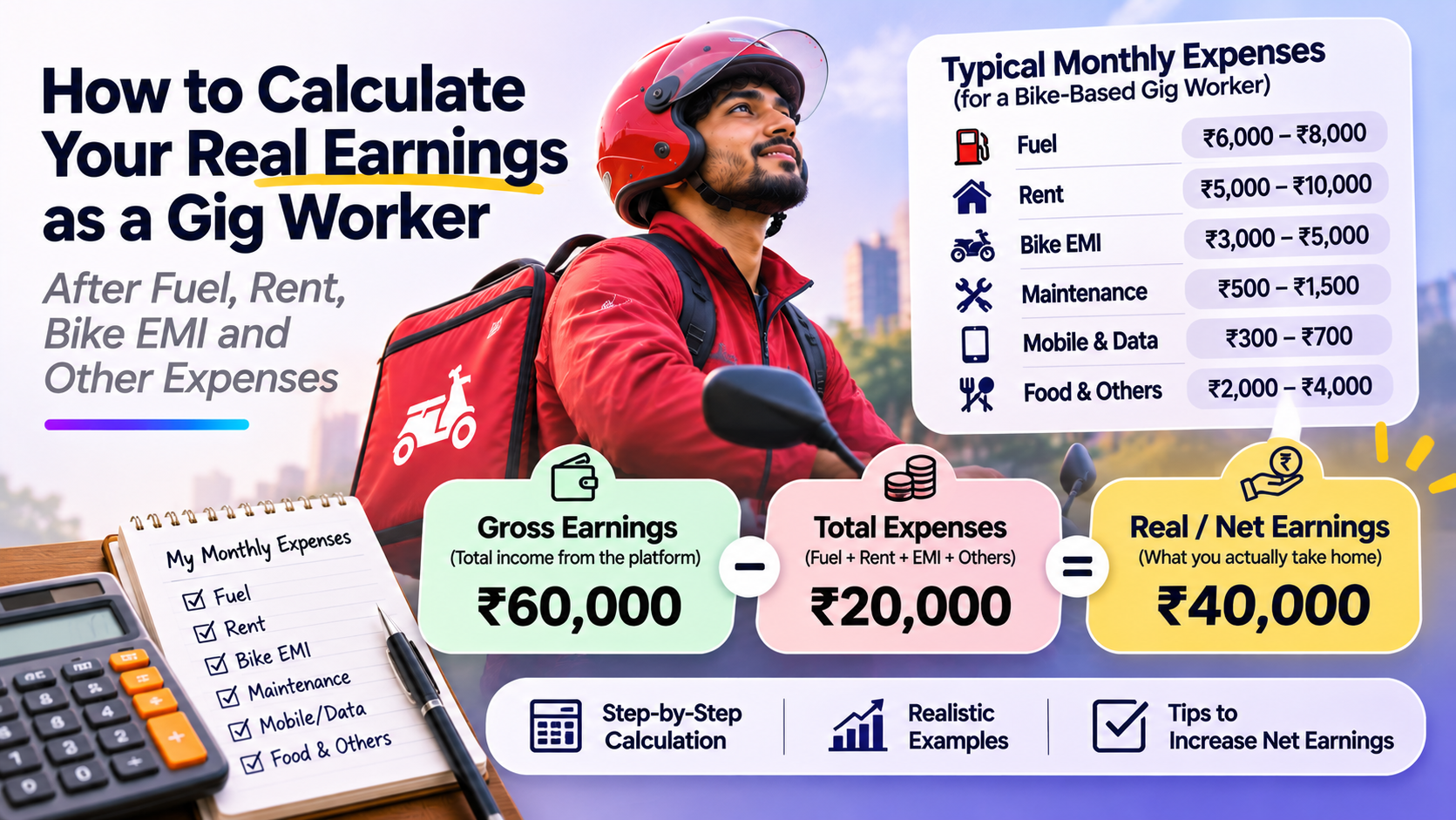
1. The number the app shows is not the number you live on
The daily total on a delivery or driver app feels like income. It is not. It is gross payouts — the revenue the work generated before a single cost was paid. Between that number and the money a worker actually lives on stand fuel, bike EMI, insurance, maintenance, data packs, platform charges and, eventually, rent. Real earnings are what survive that stack, and they are invisible inside every app: no major Indian platform displays a net figure anywhere in its interface. The worker who does not run the ledger personally is running the business blind.
The hours involved make the gap matter. A nationwide survey by the NGO Janpahal,reported by The Hindu in September 2026, found 57 per cent of gig workers work more than 49 hours a week and almost 23 per cent work over 70 hours — longer than most formal jobs in the same pay bracket. At a nine-hour, 26-day month, every Rs 20 of hidden cost per hour strips out Rs 4,680 a month between the app and the wallet — the difference between saving and borrowing.The same survey found 72.3 per cent of respondents had stayed on platforms for more than a year, so this is not a one-month calculation; it is a budget that has to hold for years.
2. The five-line formula that turns payouts into real earnings
The whole calculation fits on five lines. Line one: gross payouts — everything the platform credited during the month, taken from the payout statement rather than memory, and counting incentives only if they actually landed. Line two: fixed costs — the bills that arrive whether the phone is switched on or not: bike EMI, annual insurance divided by twelve, subscription passes, accessory instalments. Line three: variable costs — fuel, a maintenance set-aside per kilometre, and the data pack. Line four: platform charges — commissions or pass fees, plus anything clawed back through refund offsets. Real earnings are line one minus lines two, three and four. Everything else is commentary.
Two ratios make the number usable. Net earnings per hour is the only honest wage rate in gig work, and it must be computed on hours spent on the app — not hours paid for, because waiting outside a restaurant or a surge zone is unpaid by design. Cost per kilometre is the other:petrol now costs Rs 102.12 a litre in Delhi and Rs 116.15 in Hyderabad, which on a commuter bike doing 48 km to the litre works out to Rs 2.13 and Rs 2.42 of fuel per kilometre. Every extra kilometre a rider accepts — a longer detour, an additional drop — has to be judged against that running cost, not against the order value alone.
3. Fixed costs: the EMI, the insurance and the rent
Start with the loan, because many riders do not own their bike outright. An illustrative but typical case: a Rs 60,000 two-wheeler loan at 11 per cent for two years carries an EMI of Rs 2,796 — due whether the month brought 200 hours of work or 20. The EMI is therefore the first line of the fixed block, not an afterthought, and it converts part of every month's payouts into a payment to the past rather than income for the present.
Insurance is small but constant. The insurance regulator fixes third-party premiums by engine size, andfor financial year 2026-27 a one-year third-party policy costs Rs 714 for a 75cc-150cc bike and Rs 1,366 for a 150cc-350cc bike, with five-year plans at Rs 3,851 and Rs 7,365. Divided by twelve, the monthly damage is Rs 60 or so — negligible, except that a lapsed policy converts one accident into an unpayable liability. Separately,the Motor Vehicle Aggregator Guidelines 2025 require platforms, not workers, to provide health insurance of at least Rs 5 lakh and term insurance of Rs 10 lakh; a worker should verify those policies actually exist inside the app rather than assume the vehicle policy covers anything beyond the vehicle.
Rent is the most misunderstood line. It is not a cost of the bike — it is a claim on the earnings the bike produces, and it belongs to a second ledger: the household ledger. A one-BHK flat rented in April 2026 costRs 12,000-25,000 a month in Delhi-NCR, Rs 15,000-30,000 in Bengaluru, Rs 35,000-65,000 in Mumbai and Rs 10,000-22,000 in Hyderabad or Chennai. Charging rent to the bike muddles both accounts. The correct discipline is to compute business net earnings first, then test whether they cover the household ledger — rent, food, school fees, debt — with something left to save.
4. Variable costs: fuel does the most damage
Fuel is the biggest controllable cost, and it varies by city more than riders realise.Petrol stood at Rs 102.12 a litre in Delhi, Rs 107.76 in Chennai, Rs 111.21 in Mumbai, Rs 111.68 in Bengaluru and Rs 116.15 in Hyderabad in the second week of November 2026. The same month of riding — 90 kilometres a day across 26 days, or 2,340 km — burns about 48.75 litres on a 48 km/l commuter bike, which costs Rs 4,978 in Delhi and Rs 5,662 in Hyderabad. That Rs 684 difference is a pure geography tax on identical work.
Fuel is also the cost where behaviour changes the number fastest. Maintenance — servicing, tyres, brake pads, chain — averages roughly Rs 0.50 per kilometre on a commuter bike over a year (illustrative; every rider should divide their own annual repair bills by their own kilometres), and a prepaid data plan adds Rs 250-350 a month. Together with fuel, the full running cost lands near Rs 2.6-3 per kilometre before a rupee of EMI or rent. That figure is worth memorising, because platforms price orders per drop and riders think in per-drop terms — while the vehicle bills per kilometre.
5. Platform take: commissions are turning into subscriptions
The platform's own slice is a moving target, and the past two years rewrote it. Ride-hailing commissions used to runas high as 15-20 per cent per ride, according to Inc42's report on Uber's cab pilot. Nowthe Motor Vehicle Aggregator Guidelines 2025 cap the aggregator's share at 20 per cent of each fare in most cases and require a minimum guaranteed earning per hour or day. Under the zero-commission wave, Rapido moved first in 2023;Uber scrapped commissions for autorickshaw drivers in February 2025 in favour of a subscription fee; andOla rolled subscriptions out to its autos and reportedly its cabs, while Uber piloted cab passes in Delhi-NCR in August 2025 — a 72-hour pass priced at Rs 341 including 18 per cent GST, alongside a 24-hour option.
The switch matters for the ledger because it converts a variable cost into a fixed one. A commission scales down on a slow week; a Rs 341 pass does not. A cab driver buying nine 72-hour passes to cover a 26-day month pays Rs 3,069 — cheaper than a 20-per-cent commission only if the month's payouts exceed roughly Rs 15,300, which is where pass fees overtake commission.Research covering 2,100 drivers and passengers across 13 cities, reported by The Economic Times in August 2026, puts the stakes higher: a cab driver grossing Rs 4.5 lakh a year could keep about Rs 1.36 lakh more annually under a zero-commission model — though the same report flags unresolved GST questions under Section 9(5) that keep the transition uncertain. Whatever the model, the ledger line is identical: log every pass, commission and deduction weekly, because the platform's take is the one cost that never sends a bill.
6. Three riders, three ledgers: worked examples
The method is easier to trust with numbers attached. The three examples below are illustrative — payout rates, hours, mileage and rental rates are assumptions, each flagged in the method notes — but every rupee of arithmetic is exact, and the structure is the point: same formula, three very different survivors.
Rider A — Delhi, owned bike, food delivery. Works nine hours a day for 26 days — 234 hours on the app — and the payout statement shows Rs 26,910 (an assumed Rs 115 an hour). The bike runs 2,340 km, burning 48.75 litres of Delhi petrol: Rs 4,978. Maintenance set-aside at Rs 0.50 a kilometre: Rs 1,170. One-twelfth of the Rs 714 insurance: Rs 60. EMI on the Rs 60,000 loan: Rs 2,796. Data: Rs 300. Total business costs: Rs 9,304, so real earnings are Rs 17,606 — Rs 75 for every hour on the app. Then the household ledger opens: rent of Rs 15,000 for a modest one-BHK leaves Rs 2,606 before food, electricity and school fees. The app showed about Rs 1,035 a day; the ledger shows less than Rs 100 of it left over.
Rider B — Bengaluru, cab, two fee models. Uses the Rs 4.5 lakh-a-year gross benchmark from the ET-reported study: Rs 37,500 a month across 260 hours. Runs 2,600 km on CNG at Rs 99 a kilogram — 104 kg, or Rs 10,296 — plus Rs 2,080 of maintenance, Rs 400 of car insurance and Rs 300 of data: Rs 13,076 before platform charges. Under a capped 20-per-cent commission (Rs 7,500), real earnings are Rs 16,924, or Rs 65 an hour. Under the pass model — nine 72-hour passes at Rs 341, or Rs 3,069 — real earnings are Rs 21,355, or Rs 82 an hour. Same car, same hours, same fuel: the fee architecture alone changes the month by Rs 4,431, which is why the fee model deserves its own ledger line.
Rider C — Hyderabad, rented scooter, quick commerce. Rents instead of owning: Rs 300 a day for 26 days, or Rs 7,800, with maintenance and insurance typically bundled into fleet rentals.
Payouts: Rs 24,570 (an assumed Rs 105 an hour across 234 hours). Petrol at Hyderabad's Rs 116.15 — the highest of the major metros — costs Rs 5,662 for the same 2,340 km. Data: Rs 300. Real earnings: Rs 10,808, or Rs 46 an hour, with the rental alone eating 31.7 per cent of payouts. Renting shifts repair risk to the fleet, but the comparison with Rider A is stark: A's EMI, insurance and maintenance together cost Rs 4,026 against C's Rs 7,800 rental — a Rs 3,774 monthly premium for not owning, paid out of the thinnest earnings of the three.
7. What research says about the number at the bottom
The research record matches the arithmetic. The study of 2,100 drivers and passengers across 13 cities reported by The Economic Times found drivers on closed, commission-based networks surrender enough to makea zero-commission model worth about Rs 1.36 lakh a year to a driver currently grossing Rs 4.5 lakh — close to 30 per cent of gross revenue, the same order of magnitude as Rider A's entire cost stack. On the asset side,Women's World Banking's June 2026 study with Urban Company found women service partners who acquired a two-wheeler increased monthly jobs from 41 to 45 and raised net monthly earnings by Rs 5,966 — evidence that the fixed-cost line can be an investment rather than a burden when the financing is structured sensibly.
The hours data closes the loop.Janpahal's survey found 57 per cent of gig workers above 49 hours a week, 23 per cent above 70, and nearly three-quarters past their first year on platforms. Long hours are the standard coping strategy for thin net rates, and the persistence data suggests they are not working: workers are staying for years inside a calculation that looks fine in the app and fails in the ledger. The gap between the two numbers is where loan stress, skipped insurance renewals and abandoned savings live. No regulator computes it per worker; the 20-per-cent cap and the guaranteed-earning floors set the frame, but the only calculator for an individual worker is the worker's own ledger.
8. Run a 30-minute audit every month
The audit is short and repeatable. Pull the payout statement and add up everything credited — that is line one. Note the odometer at the month's start and end, and keep every fuel slip or refill log — that is line three's backbone. Divide annual costs by twelve for the fixed block: EMI, insurance, device or bag instalments. Photograph the app's deduction and pass-fee screens weekly, because that is the line most likely to move without notice. Then compute three numbers: real earnings for the month, real earnings per hour on the app, and cost per kilometre. Ten minutes of arithmetic; the payoff is knowing instead of guessing.
Re-run the audit whenever the inputs move — and they move often. Petrol prices revise daily, andthe spread between Delhi's Rs 102.12 and Hyderabad's Rs 116.15 a litre is already a 14-per-cent difference in fuel cost for identical work. Fee models are in flux as the commission-to-subscription transition plays out, and the guaranteed-earning floors under the 2025 guidelines will shift payouts themselves. The five lines take thirty minutes a month; the alternative is discovering the difference between gross and real the way most workers do — at the fuel pump, on the EMI debit date, at the end of a month when the rent is due. That ledger is, in the end, the only honest measure of gig worker real earnings India's app-based economy has produced so far: the apps show the first