Gig Worker Salary in India: How Much Can You Actually Earn Per Month?
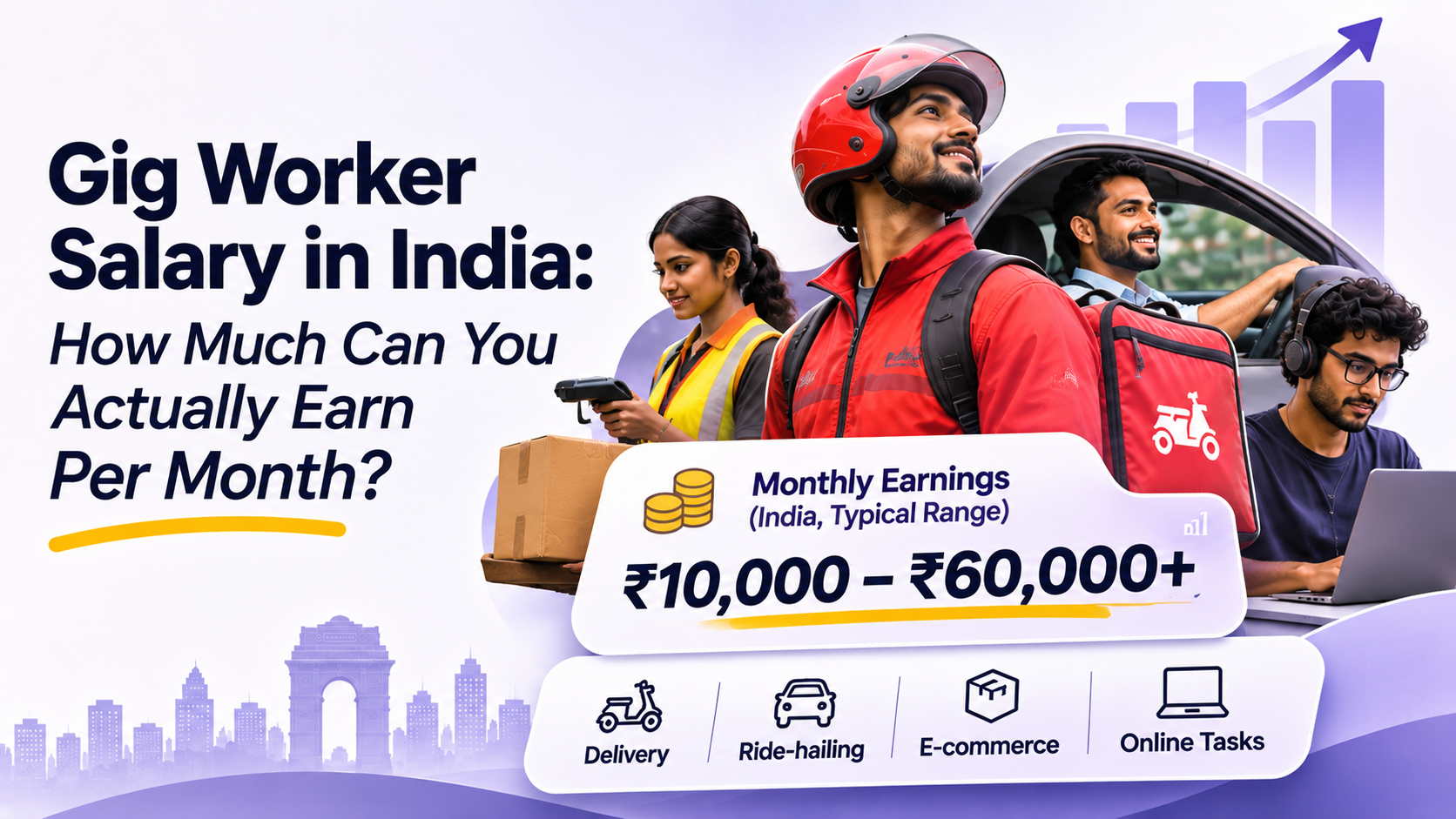
Between the advertised ceilings of Rs 50,000-60,000 a month and the 40 per cent of gig workers earning under Rs 15,000 lies the real answer.
1. What the national numbers actually say
Start with the government's own arithmetic.The Economic Survey 2025-26 states that about 40 per cent of gig workers report earnings below Rs 15,000 a month — a figure it draws from the Indian Staffing Federation — and frames the consequence as income volatility that makes credit, savings and insurance hard to plan (the same sentence sits in the employment chapter of the full Survey document). The Survey also goes further than any of its predecessors:it recommends setting minimum per-hour or per-task earnings for platform work, explicitly including waiting time, alongside portable social security and low-cost emergency savings schemes. An official document calling for a pay floor is itself a signal of how low the floor currently sits.
Industry data fills in the average.The Redseer Gig Internet Workforce Report 2026, built on a survey of 2,250 gig workers, puts average gig earnings at about Rs 138 an hour against roughly Rs 54 an hour in comparable non-gig informal work — a 2.5x premium.Monthly, it finds full-timers average about Rs 32,000, with home services at Rs 70,000-80,000, ride-hailing at Rs 37,000-39,000 and delivery at Rs 22,000-23,000. Both pictures are true at the same time becauseover 90 per cent of gig internet workers engage part-time — averaging about five hours a day, three days a week — so a high hourly rate and a modest monthly income routinely belong to the same worker. And the population this question applies to is large and growing:NITI Aayog expects India's gig workforce to triple from 77 lakh in 2020-21 to 2.35 crore by 2029-30.
2. Delivery pay, itemised: the per-order maths
Food and quick-commerce delivery is the entry point for most of the workforce, and its pay is built from parts.A January 2026 Moneycontrol review of the pay model puts base pay at Rs 20-50 per order within a 5 km radius, plus roughly Rs 8-10 for each additional kilometre; all-in, a rider earns about Rs 40-50 per order in quick commerce and Rs 50-70 in food delivery, with peak surge pushing New Year's Eve orders to Rs 120-150.Incentive slabs tied to completing 10, 20 or 25 orders a day sit on top, and tips — roughly 5 per cent of orders — pass through in full. Zomato's own disclosed averageworked out to about Rs 102 an hour in calendar 2025, up from Rs 92 in 2024.
The advertised ceilings are far higher.Blinkit's own recruitment page promises up to Rs 50,000 a month with incentives and weekly payouts,and reporting on Swiggy's partner listing cites up to Rs 60,000 a month plus a joining bonus of up to Rs 10,000. The most careful public arithmetic comes from Zomato's founder, quoted in the same Moneycontrol review:"If someone were to work for 10 hours/day, 26 days/month, this translates to ~Rs 26,500/month in gross earnings. After accounting for fuel and maintenance (~20%), the net earnings for the partner are ~Rs 21,000/month". The gap between Rs 60,000 and Rs 21,000 is not mainly deception; it is definition. Ceilings describe the busiest rider in the best week with every incentive landed; the average month, on the same company's numbers, is worth about a third of that.
3. Ride-hailing: what is left after commission and fuel
Cab and bike-taxi work looks better paid per trip and often ends up worse per month.A TISS case study of Ola and Uber driver partners recorded average monthly earnings after all expenses of about Rs 18,970 for lessee drivers — men who rent their vehicles — and Rs 31,173 for owner-cum-drivers.The study's illustrative Uber fare screenshot shows a 20 per cent platform commission plus taxes coming off the trip bill before the driver sees it, and drivers reported Ola charging commission on a per-trip basis along with further deductions. The TISS authors' conclusion is blunt: at current commission rates, taxes and fuel prices, the business remains sustainable mainly for the owner-cum-driver, who saves the driver fee and collects incentives directly. Renting a car converts a driving income into something closer to a wage with a landlord attached — which is why the same app can support an owner above Rs 31,000 and a renter below Rs 19,000 a month.
4. Home services and Amazon Flex: the upper tier
The best-documented earnings data in Indian platform work now comes from Urban Company, which publishes a partner earnings index.For the first nine months of FY26, average net in-hand earnings were Rs 28,322 a month, up from Rs 26,489 a year earlier; the top 20 per cent earned Rs 42,418, the top 10 per cent Rs 47,471, and the top 5 per cent Rs 51,673 — nearly 60 per cent more than a typical entry-level IT fresher salary.Since active partners spent about 91 hours a month on the platform, the company's own division puts net earnings at roughly Rs 313 an hour — more than double the gig-wide average.The same disclosure lists group life insurance of up to Rs 10 lakh, disability cover of Rs 6 lakh and National Pension System access: precisely the benefits layer that delivery and ride-hailing work lacks.
Amazon Flex occupies the middle ground.Its India page promises up to Rs 140 an hour, with estimated earnings shown before a delivery block is accepted. That upfront rate disclosure answers the single biggest complaint about per-order pay — that a rider discovers the effective hourly rate only after the waiting and the distance are done. It is a maximum, not a promise, but it shows what transparent per-task pricing looks like on an app screen.
5. The hours and costs behind every headline number
Three adjustments turn any monthly figure into a realistic one. First, hours:the average delivery partner logged in only 38 days across the entire year on Zomato's platform, and only 2.3 per cent worked more than 250 days — for most users, the app is a supplement, not a salary.Redseer's survey agrees: over 90 per cent engage part-time, about five hours a day, three days a week. Second, unpaid time:the Economic Survey's proposal to set per-task earnings "including waiting time" exists precisely because time spent waiting between orders currently earns nothing. Third, costs:fuel and maintenance consume roughly a fifth of gross earnings in Zomato's published arithmetic, before phone data, vehicle loan instalments and insurance.
At the sharp end, the field research is sobering.A 2025 study of 425 app-based food-delivery riders in Tamil Nadu found 66.8 per cent skipping meals while on duty and 63.3 per cent reporting dehydration — a direct consequence of pay tied to speed and volume, where every unpaid minute off the road is lost income.A second 2025 study of 255 platform workers in the state found more than 45 per cent working over 10 hours a day, for daily earnings of roughly four to ten dollars before deductions for commissions, fuel and maintenance.Academic reviews of Indian delivery work reach the same conclusion from the literature: riders commonly work 10-12 hour days yet earn below the minimum wage once unpaid time is counted. None of this appears in a recruitment advertisement.
6. The floor is rising: minimum wages, Fairwork and state laws
The comparison that gives these numbers meaning is the statutory floor.In Delhi, the notified minimum wage for unskilled work is Rs 18,456 a month — Rs 710 a day — from April 2025, and monthly minimum wages across Indian states range from roughly Rs 14,000 for unskilled to about Rs 28,000 for highly skilled work in the 2026 revision cycle. Set against that, the Survey's finding that40 per cent of gig workers earn below Rs 15,000 means a large share of platform workers take home less than a formal unskilled worker in the capital — while supplying their own vehicle, fuel and phone.
Independent scoring shows how uneven the pay floor is across platforms.In the Fairwork India Ratings 2024, bigbasket, Swiggy, Urban Company and Zomato scored 6 out of 10, while Amazon Flex scored 2, Flipkart 1, and Uber, Ola and Porter went unrated.Only bigbasket and Urban Company earned the first Fair Pay point, awarded for guaranteeing workers at least the local hourly minimum wage. A 6/10 score is not a living wage; it is a governance grade. But it tells a worker something practical: the platforms that accept a minimum-wage floor exist, and they are the minority.
States have begun to legislate.Rajasthan's 2023 act created India's first gig welfare fund financed by a fee on aggregators, with a 12 per cent interest charge on late payments into the fund (the interest provision is spelled out in this legal commentary).Karnataka's 2025 law levies a welfare fee of 1-5 per cent of the payout to the gig worker in each transaction.Telangana's draft bill goes furthest on pay specifically: it would give workers the right to seek information about the automated monitoring and decision-making systems that determine fares, earnings and customer feedback. None of these fixes a pay rate yet. What they build — registration, money flow, data disclosure — is the machinery a per-task minimum would need to be enforceable.
7. The bottom line: realistic monthly ranges
Put the verified numbers side by side and the honest answer to "how much per month" is a range that depends on hours and assets. A part-time delivery rider logging a few hours a day lands in the Rs 8,000-15,000 band that the Survey's 40 per cent figure describes. A full-time metro delivery rider doing 10-hour days, 26 days a month earns about Rs 26,500 gross and Rs 21,000 net after fuel and maintenance, on Zomato's own arithmetic. A cab driver renting his car nets about Rs 19,000 a month on average; owning the vehicle lifts the TISS average to about Rs 31,000. Home-services professionals on Urban Company average Rs 28,322 net in hand, with the top 5 per cent above Rs 51,000. On the hourly lens, verified rates run from about Rs 102 an hour on food delivery to Rs 138 across gig work and roughly Rs 313 in home services.
What will move these numbers is already visible.The Economic Survey has put minimum per-task earnings, including waiting-time compensation, into official policy language.Welfare fees in Rajasthan and Karnataka turn gig workers into a line item on platform balance sheets,Telangana's draft would expose the algorithms that set fares, andFairwork's annual scoring already separates the two platforms that guarantee a local minimum wage from the rest. For a worker choosing between apps today, the data reduces to three practical rules: compare net-of-costs hourly rates rather than advertised monthly ceilings; count waiting time honestly, because it is unpaid; and treat vehicle ownership as the single biggest lever on take-home pay.