Gig Work in India: Key Research Questions and Emerging Trends
What the driver surveys, the platform ratings and the statistical debates actually establish - and the questions they leave open for the field.
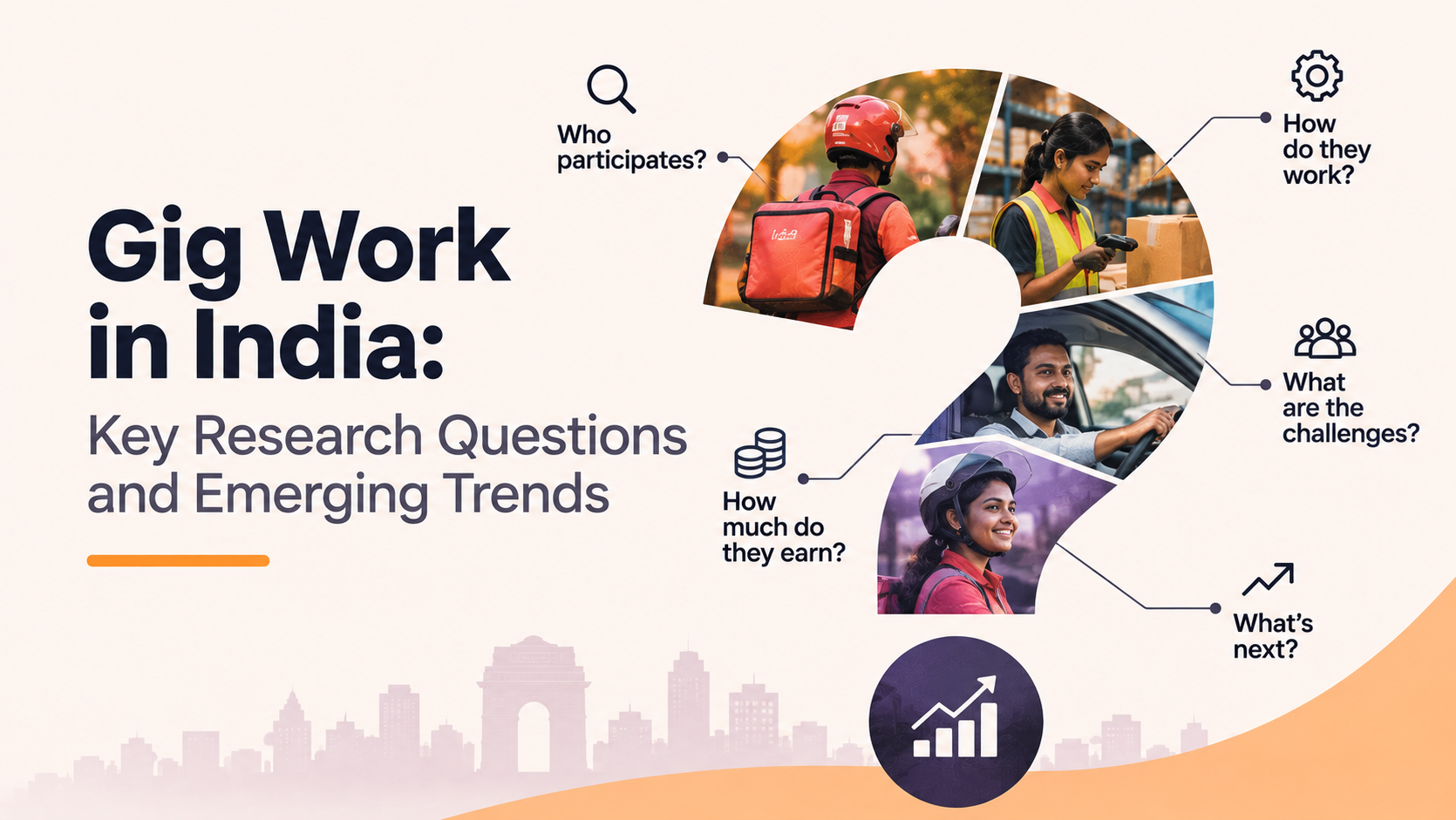
For most of its first decade, India's gig economy was argued about more than it was studied. The arguments ran on a handful of headline figures, and the studies underneath them were thin, scattered and easy to talk past. That has changed. A working paper at the United States' National Bureau of Economic Research now surveys drivers across three countries; the country's oldest economic research institute has fielded a national survey of food-delivery workers; an accountability programme has published six annual scorecards of platform conduct; and a peer-reviewed statistics journal has stepped in to explain why the headline counts disagree. The field has reached the stage where the studies themselves deserve a reading.
This report reads the studies the way a careful reader should - asking who ran them, whom they heard, and what their designs can and cannot support - and then draws out the gig work research questions they leave open alongside the currents now running through both the evidence and the work. The questions are no longer the ones the sector started with. How big the workforce is matters less than how the count is built; what a rider earns matters less than what remains once the costs come out; and the fastest-moving frontier is not another headline number but the field's own methods: net-of-costs measurement, women's participation as a first-order variable, comparative designs and India-sized fieldwork.
1. From a global template to India-sized studies
Every study in this report descends, in method, from the same ancestor. The International Labour Organization's global report on digital labour platforms - among the first comparative studies of working conditions on the major online micro-task platforms - was built ona survey of 3,500 workers across 75 countries and closed with eighteen principles for decent work on digital labour platforms. Ask workers directly, compare across platforms and countries, publish what you find - the template was set there, and the serious studies that followed have kept to some version of it.
India entered that template late and is now making up for lost time. Government estimates opened the national account; dedicated worker surveys followed; an annual ratings programme turned platform conduct into a scorecard; and the counting itself has become a subject for peer-reviewed argument. The four questions below are the ones the field can actually work on - what the work pays once costs come out, who is on the platforms and who is not, how the workforce should be counted, and what happens inside the app - and the two currents that follow run through all of them.
2. What does the work pay once the costs come out?
The sharpest recent answer comes from aworking paper at the National Bureau of Economic Research that surveyed drivers on three leading platforms across India, Indonesia and Kenya, pairing the surveys with administrative data and then doing what most earnings studies skip: subtracting vehicle costs and converting what remains into purchasing-power terms before any comparison. The finding has two steps. Hourly net earnings often look unremarkable against local alternatives. But the format's flexibility lets drivers work far beyond full-time-equivalent hours, which lifts monthly net earnings above what low-skilled or casual employment offers.
The same paper widened the lens past pay.One in three drivers across the three countries rely on platforms to top up earnings during emergencies or slow work periods - evidence of a cushioning role no platform dashboard captures. And exit patterns split by country: in India and Indonesia, drivers who leave mostly move into better-paying full-time jobs, while Kenyan drivers more often exit involuntarily, returning to offline driving on worse terms. The question the design opens for India: is the long-run pattern the cushion, the springboard, or both at once - and for which workers.
3. Who is on the platforms - and who is not on them yet
The clearest absence in India's platform workforce is women, and the studies of that absence are among the field's most direct. A study of the emerging gig economy's women workers, supported by the Asia Foundation, took testimony from women across gig segments and found that the flexibility promise lands differently for them:the report documents discrimination and abuse on the job and dismantles the idea that flexibility alone explains women's choices - all on top of a device gap underneath the work itself, since fewer than six in ten women own the smartphone the model presumes.
A complementary study from the research organisation IDinsight ran the question through the segment where the gap is widest:platform driving, where the organisation partnered with driving services in India and Indonesia to assemble descriptive evidence on women's experiences. Read together, the two studies turn a demographic observation into a design agenda - vehicles, safety, household consent, the mechanics of signing up - and open the field's most consequential participation question: what specifically unlocks women's location-based platform work, and whether the answer can travel between cities.
4. How many platform workers does India actually have?
The field's best-known numbers disagree with each other, anda peer-reviewed paper in The Indian Journal of Labour Economics explains why: it critically reviews the existing estimates of India's platform-based gig workforce and finds the disagreements run on definitions - who counts as a gig worker, which platforms belong in the frame, which survey can see the work at all - more than on measurement. The estimates are less a set of wrong answers than different answers to questions nobody stated.
The official anchor shows the drift from inside. The government report behind the sector's most-quoted projection builds its arithmetic ona survey-based estimate of about 68 lakh gig workers - a base figure that travelled far less widely than the rounded-up headlines above it. Meanwhile the country's main private household survey has beguntracking platform workers inside its own panels, an experiment in seeing a workforce the official instruments count poorly. The question opened is the field's most consequential design choice: which definition the next census-grade instrument adopts, because every downstream number - pay, growth, formalisation - inherits it.
5. What happens inside the app - and can it be measured?
Fairwork's India programme is the field's longest-running accountability instrument:six annual editions of platform ratings now sit on its India page, each scoring companies out of ten across pay, conditions, contracts, management and representation, with evidence drawn from three channels - desk research, material submitted by the platforms themselves, and worker interviews,440 of them across five cities in the latest edition. Two findings have held across editions: no platform has yet committed to a living-wage benchmark, and the representation principle has never once been scored - no edition has found adequate evidence of a platform recognising collective worker bodies.
The ratings also document how the work itself is managed. Platforms have moved to booked, committed time windows, and the reports record what that does to the flexibility the model advertises: workers who cannot commit the window risk demotion to worse-paid work. Peer-reviewed qualitative work reaches the same interior from another door -a study of beauty work on a home-services platform maps how algorithmic assignment and bureaucratic rules together shape women's working days. The question these instruments exist to answer: whether published evidence changes platform behaviour - and if scores and reports do not, what would.
6. The first current: India-sized fieldwork, run in India
The studies above mostly borrow global designs; the newest layer builds India-sized ones. The country's oldest economic research institute runsa dedicated gig economy research programme whosefirst output surveyed 924 food-delivery workers across 28 cities by telephone, structuring the entire analysis around a framework of entry, experience and exit. Its worker portrait is granular in a way headlines never are: the average rider in the sample was 29.1 years old, short-shift workers averaged 15.2 deliveries a day, and the earnings tables separate what the platform pays from what the worker keeps.
That last separation produced the field's most sobering domestic table. Active short-shift workers averagedRs 7,843 a month from the platform, and even long-shift workers - at Rs 20,744 - earned less than the Rs 22,494 recorded for a comparable peer group in the official employment survey.
The finding is not that platform work pays nothing; it is that the comparable outside option often pays slightly better once the hours are priced in. The question opened: which cities, vehicle types and incentive designs close that gap - and the programme's later outputs are built to test exactly that.
7. The second current: the evidence is going comparative
The newest India studies are designed to be compared, not just cited. TheNBER driver study was built from the start across three countries with matched instruments; thewomen-in-driving study ran the same logic across India and Indonesia; and theILO survey that set the template took 75 countries as its frame rather than one. Comparability is what turns an Indian observation into a finding about platform work itself - and it disciplines argument, because the same method run in three countries takes the pay debate out of the territory of whichever study a columnist preferred.
The current also runs inside India. Annual ratings editions are becoming a time series - the same method, repeated, so that movement can be read rather than inferred; survey programmes are structured for later waves; and the private panels tracking platform workers compound in value as they lengthen. The question opened: whether India becomes a standard-setting case in global platform-labour research - large enough to matter, documented well enough to be believed - or remains a market whose numbers are quoted everywhere and trusted nowhere.
8. The open agenda: how to read the next study
For the reader, the state of the field converts into a checklist. Five questions sort a serious study from a loud one: who paid for it; who was sampled, and from what frame - platform users or a population; whether the pay figures are gross or net of the worker's own costs; what the comparison group is; and whether the design can repeat next year, which is what separates a finding from a snapshot. Each question maps to a real failure somewhere in the existing literature, which is why the checklist matters more here than in most fields.
What remains unstudied is its own map. No Indian panel yet follows the same platform workers across years, so income trajectories over a working life remain a guess. Platform work beyond the big cities is documented mostly by anecdote. What happens to a worker after deactivation is nearly invisible. And whether published scores, state rules or welfare registrations change behaviour on the ground is the evaluation the sector will eventually be judged by. The studies reviewed here are the field's foundation; the agenda above is what should be built on it.
The bottom line
Read together, the studies agree on more than the arguments admit. Platform pay is real but thinly margined against the alternatives once costs and hours are priced in. The counting problem is definitional, and it is fixable. The interior of the app - allocation, windows, deactivation, representation - is measurable whenever someone commits to measuring it, as an accountability programme has now demonstrated across six annual editions. And the workforce's most under-represented segment is also the field's most active research front.