Delivery Jobs in Jaipur: Complete Guide
In Jaipur, a two-storey boarding house a lane away from the bus stand at Sindhi Camp lets a dozen rooms to young men who arrive from Sikar, Nagaur, Alwar and Churu with a licence and a phone, and the keeper's visitors' book - name, district, date in, date out - has become the quietest record of the city's delivery labo
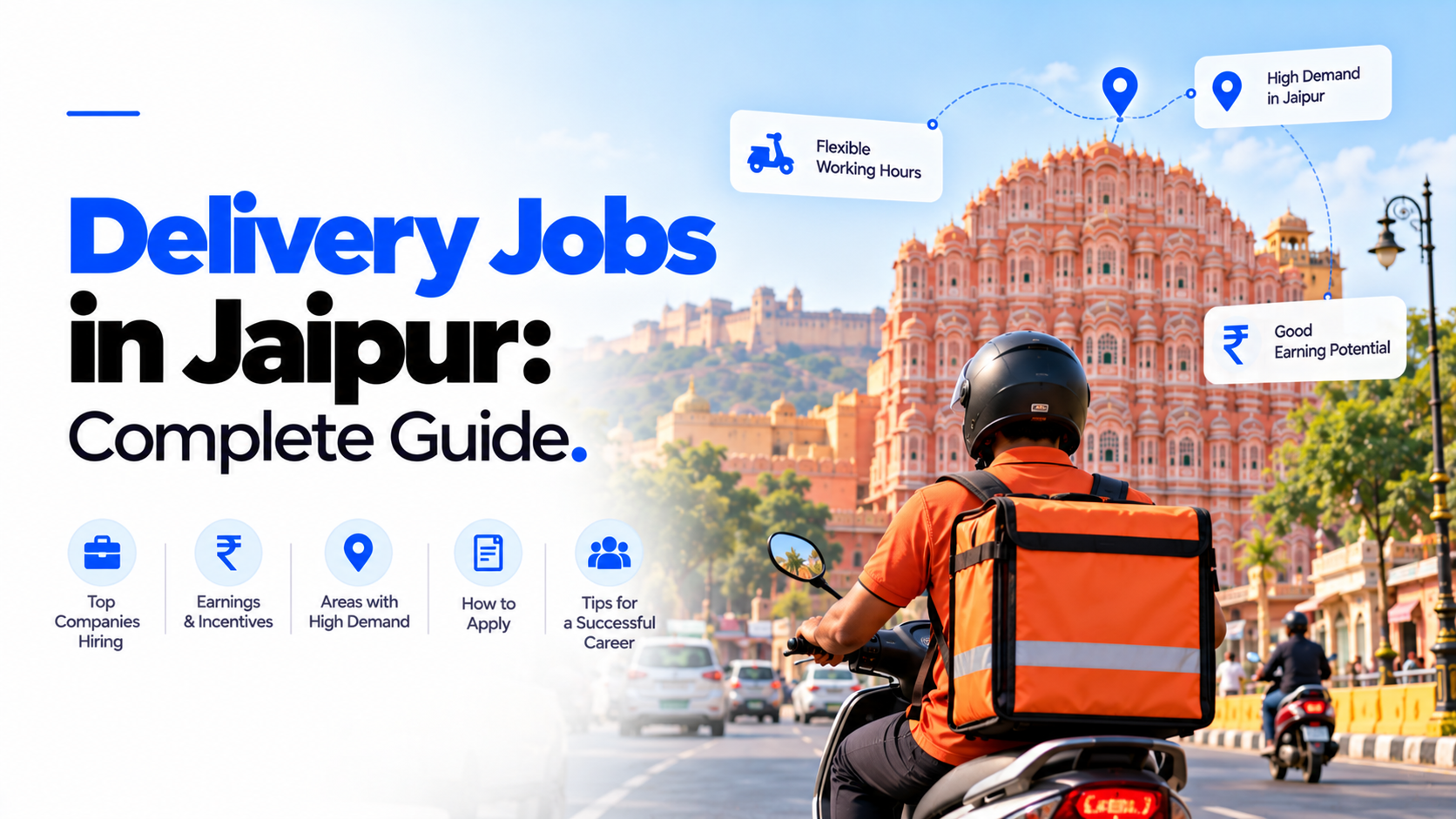
In Jaipur, a two-storey boarding house a lane away from the bus stand at Sindhi Camp lets a dozen rooms to young men who arrive in the city with little more than a licence and a phone. The man who lets the rooms has kept the visitors' book current for eight years - name, district, date in, date out - and the book has become the quietest record of the city's delivery labour market: Sikar, Nagaur, Alwar, Churu, page after page, most of the names arriving for the same kind of work.
The book's pattern is the market's pattern. Most tenants join a food or parcel app within their first days in the city. The rooms turn over fastest in the festival months and the wedding months, when the city hires in waves and the young men send money home; the summer trough empties half the house, when trips thin and the afternoons make the long shifts unbearable. Some names appear twice - the ones who tried the city once, left, and returned knowing it better. The keeper does not interview anyone. The book interviews the city.
The question the visitors' book keeps answering - what delivery jobs in Jaipur actually are, where the work sits, what it pays and who gets it - is usually answered with national averages or borrowed rumours, and both kinds of answer fail the man reading them on a boarding-house bed. This guide reads one city whole, from the worker's side: the commerce that generates the work, the zones it concentrates in, the pay structures, the season calendar, the papers and the registration that travels with a rider, the machine he brings, the hiring streets, the screens, and how a job once got is kept and grown.
What Jaipur Asks of Delivery Work
Begin with the commerce, because every delivery job is downstream of it. Jaipur is a state capital - its offices, courts and institutions generate a steady paper and parcel trade - and a tourist economy famous enough to be listed by UNESCO, with visitors who eat late, move in groups and order to their rooms. It is a jewellery and handicraft city whose workshops ship to buyers abroad, a city of hospitals, colleges and coaching centres, and above all a city of colonies: planned residential belts - Vaishali Nagar, Mansarovar, Malviya Nagar - where hundreds of families live close enough together to make a grocery run profitable.
Each layer of that commerce hires differently. The food delivery jobs in Jaipur's apps concentrate around the restaurant streets, the mall food courts and the hotel clusters, thickening sharply in the tourist months when the evenings run long. The trade in gems, prints and textiles sends parcels that must reach workshops and courier offices on time. The colonies sustain the quick-commerce stores - small dark storefronts holding a few thousand grocery lines, dispatching riders in ten-minute loops - and the e-commerce firms run the heavier parcel routes through the same belts, feeding the district towns beyond the city from Jaipur's warehouses.
Read together, the layers explain the first thing a newcomer should understand: delivery work in Jaipur is several different jobs gathered under one name. A rider inside a colony loop, a rider on tourist-lane evenings, and a rider loading parcels at a warehouse dawn are doing three working lives that happen to share a vehicle. The rest of this guide separates them, because each asks for a different street, a different shift and a different temperament.
The Zones of the Work
The job is geography before it is anything else, and the city divides into working zones that shape a rider's entire day. Bike delivery jobs in Jaipur's listings read like three different cities for that reason. The walled city and its bazaar lanes reward small machines and short, dense, walk-up trips; the office and institutional belt along MI Road, C-Scheme and the civil lines concentrates work into lunch and closing hours; the colony belts run the grocery loops all day; and the warehouse corridors out along Tonk Road toward Sitapura and the Mahindra World City side run shift-based, full-day work built around loading bays rather than doorbells.
The same zone logic repeats in every Indian city, which is why a rider who studies thedelivery jobs in Bengaluru pages of the same hiring platform recognises the shape immediately - dense cores, residential loops, warehouse edges - with only the names changed. What changes in Jaipur is the mix: the tourist months stretch the evening shift in the old city, the wedding months push the parcel trade through the bazaars, and the colony belts are busy in every season because families eat at home in every season.
The practical rule follows: choose the zone before choosing the employer. A rider's day is decided by where he sleeps relative to his first pickup, not by the app on his phone. The walled city rider who lives across town spends his best hours commuting into his own shift; the colony-loop rider who beds down inside or beside his belt starts earning while the commuter is still on the road. The boarding house near Sindhi Camp fills, month after month, with men learning this rule the expensive way - which is why the wise ones match the room to the zone before they match themselves to the app.
Who Hires, and What the Work Pays
Four kinds of employers hire in the city: the food apps, the quick-commerce grocery firms, the e-commerce and parcel companies, and the local layer - couriers, sweet shops during the wedding months, furniture stores, diagnostic laboratories - that runs its own smaller deliveries. The delivery boy salary in Jaipur's question is quoted in two currencies, and a newcomer should learn to read both: per-trip work advertises a rate for every completed drop and scales with hours, zone density and season, while fixed roles quote a monthly figure with attendance attached. Neither number is a wage until the day's costs are taken out of it - fuel, phone data, the machine's upkeep - and the comparison worth making is between take-homes, not headlines.
What moves the number, in practice, is a short list: hours actually on the road, the density of the zone worked, the season on the calendar, and the incentive terms that attach to attendance and trip counts. Two riders on the same app, in different zones, will report different delivery rider pay Jaipur figures at the same month's end, and both will be telling the truth. The delivery boy jobs in Jaipur's advertisements rarely spell this out, so the questions fall to the applicant: what counts as a trip, when the payout lands each week, what the incentive actually requires, and who bears the fuel. A rider who asks these four questions before joining has already done most of the screening an employer should have done for him.
The work families on the jobs site are separated for that reason: thecategories page of the jobs site splits food, grocery, parcel and warehouse work into distinct sections, because a pay structure attaches to each. A newcomer's honest strategy is to begin where trips are dense and the learning is fast - food or grocery inside a colony belt - and price himself against the fixed roles only after the city is under his feet, because a rider who knows his zones negotiates from evidence rather than hope.
The Season Calendar
The city hires on a calendar, and the calendar is the single most useful thing a rider can learn before his first shift. The festival months open the thick season: the Diwali weeks push the grocery and gift trade to its ceiling, the warehouses add hours and hands, and the food belts stretch deep into the night. The wedding months follow, running to February - and in a city whose fame rests on jewellery, textiles and celebration, the wedding trade hires delivery hands the way a port hires stevedores, in bunches, for stretches, at premiums. The tourist months overlap the same half-year, thickening the restaurant evenings in the old city.
The calendar cuts both ways, and the second half belongs to the summer trough: the afternoons turn brutal, the trips thin, and the hiring waves recede to a level that surprises men who arrived in November. The trough is when part time delivery jobs in Jaipur's evening-only postings matter most - students and men with morning trades keep the evening shifts staffed while the full-timers shorten their afternoons - and it is when the visitor's book at the boarding house thins, as men whose savings were not banked in the thick months go home to wait for the next season.
The lesson the calendar teaches is to plan the year, not the week. Riders who last in this trade bank the festival months deliberately, treat the trough as a season with its own work - the morning shifts, the warehouse belt, the slower fixed roles - and return to the thick months with their papers and their machines in order. The names that appear twice in the visitors' book are, more often than not, the ones who learned this the first time around.
Licence, Bank, and the Registration That Travels
A set of papers opens this work, and a newcomer should assemble them in the first days, before the first interview: a driving licence in the proper class, the vehicle's registration and insurance, Aadhaar and PAN, and a bank account in the rider's own name - because payouts land in accounts, not hands. Beside these sits the registration that travels with the worker between employers he will ever have:the labour ministry reported over five lakh gig and platform workers registered on the e-Shram portal, alongside more than thirty-one crore unorganised workers - a national database a delivery rider joins like any other worker in the informal economy.
The registration is free, self-declared and portable, and its instrument is a single number.The e-Shram portal registers unorganised workers - gig and platform workers expressly included - and issues each a Universal Account Number that stays his wherever he works;the ministry's mid-2026 statement placed registrations above 31.78 crore. For the boarding house's tenants the instruction is short: register in the joining days, keep the number with the licence, and let it travel - the UAN is the one paper that does not expire when a job changes, which in this trade happens more than once.
The registration also attaches the worker to what the state has begun to extend toward him.The labour ministry has urged platform workers to register on e-Shram for formal recognition and access to Ayushman Bharat health cover - a shield of Rs 5 lakh per family per year for secondary and tertiary hospitalisation, honoured across more than thirty-one thousand empanelled hospitals, public and private. For a rider whose parents live two hundred kilometres away, that sentence is not administrative decoration; it is the difference between a hospital visit and a debt. The honest note belongs beside it: the registration is a first step and a shield, not a salary - the work still has to be won zone by zone, on the terms the earlier sections describe.
The Machine You Bring
Behind every posting sits the access question: the machine. The two wheeler delivery jobs Jaipur's listings assume a rider arrives with wheels, and there are three ways that happens - the machine he owns, the machine he rents by the week from the agents around the transport hubs, and the machine an employer hands over with his own terms attached. Each route prices freedom differently, and the choice deserves the same weight as the choice of employer, because the machine's terms quietly become the job's terms.
The owned machine is an asset and a commitment at once: bought used in a city with a deep resale market, financed in instalments, fed and repaired at the owner's cost - and it answers to nobody at the end of a shift. The rented machine trades capital for flexibility, at a weekly price that takes a steady slice out of the week's earnings; it suits the season-worker who rides the thick months and goes home, and the newcomer who has not yet chosen his zone. The employer's machine carries no price tag at the gate and every condition after it: attendance tied to the vehicle, routes assigned, and the understanding that what was handed over can be taken back. The man joining a fixed fleet role should read the machine's terms as carefully as the pay, because the two are written in the same hand.
Jaipur itself settles part of the argument: this is a two-wheeler town, and its zones reward small machines over impressive ones. The walled city's lanes are too narrow for anything bulky, the colony gates and basement parkings favour scooters, and a machine that is easy to park is a machine that finishes its evening sooner. Where the machine spends the night matters as much as what it is - the boarding house's courtyard fills each night with the tenants' bikes, parked within sight of the windows, because a delivery man's livelihood is the vehicle under the sheet, and everyone in the trade knows it.
The Hiring Streets
Where do the Jaipur delivery jobs actually surface? Four places, and a newcomer should work all four. The app onboarding offices around the transport hubs sign men on in the morning and put them on the road within days. The referral chains inside every zone carry the next name - the men already riding bring a cousin, a neighbour, a village-mate, and the zone's trust arrives with him. The trade buildings' notice boards carry the local layer's smaller postings. And the structured listings online hold the entire market in one view:the Jaipur delivery jobs page of the hiring network gathers the city's openings where they can be compared by zone, by work type and by terms - the visitors' book, in its public form, kept by the market itself.
Reading a listing honestly is a craft worth the half hour it takes. A fair offer states what counts as a trip, the day the payout lands, the incentive's real conditions, and the machine and fuel terms in plain words; the openings on astructured jobs board carry these lines because the platform requires them. The walk-away signals are just as legible: pay discussed only in person, weeks promised in cash, pressure to join the same evening, terms that change between the phone call and the gate. A rider who treats each listing as a document to be read, rather than a door to be pushed, spends his first month working instead of regretting.
Aggregation matters more in this trade than in most, because the hiring streets move with the season calendar - the same zone that hires thickly in the festival months goes quiet in the trough, and the wall notices never say so a platform that filters the market by city and zone shows the entire market as it stands today, which is the only version worth joining. The boarding house's tenants who learned to check the whole market before signing changed rooms less often than the ones who took the first offer that walked past the gate - the book records that, too.
Getting Picked, Staying Picked
The screens test fewer things than applicants fear and more than they expect. Papers in order come first - licence, vehicle documents, identity and bank details - then the machine's condition, then road sense. Above all, though, the screens test the streets: does the applicant actually know the colonies he claims, can he find a lane in the walled city without the map, will his local shortcuts survive the evening traffic. The delivery jobs in Jaipur for students advertised around the colleges and coaching centres lean on evening availability rather than experience, which makes them the honest entry door - and the reason those screens ask about timetables before they ask about history.
The fresher's sequence is short enough to memorise: papers first, zone second, platform third, and the joining follows the order rather than the mood. The practical walk-through - how to search, compare and claim the work step by step - sits in theguide to finding gig work near you, and its central point is the one the boarding house teaches every winter: the first month decides the relationship, because the attendance habit formed in those weeks is the habit the employer's system will remember for all the weeks after.
Staying picked, in the end, mirrors getting picked. The riders who get dropped are dropped for a short list - no-shows, mishandled cash, roughness at the customer's door, a machine let go to ruin. The riders who last are kept for an equally short list: the attendance streak, the zone knowledge that compounds into speed, the ratings that follow a rider between apps like a character walked ahead of him. The visitors' book's second-time names arrive already knowing all of this - the city taught them between visits, and this time the teaching was free.